
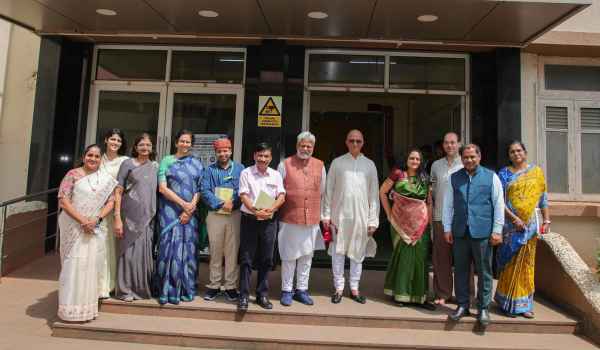
Mumbai, October 12, 2026: Being rooted in culture is not only about preserving India’s past, it is about creating opportunities to study it, question it and build new knowledge around it. From the restoration of temples in the Chambal Valley to the study of Indian metallurgy through archaeological evidence, several research studies were discussed during an international conference on “Indian Scientific Heritages: Texts, Techniques, Technological Insights,” at Somaiya Vidyavihar in Mumbai.
Renowned archaeologist and Padma Shri awardee Shri K. K. Muhammed, former Director of the Archaeological Survey of India, presented the restoration of temples in the Chambal Valley to explain the application of indigenous knowledge in heritage conservation. Following a massive earthquake in the fourteenth century, 90 temples had collapsed and gradually turned into mounds. The restoration project used Punardharan, an indigenous conservation technique also known as Anastylosis. The example showed how traditional techniques and local knowledge can inform the conservation of architectural heritage.
India’s metallurgical traditions were examined through another lens. Prof. Sharada Srinivasan, recipient of the Padma Shri and from the National Institute of Advanced Studies, Bengaluru, studied Nataraja bronzes, the Aranmula metal mirror tradition and evidence relating to early Iron Age and high-carbon wootz steel in Tamil Nadu. Her research also traced the later trade of wootz steel and its use in Damascus blades. It offers a view of Indian metallurgy that connects archaeological evidence, scientific investigation and the global movement of technology.
At Ajanta, for example, Dr. Shreekant Jadhav, Adjunct Professor at K J Somaiya Institute of Dharma Studies, studied the site’s water cisterns, or podhis. Ajanta is widely recognised for its rock-cut architecture, sculptures and paintings. Its water systems have received comparatively less attention. Dr. Jadhav’s field research used physical measurements and scale drawings to study the cisterns’ distribution, capacity and patterns of collective use. The work brings attention to the engineering and water-management knowledge embedded within the site.
The conference also explored how traditional knowledge can engage with contemporary academic disciplines.
Dr. Eric Rosenbush, Head of Research & Translation at Sowa Rigpa International College, Nepal, and President of the Drangsong Foundation, USA, examined the relationship between Ayurveda, classical medical frameworks and modern scientific research. His presentation considered how traditional medical systems and STEM disciplines could create new areas for collaborative research. The conference also made room for critical examination. Prof. Mayank Vahia, Emeritus Professor at the University of Mumbai, looked at how claims about scientific achievements in ancient India can be assessed through evidence. His presentation considered established achievements alongside areas where comparable scientific developments did not emerge. The focus was on evidence-led inquiry. This is important when studying any historical knowledge tradition.
Reflecting the vision of the National Education Policy (NEP) 2020, the two-day conference was jointly organised by K J Somaiya College of Science and Commerce and K J Somaiya Institute of Dharma Studies, with support from the Indian Council of Social Science Research (ICSSR), New Delhi. The conference brought together 236 scholars and researchers from across disciplines, creating a space for dialogue and exchange around India’s scientific and knowledge traditions. Scholars from across India and from Germany, Poland, and the United States of America made 57 scholarly presentations and explored the astronomical foundations of the Indian calendar, Aryabhata’s mathematical legacy, temple sculpture and architecture, and traditional environmental knowledge in the context of climate change.
Together, the research highlighted the breadth of India’s knowledge traditions and the value of examining them through multiple disciplines, including science, archaeology, history and cultural studies. By bringing together diverse perspectives, the conference created space for researchers to question, exchange ideas and explore India’s inherited knowledge through contemporary scholarship.
This interdisciplinary approach is central to the collaboration between K J Somaiya College of Science and Commerce (KJSSC) and K J Somaiya Institute of Dharma Studies (KJSIDS). KJSIDS brings together scholarship across Sanskrit, Buddhist and Jain studies, ancient Indian history, culture, archaeology and Indian Knowledge Systems, while KJSSC contributes scientific and research perspectives to the conversation. The result is a platform where heritage is not treated as something static. It becomes a subject for research, debate and new discovery.
For Somaiya, this is what being rooted in culture means in an academic context: connecting India’s intellectual inheritance with contemporary research and creating spaces where the past can contribute to the questions of the present.
Click Here for More Institutional Activities