
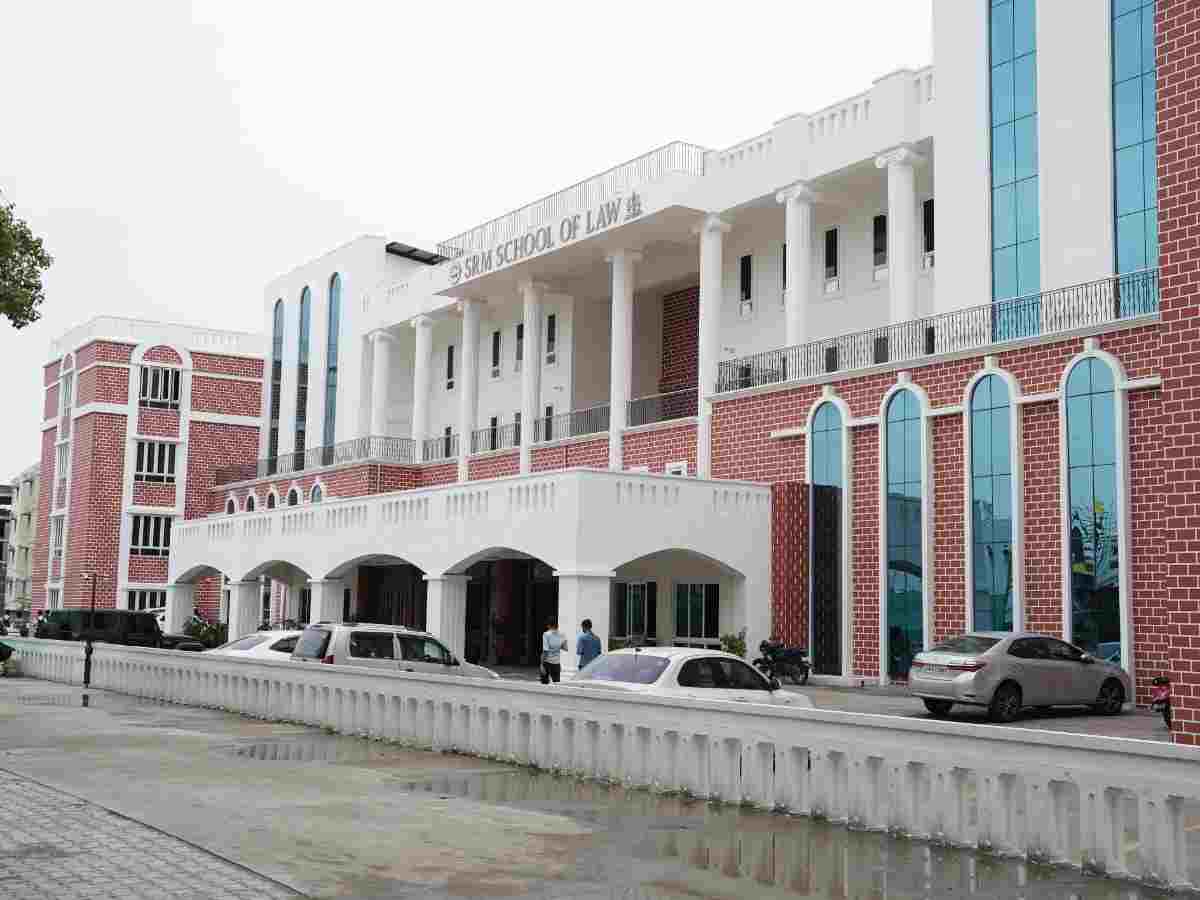
- The new programmes span Technology and Law, Criminology, Public Policy and International Business Law. Applications are open for the 2027 academic year, with the last date set for June 25, 2027.
Chennai, November 23, 2026: SRM School of Law, SRM Institute of Science and Technology (SRMIST), has announced the opening of admissions for the 2027 academic year, alongside the introduction of five new academic programmes. The expansion marks a significant step in the institution's effort to develop a multidisciplinary and globally focused centre for legal education, research and interdisciplinary learning.
The five new programmes will be introduced from 2027 and cover emerging areas at the intersection of law, technology, criminology, public policy and international business.
Five New Programmes Introduced for 2027
The newly introduced programmes are:
-
B.A. (Hons.) in Technology and Law – Four years
-
B.A. (Hons.) in Criminology and Criminal Justice Studies – Four years
-
M.A. in Public Policy – Two years
-
M.A. in Applied Criminology and Criminal Justice Studies – Two years
-
LL.M. in International Business Law – One year
The new academic offerings are intended to extend legal education beyond conventional disciplinary boundaries and provide students with opportunities to explore the relationship between law, technology, criminal justice and public policy.
Focus on International Business Law, Technology and Criminology
The new LL.M. in International Business Law is a significant addition to the postgraduate portfolio. The programme is designed to prepare graduates for the increasingly complex environment of international commercial and financial transactions.
Its academic focus will include international commercial law, international investment law and comparative legal frameworks. The programme aims to develop expertise relevant to legal practice and advisory roles in an interconnected global economy.
The new programmes in Technology and Law and Criminology and Criminal Justice Studies respond to emerging professional and societal requirements. As technology transforms economies and institutions, and criminal justice systems face increasingly complex challenges, there is a growing need for professionals with specialised and interdisciplinary knowledge.
The introduction of Public Policy will further connect legal education with economics, public administration, governance and evidence-based policymaking.
Together, these programmes reflect SRM School of Law's approach to studying law in the wider context of society, technology, markets and public institutions.
Existing Undergraduate and Postgraduate Law Programmes
Alongside the five new programmes, SRM School of Law will continue to offer its existing undergraduate and postgraduate courses.
The undergraduate law programmes include:
-
Five-year integrated B.A. LL.B. (Hons.)
-
Five-year integrated B.B.A. LL.B. (Hons.)
-
Five-year integrated B.Com. LL.B. (Hons.)
-
Three-year LL.B. (Hons.)
These programmes combine legal education with humanities, business administration and commerce to provide students with a broader understanding of law and its applications.
The postgraduate portfolio includes a one-year LL.M. programme with specialisations in:
-
Corporate Law
-
Intellectual Property Rights and Information Technology Law
-
International Trade and Investment Law
-
International Business Law
-
Criminal Law and Criminal Justice System
SRM School of Law Admissions 2027: Entrance Examination and Selection Process
Admissions to the law programmes will be based on the SRM Law Entrance Test (SRMLET 2027), followed by a personal interview.
Candidates with eligible scores in recognised entrance examinations, including the following, will also be considered for the personal interview, subject to programme-specific requirements:
-
Common Law Admission Test (CLAT)
-
Law National Aptitude Test (LNAT-UK)
-
Common University Entrance Test (CUET)
SRMLET 2027 Examination Dates
SRMLET 2027 will be conducted through continuous, on-demand, centre-based examinations from January 5 to June 30, 2027.
The examination will be available across more than 300 examination centres in India.
<badge color="success">Application deadline: June 25, 2027</badge>
The last date for submitting applications to the law programmes is June 25, 2027.
Eligibility Criteria for Interdisciplinary Non-Law Programmes
For the interdisciplinary non-law programmes, candidates will be shortlisted based on their academic profiles and invited for a personal interview.
The eligibility requirements mentioned in the announcement are:
Undergraduate programmes:
-
Applicants must have completed Class XII through the regular mode.
-
A minimum aggregate of 70% marks is required.
Postgraduate programmes:
-
Applicants must hold a bachelor's degree in any discipline.
-
The degree must have been completed through the regular mode.
-
A minimum aggregate of 70% marks is required.
SRM School of Law's Vision for Global Legal Education
Commenting on the academic expansion and institutional vision, Dr. P. Sathyanarayanan, Pro Chancellor (Academics), SRMIST, said:
"Our vision is to develop SRM School of Law as a truly global law school, benchmarked against the best institutions in India and abroad. We are fully committed to strengthening the School in all respects. The Founder Chancellor's vision is to produce outstanding students who will assume leadership positions across diverse domains of the legal profession. The new academic initiatives are an important step towards realising this larger vision."
Professor Y. S. R. Murthy, Pro Vice Chancellor, School of Law, said that the introduction of the new programmes represents more than an expansion of academic offerings. He described it as part of a broader institutional vision to develop an interdisciplinary and internationally engaged centre of excellence, where legal education intersects with technology, business, social sciences, public institutions and global governance.
Professor Indranath Gupta, Dean, School of Law, highlighted the institution's faculty, curriculum, infrastructure, student-led societies and national and international collaborations as important strengths. He said the School is committed to providing diverse learning opportunities for students and faculty members.
Practical Learning and Professional Development
SRM School of Law's academic approach combines classroom learning with practical exposure through:
-
Legal research
-
Moot courts
-
Internships
-
Advocacy exercises
-
Field studies
-
Empirical research
-
Other experiential learning opportunities
The objective is to develop graduates with analytical abilities, professional competence, ethical grounding and the capacity to respond to emerging challenges in the legal profession and related fields.
The introduction of the five new programmes marks an expansion of SRM School of Law's academic portfolio, with a greater emphasis on interdisciplinary education and the changing requirements of law, governance, technology and international business.
FAQs
1. Has SRM School of Law opened admissions for 2027?
Yes. SRM School of Law, SRM Institute of Science and Technology, has announced admissions for the 2027 academic year.
2. How many new programmes has SRM School of Law introduced?
The institution has introduced five new programmes for 2027.
3. What are the five new programmes at SRM School of Law?
The programmes are B.A. (Hons.) in Technology and Law, B.A. (Hons.) in Criminology and Criminal Justice Studies, M.A. in Public Policy, M.A. in Applied Criminology and Criminal Justice Studies, and LL.M. in International Business Law.
4. What is the duration of the new SRM School of Law programmes?
The two new B.A. (Hons.) programmes are four years long, the two M.A. programmes are two years long, and the LL.M. in International Business Law is one year long.
5. What is the last date to apply for SRM School of Law programmes?
The last date for submitting applications to the law programmes is June 25, 2027.
6. What is SRMLET 2027?
SRMLET 2027 is the SRM Law Entrance Test, which will be used for admission to law programmes, followed by a personal interview.
7. When will SRMLET 2027 be conducted?
The examination is scheduled to be conducted from January 5 to June 30, 2027, through continuous, on-demand, centre-based examinations.
8. Will CLAT, LNAT-UK and CUET scores be considered?
Yes. Candidates with eligible scores in CLAT, LNAT-UK and CUET will also be considered for a personal interview, subject to programme-specific requirements.
9. What is the eligibility criteria for undergraduate interdisciplinary programmes?
Applicants must have completed Class XII through the regular mode with a minimum aggregate of 70%.
10. What is the eligibility criteria for postgraduate interdisciplinary programmes?
Applicants must hold a bachelor's degree in any discipline, completed through the regular mode, with a minimum aggregate of 70%.
11. What are the existing undergraduate law courses offered by SRM School of Law?
The existing undergraduate programmes include B.A. LL.B. (Hons.), B.B.A. LL.B. (Hons.), B.Com. LL.B. (Hons.) and LL.B. (Hons.).
12. What practical learning opportunities are included in the academic approach?
Students receive practical exposure through legal research, moot courts, internships, advocacy exercises, field studies, empirical research and other experiential learning opportunities.
Click Here for More Exams / Admission