
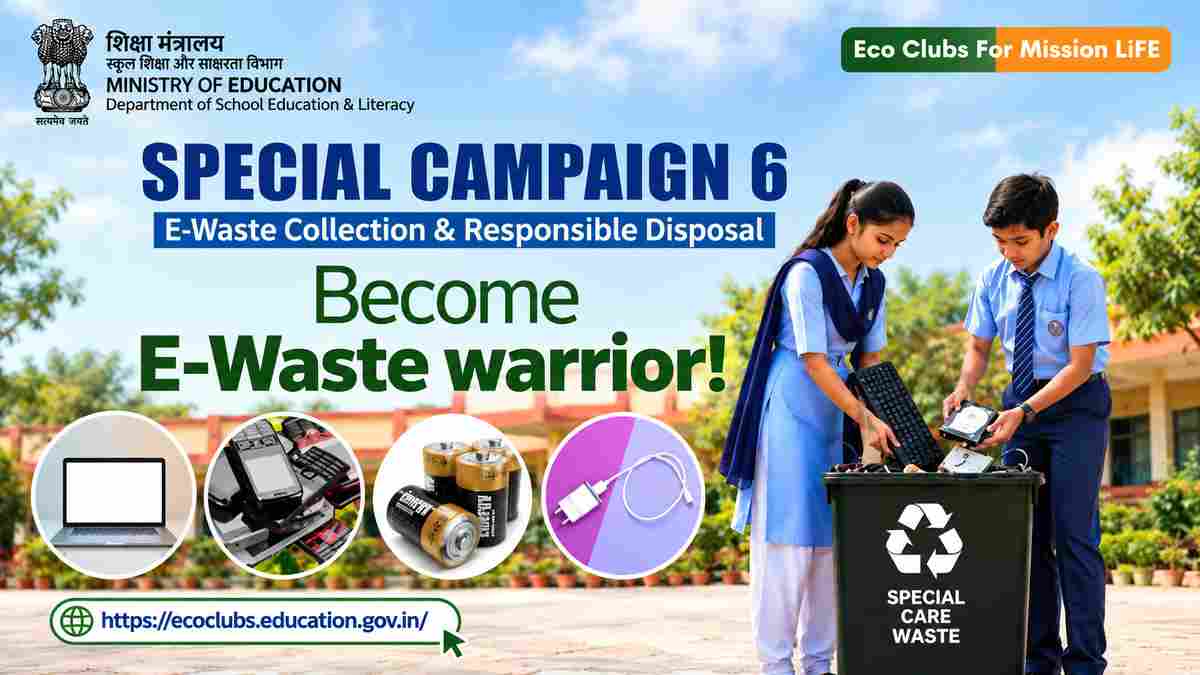
School Students Become E-Waste Warriors Under Special Campaign 6: What Students Are Doing
New Delhi: School students are getting on board an u'nconventional new role in India's cleanliness campaign: E-Waste Warriors. As part of Special Campaign 6, students and members of Eco Clubs for Mission LiFE are being encouraged to promote e-waste collection, responsible disposal and environmental awareness in schools and communities. The initiative puts students at the forefront of a growing problem that is increasingly linked to India's growing dependence on electronic devices. From discarded chargers and keyboards to obsolete phones and other electronic equipment, e-waste needs to be collected and handled systematically instead of just disposed of.
The campaign's focus on e-waste management, which runs from October 2 to October 31, 2026, has highlighted effective collection, segregation and scientific disposal of e-waste as a key priority for Special Campaign 6 as identified by the government.
What Is Special Campaign 6?
Special Campaign 6 is a government of India initiative that focuses on institutionalising cleanliness and reducing pendency and improving resource management in government offices and organisations. This year's campaign has a stronger environmental focus, with emphasis on effective collection, segregation and disposal of e-waste. The implementation phase runs from October 2 to October 31, 2026.
The campaign, while centred on government workplaces, has taken environmental education into classrooms and student communities with school education initiatives and Eco Clubs.
How Students Are Becoming E-Waste Warriors
The Department of School Education & Literacy (DoSEL) has been utilising Eco Clubs for Mission LiFE as a tool to engage students with practical environmental activities. The target is simple: students should understand what happens to electronic waste once a device is discarded and why improper disposal can lead to environmental problems. Activities can range from:
- Carrying out collection drives of discarded electronic items
- Promoting segregation of e-waste from other waste
- Creating awareness among classmates and families
- Encouraging responsible recycling and disposal
- Performing cleanliness activities and activities related to environmental awareness
- Learning about resource recovery and reuse
The approach turns environmental education from something students just read about into something they can put into practice.
Eco Clubs Bring Environmental Learning Into Schools
The Eco Clubs for Mission LiFE initiative gives schools an avenue for environmental education and student engagement. During a national webinar held by DoSEL in September, officials spoke about the role of Eco Clubs in helping students understand environmental challenges and develop responsible behaviour. The webinar discussed source segregation, recycling, reuse and safe disposal of solid and electronic waste and saw over 2.6 lakh students, teachers and community members participating via YouTube.
The department also noted that during Special Campaign 5.0, around one lakh school students collected more than 4,000 kg of e-waste across 10 cities in four states and one Union Territory. That earlier effort gives a hint at what student participation can lead to in terms of collection.
Why E-Waste Education Matters for Students
Electronic devices are becoming increasingly embedded in education. Smartphones, computers, tablets, printers and other equipment play an important role in educating and communicating.
That makes schools a natural fit for teaching students what happens when devices reach the end of their lives. Responsible e-waste education can help students to understand three interconnected ideas:
- Use responsibly. Devices should be used efficiently and maintained for longer where possible.
- Separate waste. Devices should not be mixed with ordinary household or school waste.
- Dispose responsibly. Devices should be placed in the right collection and recycling channels instead of through unsafe informal disposal.
Special Campaign 6 and the Solid Waste Management Rules, 2026
The student-focused campaign also links to awareness around the Solid Waste Management Rules, 2026 through a quiz on the rules for students in Classes 6 to 12, which runs from September 17 to October 17, 2026, on the Eco Clubs for Mission LiFE portal.
The aim is to instill environmental awareness at an early age, so that cleanliness and responsible waste management becomes everyday business instead of occasional campaign activities.
Inclusive Environmental Learning for Every Child
The e-waste project also opens up an opportunity for schools to be more inclusive and practical in their environmental education. By engaging students, who can participate in ways that are age- or ability-adjacent, such as awareness campaigns, posters, collection drives, classroom discussions and digital projects, children of varying learning strengths can all contribute to the same objective.
The message goes beyond collecting old electronics: by making students participants rather than passive receivers of environmental information, schools can link education, citizenship and sustainability in a tangible way. Special Campaign 6 therefore gives India's school students a new challenge: not just learning about a cleaner future, but assisting in building one.
Click Here for More Latest News