
New Delhi. ; A recent study by researchers from the Indian Institute of Astrophysics has explored whether some of the smallest galaxies in the universe—known as dwarf spheroidal galaxies—could host black holes. These galaxies orbit the Milky Way and are among the faintest and most dark matter-dominated systems known.
While supermassive black holes are commonly found at the centers of large galaxies, detecting them in dwarf galaxies has remained a major challenge due to their low brightness, lack of gas, and minimal stellar activity.
Understanding Black Hole Origins
This research is crucial for understanding how the first black holes formed and evolved. Scientists are particularly interested in whether the well-known relationship between a galaxy’s black hole mass and its stellar velocity dispersion extends even to the smallest galaxies.
Resolving this could help scientists build a unified theory of black hole growth across cosmic time.
Innovative Modeling Approach
Researchers K. Aditya and Arun Mangalam developed advanced dynamical models of dwarf spheroidal galaxies. These models include three key components:
- Stars
- Dark matter halo
- A potential central black hole
By analyzing stellar motion data, they were able to estimate possible black hole masses and set upper limits for their existence.
Key Findings
The study, published in The Astrophysical Journal, found that:
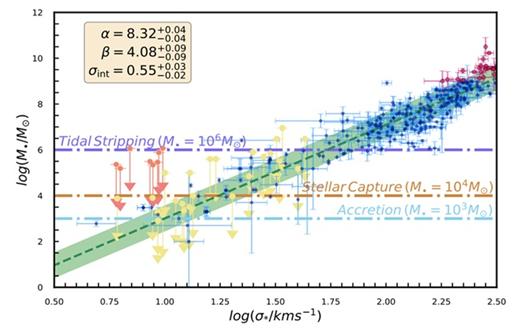
- Black holes in dwarf galaxies, if present, are typically less than one million solar masses
- Many galaxies may host intermediate-mass black holes (1,000–10,000 solar masses)
- A unified relation between black hole mass and stellar velocity dispersion exists across galaxy sizes
Interestingly, the data does not require the presence of massive black holes, but it supports the possibility of smaller ones.
Theoretical Insights and Models
The research also examined different black hole growth mechanisms:
- Gas accretion models suggest black holes of around 1,000 solar masses
- Stellar capture processes could grow them up to 10,000 solar masses
- Tidal stripping scenarios indicate these galaxies may have once been larger systems
All these models align with the observational limits found in the study.
Future Observations and Impact
This research comes at a critical time, as next-generation telescopes like the proposed National Large Optical Telescope and the Extremely Large Telescope are expected to provide unprecedented observational capabilities.
These instruments will allow scientists to:
- Study faint galaxies in greater detail
- Measure stellar movements with high precision
- Test theories about early black hole formation
The study provides a strong foundation for future discoveries, particularly in understanding whether dwarf galaxies contain primordial black hole seeds.
Click Here for More Science & Technology