
-
Two-day conference brings together around 180 scholars from India and abroad to explore Sanskrit, Ayurveda, mathematics, philosophy, yoga and other dimensions of India's intellectual heritage.
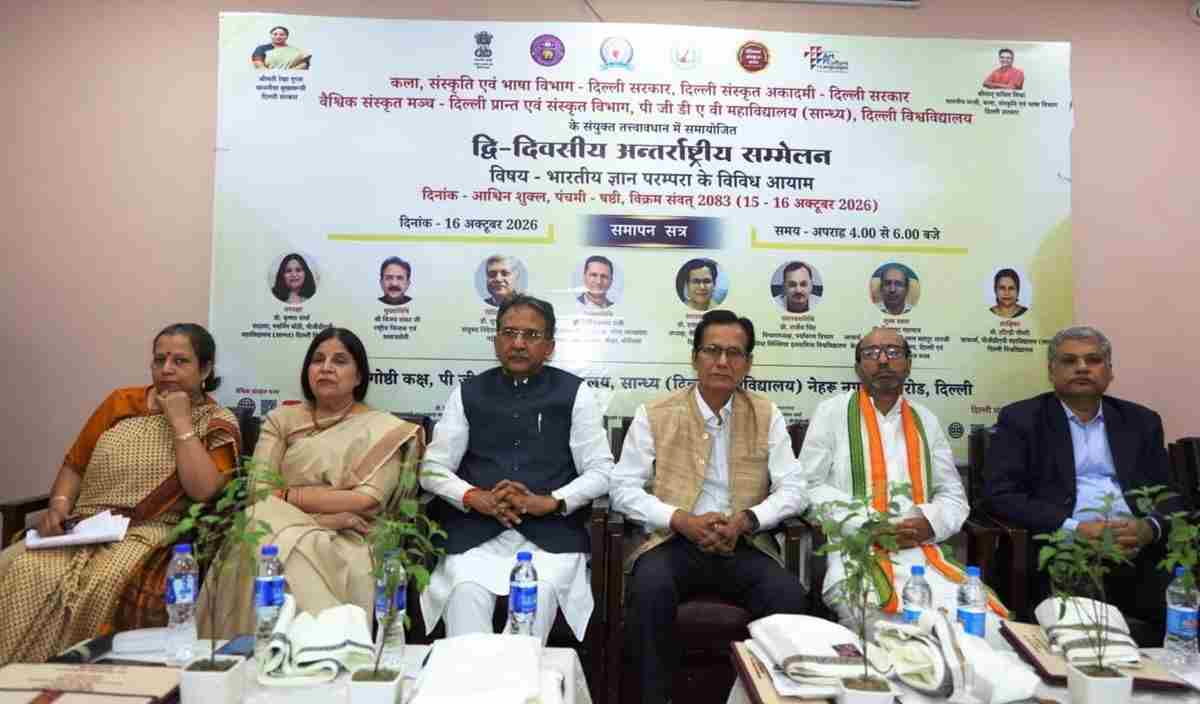
New Delhi: The Department of Sanskrit at P.G.D.A.V. College (Evening), University of Delhi, in collaboration with the Global Sanskrit Forum (Delhi Province) and the Delhi Sanskrit Academy, successfully concluded a two-day international conference on “Dimensions of the Indian Knowledge Tradition.” The conference brought together approximately 180 scholars, academicians, teachers, traditional scholars and research scholars from India and abroad to examine the depth, diversity and contemporary relevance of India's intellectual heritage.
The conference featured inaugural and valedictory sessions alongside nine hybrid academic sessions conducted in both offline and online modes. Discussions covered a broad range of subjects, including yoga, Ayurveda, philosophy, mathematics, astrology, Vastu Shastra, psychology, spirituality, culture, linguistics and music.
Nine Hybrid Sessions Explore Interdisciplinary Research
The conference featured scholarly presentations and special lectures on several dimensions of Indian knowledge systems. Topics included sound and mantra science, mathematical and scientific concepts in Indian scriptural traditions, the scientific dimensions of astrology, and music in Pāṇini's Aṣṭādhyāyī.
Research scholars presented original papers spanning yoga and Ayurveda, philosophy and history, mathematics and astrology, botany and psychology, spirituality and culture, linguistics, and music. The presentations explored connections between traditional knowledge and contemporary academic inquiry.
Principal Highlights Academic Contributions
During the valedictory session, Prof. (Dr.) Harindri Chaudhary, Principal of P.G.D.A.V. College (Evening), welcomed the participants and appreciated the quality of the research papers presented during the conference.
She informed the gathering that the abstracts received for the conference had been published in book form. She also stated that selected research papers would be published in a book in the near future, describing the conference as an academically significant event.
Prof. Krishna Sharma Emphasises the Breadth of Indian Knowledge
The valedictory session was chaired by Prof. Krishna Sharma, former Principal of P.G.D.A.V. College and a member of its Governing Body.
She observed that the Indian knowledge tradition extends beyond spirituality and encompasses numerous disciplines and art forms. Referring to Swami Vivekananda's historic address in Chicago, the principle of Atithi Devo Bhava and the ideal of Sarve Bhavantu Sukhinah, she offered guidance to research scholars.
Her address also examined marriage, the concept of the nation, education and trade, highlighting the relevance of traditional wisdom to contemporary social and intellectual discussions.
Chief Guest Highlights India's Contributions to Knowledge
Shri Vijay Shankar, public intellectual and social worker, attended as the Chief Guest. He highlighted India's contributions to mathematics, Ayurveda, astrology, space science and philosophy, emphasising the importance of understanding the practical applications of traditional knowledge.
Addressing the relationship between tradition and modernity, he observed that tradition should remain grounded in reality while modernity should remain open to new possibilities.
Dr. Shubhankar Mishra, Joint Director in the Ministry of Education and Guest of Honour, stressed the importance of incorporating the Indian knowledge tradition into educational curricula in accordance with the National Education Policy (NEP) 2020. He also highlighted the need to understand and preserve the foundational principles and authentic character of India's intellectual heritage.
Experts Discuss Vedanta, Sanskrit and Education
Dr. Rajendra Kumar Dabi, Head of the Department of Philosophy at the Mahatma Gandhi Institute, Mauritius, delivered a lecture on preserving knowledge traditions and the Vedantic vision of harmony. His address highlighted the continuing philosophical significance of Indian thought.
The keynote address was delivered by Prof. Vishnupada Mahapatra, Professor in the Department of Nyaya at Shri Lal Bahadur Shastri National Sanskrit University and National President of the Global Sanskrit Forum. Drawing on the Sanskrit maxim “Sā Vidyā Yā Vimuktaye”—meaning knowledge is that which liberates—he reflected on the purpose of education and the transformative potential of knowledge.
Prof. Darvinder Kumar, Principal of P.G.D.A.V. College (Morning), attended as a Guest of Honour. He noted that the DAV educational tradition combines values, cultural heritage and technology, describing this approach as important to the vision of a developed India.
Prof. Dayashankar Tiwari, President of the Global Sanskrit Forum (Delhi Province), attended as the special scholarly guest. He called for greater interdisciplinary research across scientific fields and discussed how Sanskrit formulations could engage with mathematical concepts. He illustrated this potential with an example involving the verification of the value of pi (π) through a Sanskrit formula.
Organising Team and Academic Contributions
The conference was organised under the leadership of Dr. Yogesh Sharma, Head of the Department of Sanskrit and Convenor. Dr. Tarun Kumar Deep and Dr. Kuldeep Singh served as Co-Convenors, while Dr. Rajesh Kumar Mishra, Secretary-General of the Global Sanskrit Forum, provided guidance and support as Advisor.
Dr. Jaishankar Sharma, Bursar and Coordinator, and senior faculty members Dr. Udita Agrawal, Prof. Anita Bajaj, Prof. Ruchira Pathak and Prof. Asha Rani contributed to the organisation of the event.
The organising committee included Dr. Ruchita Machal, Mrs. Pallavi Dutta, Dr. Jaipal, Dr. Balwant Singh, Dr. Pawan Kumar, Dr. Lalita Singh, Dr. Anand Kumar, Dr. Vikas Sharma, Dr. Alok Kumar, Dr. Kamini Rawat, Dr. Deepak Kumar Porwal, Shri Aditya Pratap Singh, Dr. Manoj Kumar, Dr. Sarika Sharma, Dr. Sonika Nagpal, Dr. Neelam Kapoor, Dr. Rajneesh Sharma, Dr. Devdutt Bharti and Dr. Abhishek Kumar Singh.
The proceedings were compered by Dr. Vikas Sharma, Assistant Professor in the Department of Hindi. The valedictory session concluded with a vote of thanks delivered by Dr. Kuldeep Singh, Assistant Professor in the Department of Sanskrit.
Research Papers to Be Published in Book Form
A key academic outcome of the conference was the planned compilation and publication of research papers presented during the event. The publication is expected to extend the reach of the scholarly discussions beyond the conference.
The two-day event concluded with a renewed emphasis on preserving, advancing and critically engaging with India's knowledge traditions while examining their relevance to contemporary education, research and society.
Frequently Asked Questions (FAQs)
1. Which college hosted the international conference on Indian Knowledge Tradition?
The Department of Sanskrit at P.G.D.A.V. College (Evening), University of Delhi, hosted the conference in collaboration with the Global Sanskrit Forum (Delhi Province) and the Delhi Sanskrit Academy.
2. What was the theme of the conference?
The theme was “Dimensions of the Indian Knowledge Tradition.”
3. How many participants attended the conference?
Approximately 180 participants from India and abroad took part.
4. What subjects were discussed during the conference?
The discussions covered yoga, Ayurveda, philosophy, mathematics, astrology, Vastu Shastra, psychology, spirituality, culture, linguistics and music, among other interdisciplinary subjects.
5. How many academic sessions were conducted?
The conference featured nine hybrid academic sessions, along with inaugural and valedictory sessions.
6. What did the conference achieve in terms of publications?
The abstracts received for the conference had been published in book form, and selected research papers were expected to be published in a forthcoming book.
7. How was NEP 2020 connected to the conference?
Dr. Shubhankar Mishra emphasised integrating the Indian knowledge tradition into educational curricula in accordance with the National Education Policy 2020.
8. Who delivered the keynote address?
Prof. Vishnupada Mahapatra, Professor in the Department of Nyaya at Shri Lal Bahadur Shastri National Sanskrit University and National President of the Global Sanskrit Forum, delivered the keynote address.
Click Here for More Latest News