
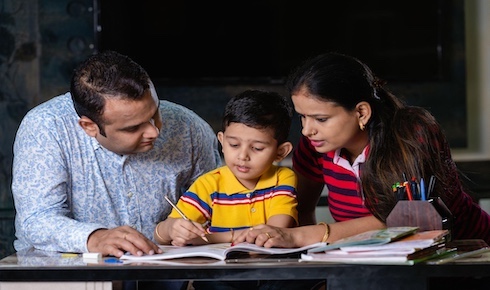
“The child’s first teacher is not in a classroom—it is at home.”
In contemporary discussions on education, the focus often remains limited to schools, curriculum reforms, and institutional quality. However, a growing body of evidence suggests that educational outcomes are deeply rooted in early home environments. In the 21st century, as family structures shift from joint to nuclear and single-parent households, parenting has become more complex and consequential.
This shift makes it necessary to move beyond structural debates and examine a more fundamental question: how does parenting shape a child’s ability to learn, adapt, and succeed? The answer begins with understanding that learning itself does not start in school—it starts much earlier.
Home as the First School: The Foundation of Cognitive Development
To understand educational outcomes, one must begin with early childhood development, where parenting plays a decisive role.
According to UNICEF, nearly 90% of brain development occurs before the age of five, making early years critical for cognitive, emotional, and linguistic growth. During this phase, responsive caregiving, verbal interaction, and emotional security shape neural connections that determine a child’s ability to learn.
The World Bank further establishes that children exposed to stimulating and nurturing home environments demonstrate higher school readiness, improved literacy and numeracy, and better long-term academic outcomes.
In India, NITI Aayog has emphasized that early childhood care and education (ECCE) is central to human capital formation, warning that inadequate early stimulation often results in permanent learning deficits.
While this establishes the cognitive foundation of parenting, it also leads to a deeper question: what happens when this environment is emotionally unstable?
From Cognitive Development to Emotional Stability: Parenting as a Mental Health Determinant
Even the strongest cognitive foundation can weaken in the absence of emotional security at home.
The World Health Organization (WHO) reports that children exposed to frequent parental conflict are significantly more likely to develop anxiety, depression, and attention-related disorders, all of which directly affect learning capacity and classroom performance.
Research by the Harvard Center on the Developing Child introduces the concept of “toxic stress,” where prolonged exposure to conflict or neglect disrupts brain development, particularly areas linked to memory, focus, and emotional regulation.
In India, the National Mental Health Survey (2015-16) highlights the growing prevalence of mental health challenges among adolescents, with family environment identified as a key contributing factor.
This creates a clear progression: while parenting builds cognitive ability, emotional instability at home can prevent that ability from translating into educational success. This naturally brings attention to another dimension of parenting—its role in shaping behavior and mindset.
From Emotional Stability to Behavioral Modeling: How Parents Shape Learning Attitudes
If emotional stability enables learning, then behavioral modeling within the home defines how a child approaches learning.
Children do not simply follow instructions—they observe, internalize, and replicate behaviors. This is supported by social learning theory, which shows that children adopt attitudes and habits demonstrated by primary caregivers.
A powerful historical example is that of Chhatrapati Shivaji Maharaj, whose leadership, discipline, and vision were deeply influenced by his mother, Jijabai. Her values of courage, strategic thinking, and resilience became foundational to his personality.
Modern research echoes this insight. Studies indicate that parental attitudes toward discipline, curiosity, and problem-solving directly influence a child’s academic motivation, persistence, and intellectual engagement.
As this behavioral influence becomes clear, it raises an important structural question: how do changing family systems affect the ability of parents to provide such environments?
From Behavioral Influence to Structural Change: Rethinking Family Systems with Evidence
The transition toward nuclear families and dual-income households has significantly altered caregiving patterns.
Data from the National Family Health Survey (NFHS-5) shows a steady rise in urban nuclear households and working parents, leading to increased reliance on daycare and early childcare services.
However, evidence suggests that the impact of these changes depends less on structure and more on quality of care.
Studies by UNICEF and the OECD indicate that high-quality early childcare centers can positively support cognitive and social development, particularly when children continue to receive active parental engagement at home.
At the same time, the Harvard Center on the Developing Child emphasizes that the absence of consistent, responsive caregiving—whether in a joint family, nuclear setup, or daycare—can result in developmental delays.
This leads to an important conclusion: it is not the family structure, but the consistency and quality of parenting within that structure that determines outcomes. Extending this understanding further reveals that parenting is not just a personal responsibility—it has national implications.
From Family Structures to National Outcomes: Parenting and the Demographic Dividend
Parenting directly influences the quality of a nation’s future workforce, linking it to India’s demographic dividend.
The World Bank’s Human Capital Index highlights that early childhood conditions, including parenting quality, significantly impact future productivity, learning capacity, and earning potential.
Similarly, NITI Aayog has emphasized that early-life deprivation—cognitive, emotional, or nutritional—translates into weaker human capital outcomes, ultimately affecting economic growth and national development.
Challenges such as learning deficits, malnutrition, childhood obesity, and emotional distress often originate in early home environments, creating a cycle that limits both individual and national potential.
Recognizing this connection naturally leads to the role of institutions—particularly the state—in strengthening parenting environments.
From National Concerns to Policy Response: Strengthening Parenting through State Support
Given its long-term implications, parenting must be supported through policy frameworks and institutional mechanisms.
The National Education Policy (NEP) 2020 recognizes Early Childhood Care and Education (ECCE) as foundational and highlights the importance of parental awareness in early learning.
Programs such as the Integrated Child Development Services (ICDS) aim to support children through nutrition, early learning, and community-based care systems.
However, evidence suggests the need for a broader approach that includes:
-
Parental education on early childhood development
-
Mental health awareness within families
-
Quality regulation of childcare institutions
-
Community-based caregiving support systems
Such interventions shift the focus from controlling parenting to enabling informed and supportive caregiving environments. This perspective is also reflected in the legal framework of the country.
Legal Recognition of Child Welfare as a Foundational Principle
The importance of parenting is reinforced within India’s legal system, where child welfare is treated as paramount.
The Supreme Court of India, in various judgments, has consistently held that the “welfare of the child” must be the primary consideration, including their emotional, psychological, and developmental well-being.
This legal standpoint strengthens the broader argument that the environment created by parenting plays a decisive role in shaping a child’s educational and life outcomes.
Rethinking Parenting in the 21st Century
A school counselor once observed a student whose academic performance had declined despite strong intellectual ability. Over time, it became evident that the child was exposed to constant parental conflict at home.
When asked about his difficulty, the child said,
“I don’t know what to focus on—my studies or what’s happening at home.”
This reflects a larger reality. The debate is not about joint versus nuclear families, but about whether children grow up in environments that provide:
-
Emotional security
-
Cognitive stimulation
-
Positive behavioral models
Because ultimately, education systems can support learning—but they cannot substitute for the foundational role of parenting.
In shaping the future of education, it becomes essential to recognize that the strength of a nation’s classrooms is deeply dependent on the strength of its homes.
Click Here for More Edu Guru Corner