
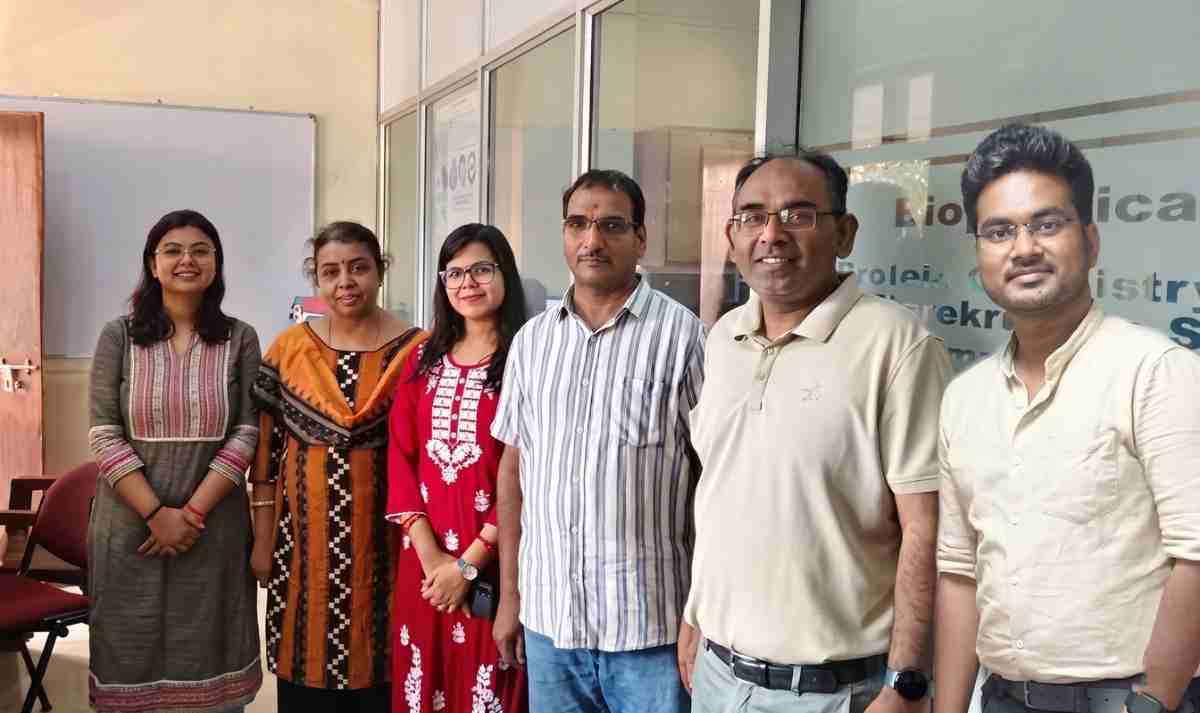
- Researchers at NIT Rourkela have developed a novel hydrogel using discarded pharmaceutical proteins, offering potential applications in wound healing, tissue regeneration and drug delivery. The innovation, which has also received an Indian patent, converts inactive protein aggregates into functional biomaterials.
ROURKELA, November 26, 2026: Researchers from the National Institute of Technology (NIT) Rourkela have developed an innovative way to repurpose inactive proteins discarded by pharmaceutical companies by converting them into hydrogels with potential applications in wound healing, tissue regeneration and drug delivery.
The research team, comprising Prof. Harekrushna Sahoo, Prof. Monalisa Mishra and Prof. Devendra Verma, has developed a process to transform discarded protein aggregates into functional wound-healing microgels.
The innovation offers a potential approach to converting pharmaceutical waste into valuable biomaterials that could support future developments in healthcare and regenerative medicine.
The research findings have been published in the Royal Society of Chemistry's Journal of Materials Chemistry B (2026). The research team has also reported securing an Indian patent for the developed technology under Application No. 202531107839, dated November 6, 2025.
How NIT Rourkela Researchers Converted Waste Proteins into Hydrogels
Proteins perform several essential functions in the human body, including tissue repair, regulation of biological processes and supporting various cellular activities. They are also important components of modern medicines and regenerative therapies.
However, proteins are sensitive molecules. Exposure to heat, chemicals and harsh processing conditions can alter their natural three-dimensional structures.
When proteins lose their original structure, they can unfold and stick together, forming clusters known as protein aggregates. This process can cause them to lose their biological functions.
Consequently, pharmaceutical and biotechnology companies often discard such inactive proteins.
The NIT Rourkela research team has developed a method to repurpose these discarded proteins rather than treating them as waste.
The researchers used BMP-2 proteins as the starting material and converted them into hydrogel structures through a specialised processing method involving heat treatment, hydrogen peroxide and hyaluronic acid.
BMP-2 Protein and Hyaluronic Acid Used to Develop Hydrogel
The development process involved several steps.
-
Protein Treatment: The BMP-2 proteins were heated to approximately 85°C for 10 minutes, causing them to unfold.
-
Protein Aggregation: Chemical reactions promoted the aggregation of the unfolded proteins.
-
Hydrogel Formation: Hydrogen peroxide and hyaluronic acid were added to the protein aggregates to develop the gel structure.
-
Functional Properties: The resulting hydrogel contained tiny pores that allowed it to absorb water, retain medicines and interact with biological tissues.
The combination of BMP-2 protein and hyaluronic acid played an important role in improving the hydrogel's structure and functional properties.
According to Prof. Harekrushna Sahoo, Professor, Department of Chemistry, NIT Rourkela, the two components contributed synergistically to the development and performance of the material.
He explained:
"The synthesis and performance are associated with the synergistic contribution of BMP-2 protein and hyaluronic acid, particularly its water-retention properties which improved the hydrogel architecture, antioxidant activity and sustained drug-release characteristics."
Hydrogel Demonstrates Potential for Drug Delivery
One of the important features of the developed hydrogel is its ability to retain and gradually release medicines.
During laboratory-scale experiments, the researchers loaded the hydrogel with the antibiotic ampicillin and evaluated its drug-release capabilities.
The results indicated that the material could support sustained drug release, suggesting potential applications in targeted drug delivery systems.
This property could be useful in developing biomaterials designed to deliver therapeutic substances to specific areas of the body.
However, further studies will be necessary to establish its effectiveness, safety and suitability for medical applications.
NIT Rourkela Hydrogel Supports Fibroblast Growth
Apart from its drug-delivery potential, the research team also evaluated the hydrogel's interaction with cells associated with wound healing.
The experiments indicated that the developed material supported the growth of fibroblasts.
Fibroblasts are specialised cells that play an important role in tissue repair and wound healing. They contribute to the formation of extracellular matrix components and support the restoration of damaged tissues.
To further investigate the wound-healing properties, the researchers evaluated the hydrogel using Drosophila melanogaster as an in vivo experimental model.
Prof. Monalisa Mishra, Associate Professor, Department of Life Sciences, NIT Rourkela, said:
"Evaluation of the wound-healing efficacy of the newly designed and synthesized BMP-2–hyaluronic acid composite hydrogel was done using Drosophila melanogaster as the in vivo model. Although, we found that the hydrogel is quite promising with our model but still it has to be done and proved biocompatibility with higher animal models before clinical trial."
The findings indicate promising preliminary results, although further biological testing is necessary before the material can be considered for clinical applications.
NIT Rourkela Researchers Secure Indian Patent
The research team has also secured an Indian patent for the developed hydrogel technology.
The available patent details are:
|
Particulars |
Details |
|---|---|
|
Institution |
NIT Rourkela |
|
Innovation |
Protein-based hydrogel |
|
Patent Application Number |
202531107839 |
|
Application Date |
November 6, 2025 |
|
Main Components |
BMP-2 protein and hyaluronic acid |
|
Potential Applications |
Wound healing, tissue regeneration and drug delivery |
The patent represents an important intellectual property milestone for the research team and highlights the potential of converting pharmaceutical waste into functional biomaterials.
Further Research Required Before Clinical Trials
Although the initial experimental results are promising, the researchers have emphasised that additional studies are required to establish the safety and effectiveness of the hydrogel.
The next phase will focus on developing biological models to evaluate its biocompatibility, toxicity and therapeutic performance in higher animal models.
Prof. Devendra Verma, Professor, Department of Biotechnology and Medical Engineering, NIT Rourkela, highlighted the future research direction.
He said:
"The cell-line outcome is promising and could be an efficient candidate for clinical trials provided its biocompatible and non-toxic to higher animal models. It might take 10-12 months to prove the same with higher animal models which might open up for clinical trial."
The planned studies will help determine whether the material can progress towards further preclinical evaluation and, subject to the necessary approvals and evidence, potential clinical trials.
Research Offers New Possibilities for Pharmaceutical Waste Utilisation
The NIT Rourkela innovation highlights an emerging approach to converting pharmaceutical and biotechnology waste into useful materials.
Instead of discarding inactive proteins, the researchers have demonstrated a method to repurpose them into hydrogels with potential biomedical applications.
The development could contribute to research in sustainable biomaterials, regenerative medicine and advanced drug delivery technologies.
By combining protein aggregation with hyaluronic acid, the research team has explored a new route for developing functional materials from otherwise discarded biological resources.
While substantial research and validation remain necessary before clinical use, the findings represent a promising step towards developing sustainable biomaterials for future healthcare applications.
Frequently Asked Questions (FAQs)
1. What have NIT Rourkela researchers developed?
Researchers at NIT Rourkela have developed a hydrogel by repurposing inactive BMP-2 proteins discarded by pharmaceutical companies. The material has potential applications in wound healing, tissue regeneration and drug delivery.
2. Who led the hydrogel research at NIT Rourkela?
The research team includes Prof. Harekrushna Sahoo from the Department of Chemistry, Prof. Monalisa Mishra from the Department of Life Sciences and Prof. Devendra Verma from the Department of Biotechnology and Medical Engineering.
3. What materials are used to develop the hydrogel?
The hydrogel is developed using aggregated BMP-2 proteins and hyaluronic acid through a specialised processing method involving heat treatment and hydrogen peroxide.
4. What is the role of hyaluronic acid in the hydrogel?
Hyaluronic acid contributes to the hydrogel's water-retention properties and helps improve its structure, antioxidant activity and sustained drug-release characteristics.
5. How can the hydrogel help in wound healing?
The laboratory studies indicated that the hydrogel supported fibroblast growth. Fibroblasts are important cells involved in tissue repair and wound healing.
6. Can the developed hydrogel deliver medicines?
Yes. Researchers loaded the hydrogel with the antibiotic ampicillin and evaluated its drug-release capabilities. The results suggested potential for sustained drug delivery.
7. Has NIT Rourkela received a patent for this technology?
The research team reports securing an Indian patent for the technology under Application No. 202531107839, dated November 6, 2025.
8. Which animal model was used to evaluate wound-healing properties?
The researchers used Drosophila melanogaster as an in vivo experimental model to evaluate the wound-healing potential of the hydrogel.
9. Is the hydrogel ready for clinical use?
No. The research is still at the experimental stage. Further biocompatibility and safety studies using higher animal models are required before potential clinical trials.
10. Where have the research findings been published?
The findings have been published in the Royal Society of Chemistry's Journal of Materials Chemistry B (2026).
11. What are the potential applications of this research?
Potential applications include wound-healing materials, tissue regeneration, sustained drug delivery and the development of sustainable biomaterials from pharmaceutical waste.
Click Here for More Science & Technology