
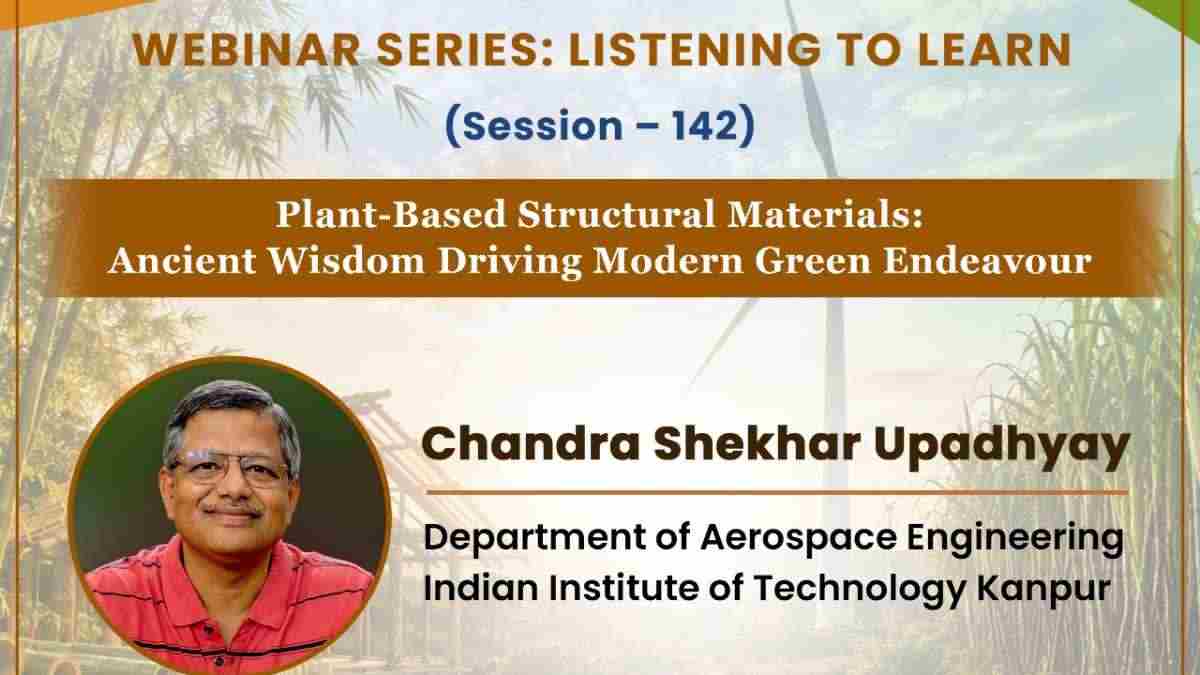
Plant-Based Structural Materials on September 18
New Delhi: Could solutions to engineering problems of the future be found in materials that have been used for many generations? This will be the focus of NCERT’s ‘Listening to Learn’ Session 142 titled Plant-Based Structural Materials: Ancient Wisdom Driving Modern Green Endeavour, scheduled for September 18, 2026 between 10 AM and 11 AM IST.
Session 142 aims to explore how traditional knowledge and plant-based materials can offer solutions to modern engineering problems. The session will include Prof. Chandra Shekhar Upadhyay, Professor in the Department of Aerospace Engineering at IIT Kanpur, who will discuss the relationship between structural materials, traditional knowledge and contemporary sustainable engineering.
IIT Kanpur’s official faculty profile confirms Prof. Upadhyay’s position and details his areas of interest as mechanical behavior of materials, solid mechanics and design, computational materials science, material degradation and structures, structural dynamics and aeroelasticity.
What Will the Session Cover?
The main focus of Session 142 is to determine how traditional knowledge and plant-based materials can provide modern engineering solutions. Materials derived from plants have gained considerable interest in engineering over the years. Researchers are interested in finding alternative materials that will improve the sustainability of materials and engineering systems. The NCERT session is expected to forward this discussion to the educational domain by merging:
- Traditional and indigenous knowledge
- Plant-based materials
- Structural engineering
- Materials science
- Sustainable engineering
- Modern technological challenges
The session’s main aim is to merge traditional and modern knowledge of engineering to better equip modern engineering and technology with sustainable solutions.
Who is Prof. Chandra Shekhar Upadhyay?
Prof. Chandra Shekhar Upadhyay has an M.S. and PhD in Aerospace Engineering from Texas A&M University and a B.Tech. in Aerospace Engineering from IIT Kharagpur. He is a Professor in the Department of Aerospace Engineering at IIT Kanpur. His IIT Kanpur faculty page states his primary areas of research are mechanics of materials, mechanics and design of structures and materials, computational materials science and degradation of materials, and structure and dynamics of aeroelasticity. These areas provide an excellent academic basis of materials and their engineering behaviour.
Why Plant-Based Materials Matter in Engineering
Phrases like plant-based materials are not traditionally associated with aerospace or structural engineering, but they are increasingly key elements of materials science. The use of bio-based elements and natural fibres is proven to strengthen and lighten engineered materials. Natural-fibre composites research uses plant fibres for their low density and renewable origins. However, their suitability for specific structural applications depends on several factors, which include mechanical properties, durability, tolerance to moisture, processing and consistency.
This is much more complex than just exchanging regular materials for plant-based alternatives. The NCERT session gives us a chance to present matrix-based engineering models to students and embrace this way of thinking.
Ancient Wisdom Meets Modern Engineering
The merging of ancient wisdom and modern green engineering interests me the most in the session title. Traditional communities have phonetic methods of crafting building materials, transportation, shelters, and tools from available natural resources. Modern Engineering relies on controlled testing and the performance demands of the intended use to assess a material.
The exciting part is integrating the two systems. Modern Science will be able to analyse the properties and constraints of the materials derived from Traditional Knowledge. We aren’t suggesting that all of traditional knowledge will be functional in modern engineering. We are, however, suggesting a basis for exploration and analysis.
Green Engineering and the Quest for Innovative Materials
Sustainability is rapidly becoming one of the key design considerations in engineering. More factors are relevant to the evaluation of engineering materials today, including the consumption of resources, environmental impact, longevity, and the design of products that minimise waste.
Bio-based structural materials present an interesting new frontier for the industry. Designing bio-based materials for performance and providing clear environmental and resource advantages over traditional materials is the goal. The materials emphasis in the NCERT session falls within the “green endeavour”.
NCERT and Digital Access for Educational Content
NCERT and CIET employ digital techniques to disseminate educational materials to learners beyond the school classrooms. PM eVIDYA is an Indian government initiative wherein educational content is made available via multiple media and modalities, including DTH television, e-books/ digital content, radio, and podcasts.. CIET refers to PM eVIDYA as an ICT multimodal initiative of the Ministry of Education for facilitation of school-level teaching and learning.
NCERT has established PM eVIDYA specific channels for different school classes viz., Channels 9, 10, 11 and 12 for classes IX to XII. A multi-modal approach to programming will enable education to reach a greater number of learners with diverse levels of access to the internet.
Watching and Listening to Learn Session 142
The program will be available for viewing on the NCERT Official YouTube Channel on:
- Friday, September 18, 2026
- 10 AM to 11 AM
- Topic: Plant-Based Structural Materials
- Speaker: Prof. Chandra Shekhar Upadhyay, IIT Kanpur
This program will also be aired on PM eVidya Channels 9, 10, 11 and 12 as per NCERT informs us. NCERT's official information on PM eVIDYA assures that these Channels are part of their school-education DTH services.
Why Students Should Pay Attention
This topic connects interestingly with the fields of science, engineering, sustainability and indigenous knowledge. For school students, it shows that engineering may not just involve machines and computers - innovation may be done with materials as well. For teachers, this discussion provides a valuable opportunity to show that:
- Science and Technology
- Environmental education
- Materials Science
- Indigenous Knowledge
- Sustainable Development
- Innovation and Design
- may all be integrated in a single example.
This example may even motivate students to see existing natural materials differently - not as a remaining resource to be extracted, but an unexplored domain, waiting to be studied using scientific methods.
Inclusive Learning Through Digital Platforms
One of the most important features of programs that integrate many delivery systems is that they can reach beyond the learners in a single physical classroom. NCERT has integrated multiple delivery systems (television, digital resources, radio, etc.) in its PM eVIDYA, and includes provisions also for Children with Special Needs (CwSN).
This is important because educational enrichment should not be determined by whether a student was able to attend a particular event. Therefore, a session on complex engineering concepts may be integrated in a delivery system that covers a wide range of learners, students, and teachers.
Final Thoughts
NCERT's session 142, Listening to Learn, uses a unique approach to incorporate sustainable engineering by considering the opportunities provided by plant based structural materials and traditional wisdom. Under the leadership of Prof. Chandra Shekhar Upadhyay of IIT Kanpur, the session planned for the 18th of September brings together the aspects of materials science, aerospace engineering, sustainability, and indigenous wisdom in a format which promotes accessibility to education at all levels. Innovation can inspire people to consider unconventional places to begin developing ideas.
Many people may think the next great idea in engineering will come from breakthrough discoveries in a well-equipped lab. However, the answer may lie in allocating the time to observe what nature has already taught us.
Click Here for More Latest News