
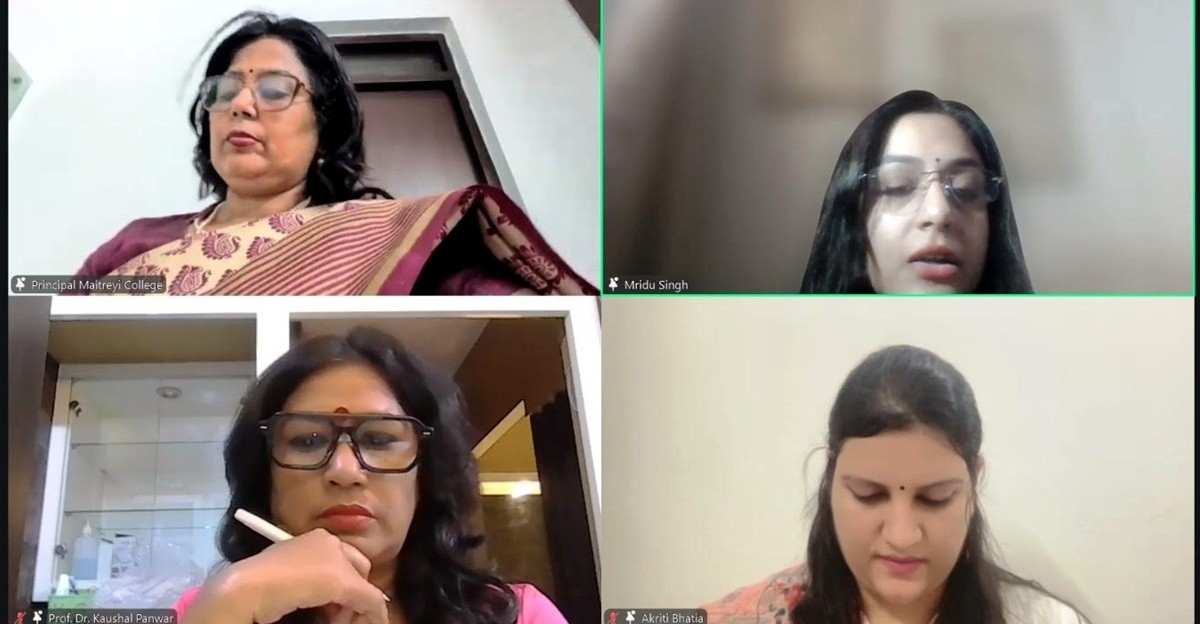
New Delhi । Maitreyi College, University of Delhi, organised an international special lecture on “Labour, Profession and Dignity: The Indian Knowledge Tradition Perspective” on October 14, 2026. The event was organised under the guidance of Principal Prof. Haritma Chopra, with the support of Vice-Principal Prof. Jyoti Singh and under the leadership of Dr. Pramod Kumar Singh, Nodal Officer and Coordinator of the Vidushi Arundhati Centre for Indian Knowledge Tradition. The programme was organised in collaboration with the Institute of Advanced Sciences, USA, and the Council of Indic Studies and Research, New Delhi. The overwhelming response to the event, with all designated seats filled even before its commencement, reflected the growing interest in the subject.
The programme commenced with a welcome address by Prof. Haritma Chopra, Principal of Maitreyi College and Director of the Vidushi Arundhati Centre for Indian Knowledge Tradition. She drew attention to the invaluable contributions of workers and service providers in everyday life, highlighting issues related to the dignity of labour, social respect and social security for domestic workers and other service personnel. She emphasised that the value of an individual's work should be assessed on the basis of skill and contribution to society rather than caste, social background or traditional occupation. She also underlined the contemporary relevance of the subject and appreciated the Centre's efforts to promote the study, research and dissemination of Indian knowledge traditions in contemporary contexts.
The first speaker, Dr. Aakriti Bhatia, Assistant Professor at the Centre for the Study of Social Systems, Jawaharlal Nehru University, delivered an insightful and thought-provoking lecture on the relationship between labour, occupations and broader structures of social inequality, caste, class and gender. Drawing upon the Bhagavad Gita, Kautilya's Arthashastra and Vedic thought, she explored traditional Indian perspectives on action, labour and social responsibility, highlighting their continuing relevance. Referring to the ideas of Mahatma Gandhi, Swami Vivekananda and Dr. B. R. Ambedkar, she discussed the dignity of labour and the importance of traditional skills and practical knowledge.
Dr. Bhatia also highlighted the challenges faced by app-based service workers, construction labourers and street vendors, stressing the need for social security, legal protection and dignified working conditions. Drawing attention to women's unpaid domestic labour, she called for a more equitable understanding of work, beginning within the family, and urged society to critically examine established social attitudes towards different occupations. During the interactive question-and-answer session, she responded to participants' queries with clarity, detailed explanations and reasoned arguments, enriching the discussion and deepening participants' understanding of the subject.
The chief guest, Prof. Kaushal Panwar, Chair of the Indian Studies Chair of the Indian Council for Cultural Relations (ICCR) at Wijaya Kusuma University, Indonesia, discussed the relationship between action, labour and human dignity in the light of Indian knowledge traditions. She observed that while professions such as medicine, engineering, teaching and administration often enjoy greater social prestige, the contributions of farmers, carpenters, blacksmiths, sanitation workers, domestic workers and traditional artisans deserve equal recognition and respect.
Referring to the concept of _Karma Yoga_ in the Bhagavad Gita, Prof. Panwar explained that work should not be viewed merely as a means of earning a livelihood, but also as an expression of dedication, responsibility and service to society. Citing traditional crafts, including Banarasi silk sarees, she highlighted the knowledge, craftsmanship and creativity preserved and transmitted across generations. She emphasised that the dignity of a profession should not be determined solely by income, designation or social status, but by the skills, quality, ethics and contribution to public welfare associated with it. She called for a respectful attitude towards every individual and every form of labour, in keeping with the welfare-oriented ideals of Indian traditions.
The programme concluded with a vote of thanks by Dr. Pramod Kumar Singh, Nodal Officer and Coordinator of the Centre and Deputy Dean, Students' Welfare, University of Delhi. He expressed gratitude to the chief guest, Prof. Kaushal Panwar, for her contributions to the promotion of Indian languages, particularly Hindi and Sanskrit, abroad, and to the advancement of Indian knowledge traditions. He also appreciated Dr. Aakriti Bhatia for her engaging and thought-provoking lecture. He acknowledged the guidance of Principal Prof. Haritma Chopra and the support of Vice-Principal Prof. Jyoti Singh, while thanking Dr. Mridusmita Singh for conducting the programme effectively and all members of the Centre for their valuable contributions.
The session was smoothly moderated by Dr. Mridusmita Singh, Assistant Professor in the Department of Sociology, Maitreyi College, who connected the speakers' insights with the central themes of the discussion. Technical support was provided by Mr. Pawan Harshana of the Department of Sociology and Dr. Neelima Ohri of the Department of Mathematics. Dr. Meenu Kumari, Dr. Hemlata Rani and other members of the Vidushi Arundhati Centre for Indian Knowledge Tradition played an important role in the successful organisation of the event.
The lecture reinforced the message that every form of honest work deserves dignity and recognition, and that a more equitable society must move beyond occupational hierarchies to acknowledge the skills, contributions and humanity of all workers.
Click Here for More Institutional Activities