
-
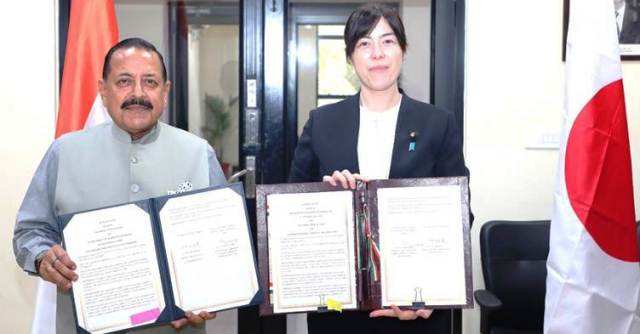
ONODA Kimi appreciates India’s rapid economic growth and its strong commitment to innovation, particularly the large-scale adoption of artificial intelligence across sectors
-
India–Japan S&T Partnership Entered a New Phase Following Prime Minister Sh Narendra Modi’s Japan Visit last year: Dr. Jitendra Singh
India and Japan advanced their strategic partnership in science, technology and innovation during the high-level bilateral engagement with a strong focus on emerging and critical technologies.
The meeting marked the exchange of a Memorandum of Cooperation (MoC) in the field of health and medical devices among the Japan Agency for Medical Research and Development (AMED), the Indian Council of Medical Research (ICMR) and the Department of Science and Technology (DST).
A Letter of Intent (LoI) on cooperation in Quantum Science and Technology was also signed between the Cabinet Office of Japan and DST, opening new avenues for collaboration in next-generation technologies.
The engagement builds upon the outcomes of the visit of Prime Minister Shri Narendra Modi to Japan in August 2025, during which both sides agreed to expand cooperation under the India-Japan Science, Technology and Innovation Partnership across a wide spectrum of domains, including industry and startups.
Addressing the gathering, Dr. Jitendra Singh said- India and Japan share a natural synergy in science and technology. While Japan brings advanced technological capabilities, India offers a vast pool of talented human resources. Together, we can accelerate innovation in frontier areas and translate research into impactful societal outcomes.
The Minister added that India’s expanding national missions in Quantum Technologies, Cyber-Physical Systems, Electric Mobility, Clean Energy and Advanced Computing reflect the country’s strong push towards deep-tech sectors, creating new opportunities for joint research, co-development and industrial partnerships.
Speaking on the occasion, Ms. ONODA Kimi appreciated India’s rapid economic growth and its strong commitment to innovation, particularly the large-scale adoption of artificial intelligence across sectors. She shared that her visit to India, including interactions with academic institutions, reflected a strong culture of resilience among young researchers, with the ability to learn from failure and continue pursuing innovation.
ONADO Kimi highlighted that Japan’s strengths in advanced manufacturing and computational technologies, including quantum and AI, align closely with India’s expanding technology ecosystem. She expressed confidence that the agreements exchanged during the meeting, particularly in quantum technologies and health research, will promote deeper collaboration spanning research, application and industrial deployment.
During the discussions, both sides exchanged detailed views on strengthening cooperation under India’s National Quantum Mission, which is advancing an integrated approach across quantum computing, communication, sensing and materials, along with progress in long-distance quantum secure communication networks.
Japan shared insights on its network of quantum innovation hubs, including global initiatives aimed at industrialisation and standardisation of quantum technologies, and expressed interest in building linkages with Indian institutions. Both sides discussed enhancing collaboration between research hubs in India and Japan to accelerate innovation and technology deployment.
The discussions also covered ongoing initiatives such as researcher mobility and joint innovation platforms, including programmes that enable Indian researchers to undertake collaborative research and industry internships in Japan. Both sides acknowledged the value of such initiatives in strengthening academic and industrial linkages.
In the field of health research and medical technologies, both sides deliberated on expanding cooperation through joint research programmes, capacity building and structured funding arrangements. It was discussed that collaborative research projects could be supported by respective funding agencies in India and Japan, alongside institutional mechanisms such as workshops and researcher-level engagements to identify priority areas of mutual interest.
The interaction also reflected a shared understanding on the importance of strengthening science and technology partnerships among like-minded countries to support a free and open Indo-Pacific, with collaboration extending across academia, research institutions and industry.
From the Indian side, key participants included Prof. Abhay Karandikar, Secretary, Department of Science and Technology, and Prof. Rajiv Bahl, Director General, Indian Council of Medical Research, along with senior officials associated with international cooperation and quantum initiatives.
The Japanese delegation included senior officials such as Mr. Fukunaga Tetsuro, Director-General, Secretariat of Science, Technology and Innovation Policy; Mr. Hayashi Teiji, Ambassador for Global Health, and representatives from AMED and the Embassy of Japan in India.
The meeting concluded with both sides agreeing to intensify engagement at multiple levels, including researcher-to-researcher collaboration, institutional partnerships and industry linkages, to further deepen India–Japan cooperation in science, technology and innovation.
Click Here for More Science & Technology