
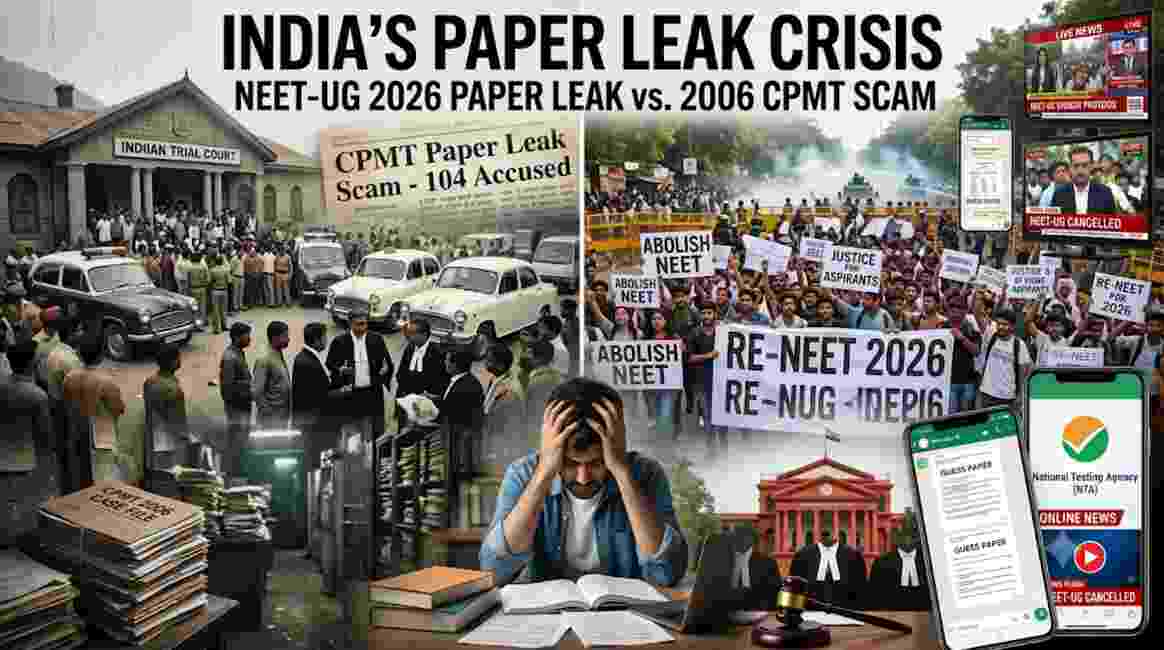
The NEET Scandal 2026 has sent a series of ripples through the medical admissions process in India, leaving almost 22 lakh aspirants in the lurch due to multiple lapses, loss of confidence, and the gruelling process of re-examinations. Initially, reports of leaked question banks in coaching centres mushroomed into student protests and the resignations of political leaders, as well as litigation in courts across the country, including in Karnataka.
All About the Past Medical Exam Scams
Even before the outbreak of the NEET Scandal 2026, the medical entrance system in India was riddled with unaddressed examination fraud. In June, 2006, a trial court in Shimla issued a final order to speed up the proceedings in the paper leak case for the Combined Pre-Medical Test (CPMT) held in the state in 2006, leaving the case languishing before a lower court for two decades. The 2006 leak, which involved 104 persons from across the country, including politicians' relatives, doctors and bureaucrats, lasted for 20 years, and all the accused persons were on bail.
Likewise, the NEET-UG 2024 controversy highlighted issues related to paper processing and grace marks. Similarly, in the NEET-UG 2024 controversy, there were flaws related to paper handling and grace marking. Even after stringent assurances of reform and the Public Examinations (Prevention of Unfair Means) Act, 2024, there were systemic shortcomings in NEET-UG on May 3, 2026.
How the NEET Scandal 2026 Unfolded
In the wake of the examination held on May 3, an alarm bell rang in Sikar, Rajasthan, in no time. It was observed that the educators and students found an uncanny resemblance between 120 to 140 questions of a ‘guess paper' sent on WhatsApp ahead of the test and the question booklet of the National Testing Agency (NTA), especially in the Chemistry and Biology sections of the paper.
The Special Operations Group officers of Rajasthan Police started arresting people, and they found an inter-state gang in the state of Rajasthan, Maharashtra and Haryana. On May 12, the NTA decided to cancel the May 3 examination altogether and hand it over to the Central Bureau of Investigation (CBI) as a result of rising evidence and public outrage.
The new test, known as 're-NEET', was scheduled for June 21, 2026. When the sudden cancellation followed years of preparation, it caused huge psychological stress to the students. Sadly, more than 12 aspirants who were to appear for the exam died by suicide, making it a national human tragedy.
Student Uprising and Political Fallout
By July 2026, grievances had turned into huge street protests. More than 20,000 students and young activists marched towards Parliament in New Delhi, demanding accountability, as they were chased by the police with lathis and tear gas. When public pressure was mounting, and Union Education Minister Dharmendra Pradhan faced an admission of a "breach in the command chain", he resigned on 25th July 2026, and the government announced plans to switch NEET to a computer-based test format and set up fast-track courts.
The response from Karnataka was street demonstrations and relief from the High Court. The response from Karnataka was street protests and relief from the High Court.
After the NEET Scandal 2026, Karnataka became one of the most competitive states on the political and legal battlefields:
Student unions and the youth wings in the districts of Mandya, Bagalkote (Hunagunda and Ilkal) held strong protests. The protesters shouted slogans to abolish the NEET and replace it with entrance exams conducted by the states, such as the Common Entrance Test (CET).
In response, Karnataka Chief Minister Siddaramaiah and Deputy CM DK Shivakumar strongly slammed the Delhi police's action against student protesters and called for accountability in the Parliament regarding the psychological and economic damage caused to the families.
On November 20, 2026, the Karnataka High Court intervened on behalf of the aspirants, ensuring the protection of genuine merit. The Karnataka High Court stepped in on behalf of the aspirants on November 20, 2026, ensuring the protection of genuine merit. The NTA had suspended the exam result of a Karnataka student with 570 marks in the cancelled May 3 exam, saying she had her mobile phone in her pocket during the test. The court ruled that the NTA's order was set aside and that she could keep her medical seat, as the exam had been cancelled and couldn't be revived to supersede the merit she had scored in a valid exam.
Karnataka’s Response: Street Protests and High Court Relief
While the legal battle in the Himachal CPMT case had dragged on for two decades, the case related to the NEET Scandal 2026 is now beginning to become an active trial. The CBI has filed charge sheets against 14 accused, comprising three experts from NTA who leaked the copyrighted papers of the subjects while working on them during the translation and proofreading process and operatives of the coaching institutes as well as middlemen. Both sides of the evidence were to begin on November 25, 2026, with all 14 accused pleading not guilty.
Where the Investigation Stands Now
The NEET Scandal 2026 has now demonstrated that the high-stakes testing system cannot be kept on a damage control basis. The Karnataka High Court's assertion of the student merit system and the CBI's quick-track court suggestion guarded optimism, but it will take a perfect digital testing system, transparent governance and speedy punishment for those who treat students' futures as a commodity to engender trust amid millions of young Indians.
Click Here for More Students Corner