
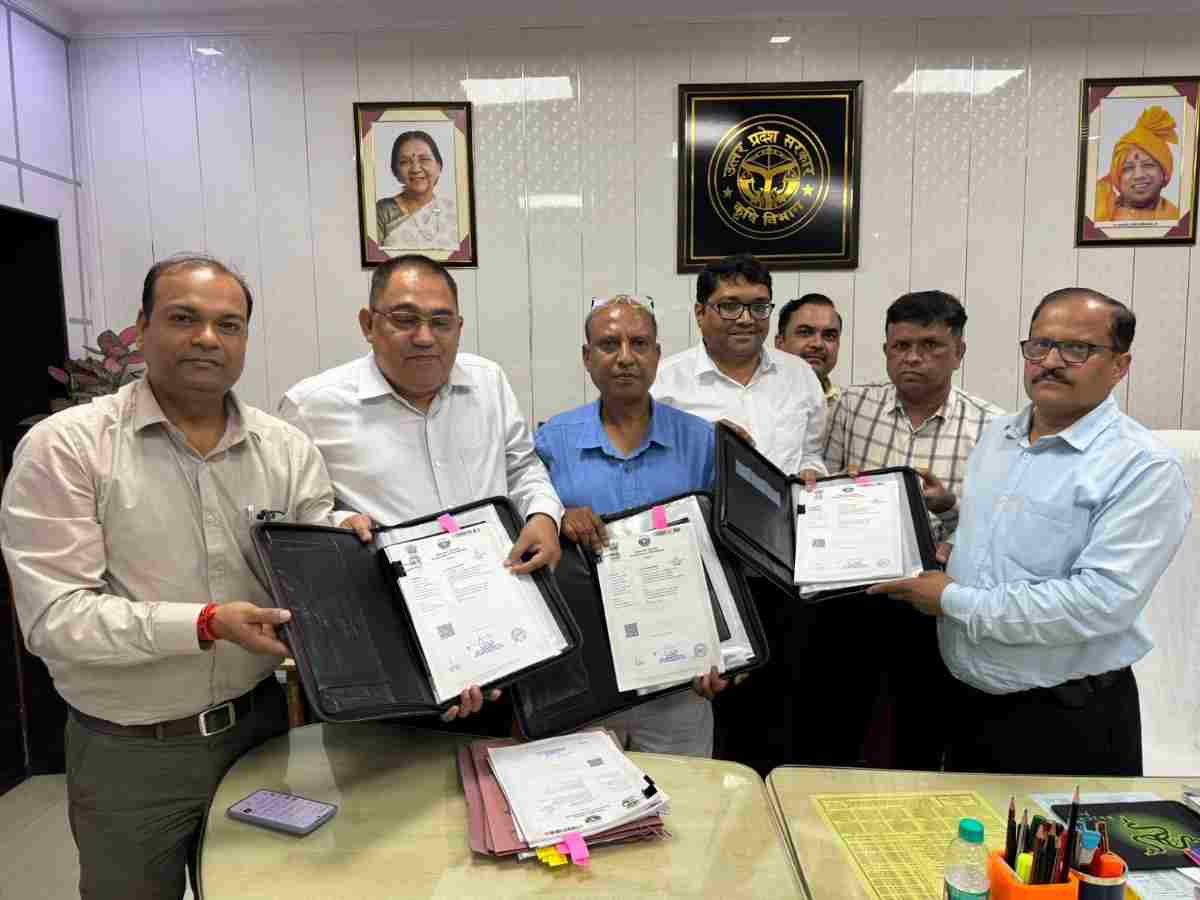
IIT Roorkee Partners with UP Government to Advance Carbon Credits for Sustainable Agriculture
Two Tripartite MoUs bring together IIT Roorkee, Uttar Pradesh Government and industry to create a technology-enabled, farmer-centric carbon credit ecosystem
Roorkee, Uttarakhand, September 2026: The Indian Institute of Technology Roorkee (IIT Roorkee) has strengthened its collaboration with the Government of Uttar Pradesh to promote sustainable agriculture and expand farmer participation in emerging carbon-credit markets.
The institute has signed two Tripartite Memoranda of Understanding (MoUs) with the Directorate of Agriculture, Government of Uttar Pradesh, and two industry partners — M/s Compliance Kart Pvt. Ltd. and M/s Trayambhu Tech Solutions Pvt. Ltd. — under the programme “Carbon Credits Initiation and Its Benefits for Sustainable Agriculture in Uttar Pradesh.”
The programme is structured as a Public–Private–Academic Partnership (PPAP/PPP) and is being implemented under the approved framework of the Government of Uttar Pradesh.
The partnership brings together government policy, IIT Roorkee’s scientific and technical expertise, and industry capabilities to establish a transparent, credible and farmer-centric carbon-credit ecosystem in the state.
The initiative focuses on connecting sustainable agricultural practices with carbon-finance opportunities while using scientific measurement and digital technologies to improve monitoring and verification.
What is the IIT Roorkee carbon-credit programme?
The programme aims to encourage farmers to adopt climate-smart and regenerative agricultural practices that can improve environmental sustainability while potentially creating opportunities for participation in carbon markets.
The key areas covered under the initiative include:
- Enhancement of soil organic carbon
- Water conservation
- Improved irrigation efficiency
- Reduction of greenhouse-gas emissions
- Agroforestry
- Biodiversity conservation
- Sustainable and regenerative agricultural practices
- Digital monitoring and verification of project outcomes
The programme is designed around the principle that sustainable farming practices should generate measurable environmental outcomes and, where eligible under applicable carbon-market methodologies, provide farmers with access to emerging carbon-finance mechanisms.
IIT Roorkee had earlier announced the broader sustainable agriculture and carbon-credit initiative for western Uttar Pradesh, with the initial implementation planned across Saharanpur, Muzaffarnagar and Shamli districts.
IIT Roorkee to provide scientific and technical expertise
Under the MoU framework, IIT Roorkee will act as the Technical and Scientific Nodal Agency for the programme.
The institute will contribute expertise across several important components of carbon-credit project development and monitoring.
Its responsibilities will include:
- Developing and contributing to scientific methodologies
- Reviewing Project Design Documents
- Supporting monitoring systems
- Supervising the Digital Monitoring, Reporting and Verification (D-MRV) framework
- Scientific evaluation
- Quality review
- Capacity building
- Research
- Technical coordination
This role is significant because carbon-credit projects require credible systems for measuring, reporting and verifying environmental outcomes.
IIT Roorkee's involvement is intended to strengthen the scientific basis and technical credibility of the programme.
Digital technology to power carbon-credit monitoring
A major feature of the initiative is the proposed use of digital technologies for monitoring agricultural activities and environmental outcomes.
The programme envisages the integration of:
Satellite technology + GIS mapping + GPS-enabled field systems + mobile applications + IoT + digital audit trails + transparency dashboards
These technologies are expected to support field-level data collection, monitoring, traceability and verification.
The Digital Monitoring, Reporting and Verification (D-MRV) framework will be particularly important for creating reliable records of agricultural interventions and their environmental outcomes.
IIT Roorkee's earlier programme documentation has also highlighted digital monitoring and verification systems as an important component of the carbon-credit initiative.
Farmers at the centre of the carbon-credit ecosystem
One of the central objectives of the programme is to make farmers active participants in the emerging carbon economy.
The initiative is intended to connect farmers adopting sustainable agricultural practices with carbon-credit mechanisms, while placing emphasis on transparent benefit-sharing, climate resilience and sustainable rural development.
This farmer-centric approach is particularly relevant because small and marginal farmers can face challenges in accessing emerging carbon markets due to issues such as project scale, technical requirements, measurement and verification costs.
The programme seeks to address these challenges through an institutional framework involving the state government, IIT Roorkee and industry partners.
However, the actual generation and monetisation of carbon credits will depend on project eligibility, applicable methodologies, verification requirements and carbon-market conditions.
Initial focus on three Uttar Pradesh districts
The programme will initially cover:
- Saharanpur
- Muzaffarnagar
- Shamli
These districts are part of western Uttar Pradesh's important agricultural landscape.
The programme may subsequently be expanded to other agro-climatic zones of Uttar Pradesh, subject to the required approvals and performance assessment.
The phased approach will allow the partners to establish implementation mechanisms, undertake baseline planning, deploy monitoring systems and onboard farmers before potentially scaling the programme across additional regions.
MoUs provide five-year implementation framework
The two MoUs provide an initial five-year framework for the collaboration.
The implementation framework is expected to involve several stages, including:
- Coordination among participating institutions and organisations
- Baseline planning
- Development of project-specific agreements
- Deployment of Digital Monitoring, Reporting and Verification systems
- Farmer onboarding
- Scientific and technical evaluation
- Monitoring and verification
- Carbon-credit project development and market participation, where applicable
This structured approach is intended to create a long-term ecosystem rather than a one-time agricultural intervention.
Alignment with India's carbon-market framework
The programme is aligned with India's evolving Carbon Credit Trading Scheme (CCTS) and recognises applicable national and international carbon-market standards.
The framework also refers to standards and mechanisms including:
- Verra VCS
- Gold Standard
- Article 6-compatible frameworks
The application of any particular standard or methodology will depend on the requirements applicable to individual projects.
India's development of carbon-market mechanisms has increased interest in projects capable of demonstrating measurable greenhouse-gas reductions or carbon sequestration.
The IIT Roorkee-UP initiative seeks to connect agricultural sustainability with this emerging climate-finance ecosystem.
Compliance Kart and Trayambhu Tech Solutions join the initiative
The two industry partners participating in the MoUs are Compliance Kart Pvt. Ltd. and Trayambhu Tech Solutions Pvt. Ltd.
Mr. Alok Pandey, Authorised Signatory, Compliance Kart Pvt. Ltd., said the partnership would help connect climate action, scientific rigour and grassroots implementation while creating greater value and participation for farmers.
Mr. Prabir Mishra, Authorised Signatory, Trayambhu Tech Solutions Pvt. Ltd., said the collaboration would combine technology, scientific expertise and field-level implementation to support sustainable agricultural practices and strengthen farmer participation in the emerging carbon-credit ecosystem.
The companies' participation follows IIT Roorkee's efforts earlier in 2026 to identify and empanel industry partners for the sustainable agriculture carbon-credit programme. The institute had issued an Expression of Interest for industry partners with capabilities related to sustainable agriculture, geospatial technologies, digital MRV systems and carbon-credit lifecycle management.
IIT Roorkee leadership highlights climate and social impact
Prof. K. K. Pant, Director, IIT Roorkee, said the institute remains committed to translating scientific knowledge and technological innovation into solutions with meaningful societal and environmental impact.
He emphasised that the collaboration between government, academia and industry can help develop a credible carbon-credit ecosystem capable of supporting sustainable agriculture, strengthening climate resilience and creating new opportunities for farmers.
The IIT Roorkee team involved in the initiative includes Prof. Vivek Kumar Malik, Dean, Sponsored Research and Industrial Consultancy (SRIC), who is providing institutional and strategic oversight, and Dr. A. S. Maurya, Nodal Officer/Authorised Signatory, who is contributing to technical and scientific coordination.
What could carbon credits mean for farmers?
Carbon credits are generally associated with verified reductions in greenhouse-gas emissions or increases in carbon sequestration. In agriculture, practices such as improved soil management, agroforestry, residue management and more efficient resource use can potentially contribute to measurable climate benefits.
The IIT Roorkee programme is designed to explore these opportunities at scale by combining agricultural interventions with scientific measurement and digital monitoring.
The programme's farmer-centric approach is intended to ensure that the economic and environmental dimensions of carbon markets are considered together.
It is important to note that participation in a carbon-credit programme does not automatically guarantee a fixed income to every farmer. Carbon-credit issuance and revenue depend on the project's methodology, measured and verified outcomes, market arrangements and other applicable conditions.
From sustainable farming to carbon markets
The IIT Roorkee initiative represents an effort to establish a link between farm-level sustainability and the wider carbon economy.
For farmers, sustainable practices can contribute to soil health, water conservation and climate resilience. For the carbon market, scientifically measured agricultural outcomes can potentially form the basis for eligible carbon projects.
Technology is expected to serve as the bridge between the two.
Satellite data, GIS, GPS-enabled systems, mobile applications and IoT can help collect and organise field-level information, while digital audit trails and transparency dashboards can support accountability.
The scientific role of IIT Roorkee is intended to complement these technologies by supporting methodologies, validation, monitoring and quality assurance.
A broader model for climate-smart agriculture
The partnership could provide a model for integrating public policy, academic research, private-sector capabilities and farmer participation in climate-smart agriculture.
If successfully implemented and scaled, such an ecosystem could help address multiple objectives simultaneously — improving agricultural sustainability, strengthening climate resilience, promoting digital monitoring and creating pathways for farmers to participate in carbon markets.
For Uttar Pradesh, the initial implementation across Saharanpur, Muzaffarnagar and Shamli provides a defined geographical starting point. Expansion to additional agro-climatic regions could follow after assessment of the programme's implementation and outcomes.
The collaboration ultimately seeks to move from isolated sustainable farming interventions towards a more integrated system in which scientific research, digital technology, agricultural practices and carbon finance work together.
IIT Roorkee has said the initiative forms part of its continuing commitment to translating research and innovation into scalable solutions for climate action, sustainable agriculture and inclusive development.
Key Facts at a Glance
| Particular | Details |
|---|---|
| Lead technical institution | IIT Roorkee |
| Government partner | Directorate of Agriculture, Government of Uttar Pradesh |
| Industry partners | Compliance Kart Pvt. Ltd.; Trayambhu Tech Solutions Pvt. Ltd. |
| Programme | Carbon Credits Initiation and Its Benefits for Sustainable Agriculture in Uttar Pradesh |
| Partnership model | Public–Private–Academic Partnership (PPAP/PPP) |
| Initial districts | Saharanpur, Muzaffarnagar and Shamli |
| Initial framework | Five years |
| IIT Roorkee's role | Technical and Scientific Nodal Agency |
| Monitoring system | Digital Monitoring, Reporting and Verification (D-MRV) |
| Technologies proposed | Satellite, GIS, GPS, mobile applications, IoT, digital audit trails and dashboards |
| Key focus | Sustainable agriculture, soil carbon, water conservation, emissions reduction, agroforestry and biodiversity |
| Carbon-market alignment | India's CCTS and applicable national/international standards |
Frequently Asked Questions
What is the IIT Roorkee carbon-credit initiative?
It is a programme involving IIT Roorkee, the Government of Uttar Pradesh and industry partners to promote sustainable agriculture and develop a technology-enabled ecosystem through which eligible agricultural climate benefits can potentially participate in carbon markets.
Which Uttar Pradesh districts are covered initially?
The initial programme covers Saharanpur, Muzaffarnagar and Shamli districts, with potential expansion to other agro-climatic zones subject to approvals and performance assessment.
What will IIT Roorkee do in the programme?
IIT Roorkee will serve as the Technical and Scientific Nodal Agency, supporting scientific methodologies, project-document review, monitoring, D-MRV supervision, scientific evaluation, quality review, capacity building and technical coordination.
What is D-MRV?
D-MRV stands for Digital Monitoring, Reporting and Verification. It refers to the use of digital technologies and systems to collect, monitor, record and verify information relevant to carbon-credit projects.
How can farmers potentially benefit?
Farmers adopting eligible sustainable agricultural practices may gain an opportunity to participate in carbon-finance and carbon-market mechanisms. The programme specifically emphasises transparent benefit-sharing and farmer participation.
What agricultural practices are being promoted?
The programme focuses on areas such as soil organic carbon enhancement, water conservation, improved irrigation efficiency, greenhouse-gas emission reduction, agroforestry and biodiversity.
Is the programme connected to India's Carbon Credit Trading Scheme?
Yes. The programme is aligned with India's evolving Carbon Credit Trading Scheme (CCTS) and recognises applicable carbon-market standards and frameworks.
Which companies are collaborating with IIT Roorkee?
The two industry partners named in the MoUs are Compliance Kart Pvt. Ltd. and Trayambhu Tech Solutions Pvt. Ltd.
How long will the MoU framework operate?
The MoUs provide an initial five-year framework for implementation.
Will every farmer automatically earn carbon-credit income?
No. Carbon-credit income cannot be assumed automatically. Carbon credits generally require eligible activities, appropriate methodology, measurement, reporting and verification, and successful participation in an applicable carbon-market mechanism
Click Here for More Institutional Activities