
-
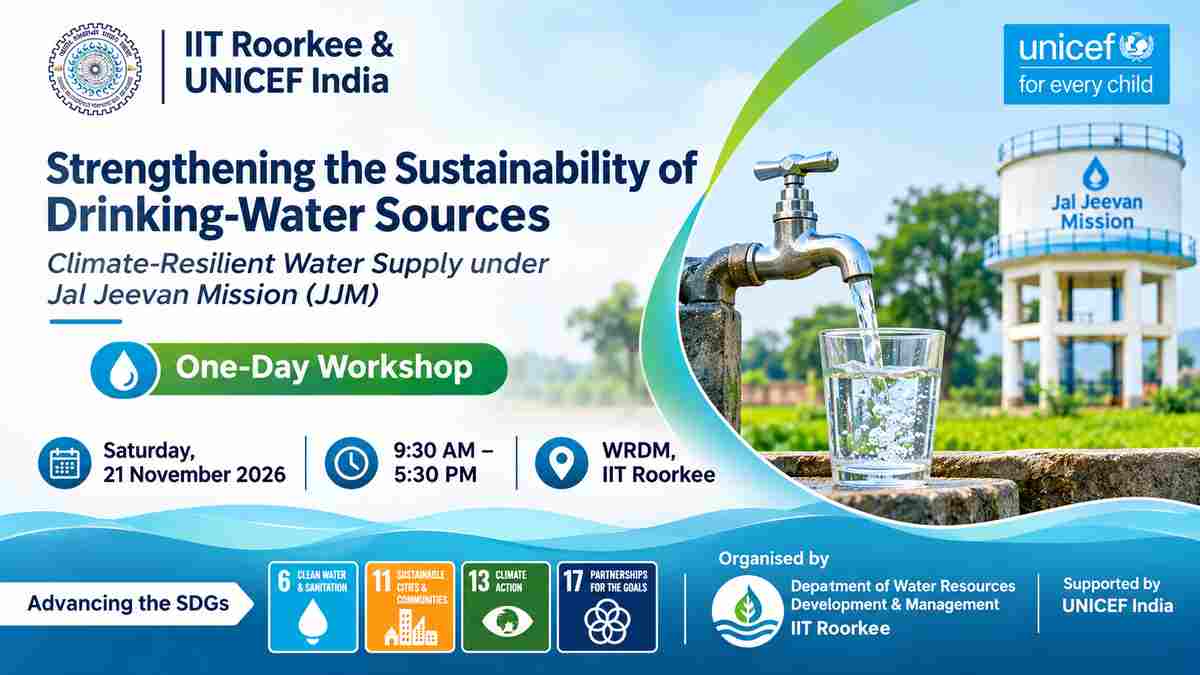
IIT Roorkee and UNICEF India will host a Workshop on Climate Resilient Drinking Water Supply, as part of the Jal Jeevan Mission on 21st November.
Roorkee: Reliable drinking water is more than providing household tap connections. The water source that gets mapped to those connections should also remain reliable under various climate change impacts, including shifting rainfall patterns and depleting groundwater. Recognizing this challenge, the Department of Water Resources Development and Management (WRDM) at IIT Roorkee, with support from UNICEF India, will organize a one-day workshop on strengthening the sustainability of drinking water sources, as part of the Jal Jeevan Mission (JJM).
The workshop, titled “Strengthening the Sustainability of Drinking-Water Sources: Planning and Practices of Climate Resilient Water Supply under Jal Jeevan Mission (JJM)”, will take place on 21st November 2026 from 9.30 am to 5.30 pm at the WRDM, IIT Roorkee. It aims to bring together participants from diverse backgrounds to discuss practices and approaches that can be adopted for integrating resilience to climate challenges in drinking water systems.
IIT Roorkee Workshop 2026: Date, Time and Venue
This is a one-day workshop for which participants will be trained on how to plan for ensuring reliability of water sources in the context of JJM.
|
Particular |
Details |
|
Workshop date |
November 21, 2026 |
|
Day |
Saturday |
|
Timing |
9:30 AM to 5:30 PM |
|
Venue |
WRDM, IIT Roorkee |
|
Organising department |
Department of Water Resources Development & Management |
|
Supporting organisation |
UNICEF India |
|
Theme |
Climate-resilient drinking-water supply under JJM |
|
Format |
One-day workshop |
The announcement provides the name of the organizers and the schedule of the event but does not provide an session-wise program or a confirmed participant list.
Why Drinking-Water Source Sustainability Matters Under JJM
A household tap connection may improve access to drinking water, but its usefulness will depend on the sustainability of the source to provide sufficient water in the long-term. Variability in rainfall and prolonged dry periods can impact the availability of both groundwater and surface water. Changing land use, and local environmental stresses can also impact availability and sustainability of water sources.
Due to the above mentioned reasons, sustainability of water sources is integral to long term rural water security. It is important to consider the sustainability of water sources to inform plans for the provision of rural drinking water supply systems. The goal of the Jal Jeevan Mission (JJM) is to provide a rural household tap connection. The broader implementation of the JJM includes the sustainability of the source, water quality, community participation, and operation and maintenance of the system.
UNICEF India has supported state governments to identify and assess climate change-related risks and integrate climate resilient practices in water supply systems planning. The training and assessments undertaken by UNICEF India with IIT Roorkee have focused on technical advice and capacity building to address climate change. The planning approaches used to address climate change are also applicable to different water management approaches and practices. The upcoming workshop will address these management approaches and practices.
What Will the Workshop Cover?
The programme will provide an opportunity for people working in different fields (research, policy and practice) to share knowledge on climate-resilient water supply. The key themes to be discussed will include:
- Sustainability of water sources: Planning to ensure that adequate supplies of groundwater and surface water are available now and in the future.
- Climate resilience: Assessing how different climate-change related risks affect the availability and reliability of water supply.
- Planning approaches: Considering sustainability of water sources in water supply planning under the JJM.
- Practices: Sharing practical experiences in the field related to water management and implementation.
- Coordination: Promoting collaboration among technical and practitioner fields as well as institutions engaged in the provision of drinking water services.
It is important to consider both practices and planning because water-supply resilience is affected by many factors at various levels including assessments and local implementation.
Four Sustainable Development Goals Represented by the Workshop
The programme is aligned to four United Nations Sustainable Development Goals (SDGs) and demonstrates the critical role of water in the goal of creating sustainable communities and in climate action.
|
Sustainable Development Goal |
Connection with the workshop |
|
SDG 6 – Clean Water and Sanitation |
Supporting sustainable and reliable drinking-water sources |
|
SDG 11 – Sustainable Cities and Communities |
Strengthening the resilience of water services and communities |
|
SDG 13 – Climate Action |
Addressing climate-related risks to water availability |
|
SDG 17 – Partnerships for the Goals |
Encouraging institutional and technical collaboration |
The workshop is also concerned with extending water service infrastructure. It focuses on the ecological and institutional frameworks to guarantee the sustainability of drinking water services.
Where Will the IIT Roorkee - UNICEF Workshop be Held?
The workshop will be hosted at the Department of Water Resources Development and Management at IIT Roorkee on 21 November. The announcement doesn't mention a separate registration deadline, participation fees or clear eligibility criteria.
Participants are suggested to visit the department website for the latest information on registration and any other changes to the workshop.
Frequently Asked Questions
1. When will the IIT Roorkee drinking-water sustainability workshop be held?
The workshop will be held on November 21, 2026.
2. What are the timings of the workshop?
The workshop will be held from 9:30 am to 5:30 pm.
3. Who is conducting the workshop?
The department of Water Resources Development and Management at IIT Roorkee, in collaboration with UNICEF India.
4. What is the main subject of the workshop?
The workshop aims to enhance the sustainability of drinking-water sources through the implementation of climate-resilient planning and practices for the Jal Jeevan Mission.
5. Where will the workshop be conducted?
The venue is WRDM, IIT Roorkee.
6. Which of the Sustainable Development Goals are related to the workshop?
The workshop is related to SDG 6, SDG 11, SDG 13, SDG 17.
7. Who can participate in the workshop? are students and the general public allowed?
Participation is not restricted. Interested participants can visit the official department webpage of IIT Roorkee.
Click Here for More Latest News