
-
An international research team led by GSI/FAIR in Germany measured the chemical bond strength in seaborgium hexacarbonyl for the first time, revealing that relativistic effects weaken the bond more than expected.
Roorkee, Uttarakhand, October 22, 2026: Researchers from the Indian Institute of Technology (IIT) Roorkee have contributed to an international scientific study that measured the chemical bond strength in a compound of a superheavy element for the first time. The research, led by scientists at GSI/FAIR in Darmstadt, Germany, examined seaborgium hexacarbonyl, Sg(CO)₆, and found that its chemical bond is weaker than expected from established periodic trends.
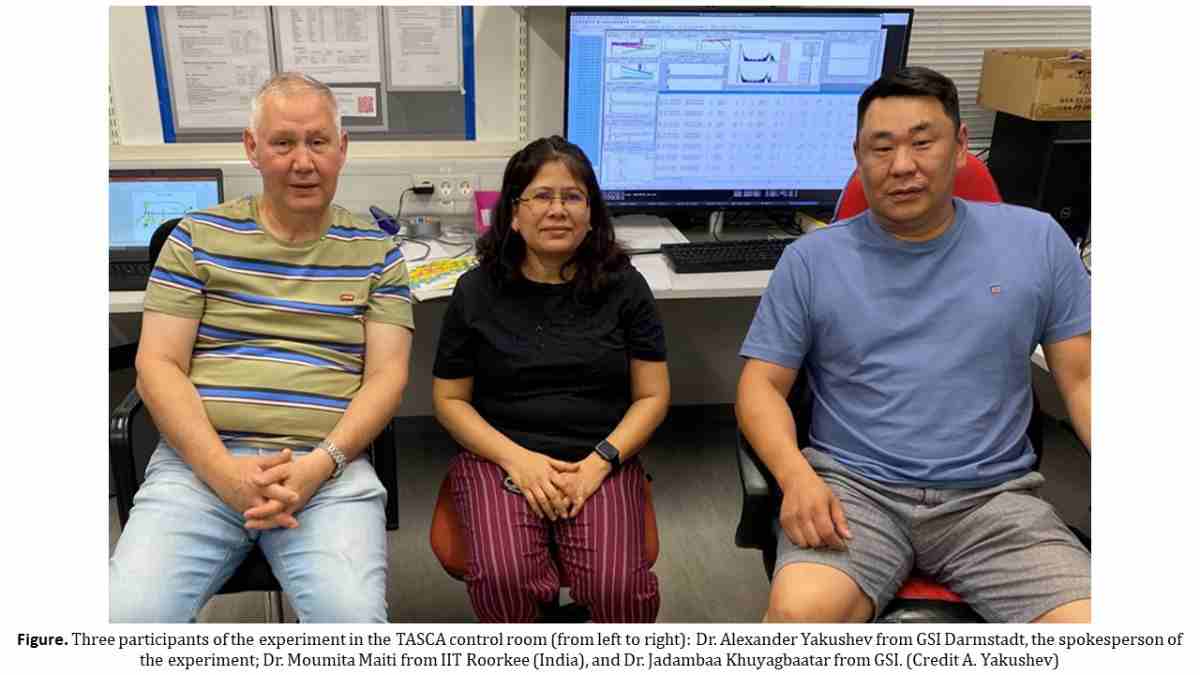
The findings, published in the journal Nature, provide experimental evidence of how relativistic effects influence the chemical properties of elements at the extreme end of the periodic table. Prof. Moumita Maiti of IIT Roorkee participated in the experiment as part of the international collaboration.
First Experimental Measurement of Seaborgium Bond Strength
The study focused on seaborgium, a superheavy element with atomic number 106. The researchers investigated its hexacarbonyl compound, in which a central seaborgium atom is bonded to six carbon monoxide (CO) ligands.
The experiment determined that the first bond dissociation energy of Sg(CO)₆ is approximately 188 kilojoules per mole. This value is around 4 kilojoules per mole lower than that of the corresponding tungsten compound, W(CO)₆.
The result challenges the expected pattern among Group 6 elements. The bond strength in hexacarbonyl compounds increases from chromium to molybdenum and tungsten. Researchers had expected seaborgium to continue this trend, but the measurements revealed a reversal.
How Relativistic Effects Influence Superheavy Elements
Superheavy elements, generally defined in this research context as elements with atomic numbers from 104 to 118, are produced artificially through nuclear reactions at particle accelerators. Their production rates can be extremely low, and many have short radioactive lifetimes, making experiments particularly difficult.
At the high nuclear charges of these elements, electrons close to the nucleus can reach velocities at which relativistic effects become significant. These effects alter the energies and distribution of atomic electrons, changing the electronic structure and, consequently, the chemical behaviour of the elements.
In seaborgium, relativistic effects destabilise the 6d atomic orbitals involved in bonding. This weakens interactions between the seaborgium atom and carbon monoxide ligands, explaining why the measured bond strength does not follow the trend observed for lighter Group 6 elements.
The experimental result agrees with advanced quantum-chemical calculations that account for relativistic effects.
How Scientists Conducted the Experiment
The research team produced the short-lived isotope seaborgium-259 at the GSI/FAIR facility in Germany. For comparison, the scientists also produced short-lived tungsten isotopes, allowing the two elements to be studied under similar experimental conditions.
The atoms were isolated using TASCA, the TransActinide Separator and Chemistry Apparatus. They were then introduced into a gas mixture containing helium and carbon monoxide, where chemical reactions could form carbonyl compounds.
The experimental setup used two detector arrays to distinguish volatile hexacarbonyl complexes from other reaction products. The complexes could travel through the first detector channel and reach a second, cooled detector, where they were captured and identified through their radioactive decay.
Researchers registered 75 seaborgium events, of which three were identified in the detector associated with the hexacarbonyl compound. Comparing these observations with the tungsten results enabled the team to determine the relative bond strength.
The experiment illustrates how chemical properties can be studied even when only individual atoms of a superheavy element are available.
IIT Roorkee’s Contribution to International Research
Prof. Moumita Maiti of IIT Roorkee participated in the experimental measurements alongside researchers from GSI/FAIR and other institutions. The collaboration brought together expertise in nuclear science, experimental chemistry, detection techniques and theoretical calculations to investigate a chemical property that had remained difficult to measure directly.
Commenting on the work, Prof. Maiti said that studying superheavy elements requires specialised techniques, precision and close international collaboration. She noted that combining expertise across institutions makes it possible to investigate chemical bonding under the influence of relativistic effects and improve understanding of these complex elements.
The study also involved researchers affiliated with the Helmholtz Institute Mainz, Johannes Gutenberg University Mainz, the Czech Technical University in Prague, the University of Liverpool, the Japan Atomic Energy Agency and the University of Jyväskylä, among other participating institutions.
Why the Findings Matter
The research provides a new experimental basis for understanding how chemical bonding changes in superheavy elements. By measuring bond strength rather than relying solely on theoretical predictions, scientists can test models of atomic structure under extreme conditions.
The findings may also help researchers develop methods for investigating compounds of even heavier elements. The international team is preparing further experiments to extend chemical studies beyond seaborgium.
The work represents a significant step in exploring the limits of the periodic table and understanding how fundamental physical effects shape the chemical behaviour of the heaviest known elements.
Frequently Asked Questions (FAQs)
1. What is the key finding of the IIT Roorkee-associated research?
The international team measured the chemical bond strength in seaborgium hexacarbonyl, Sg(CO)₆, for the first time and found that its bond is weaker than expected from periodic trends.
2. Which superheavy element was studied?
The researchers studied seaborgium, symbol Sg, which has atomic number 106.
3. What role did IIT Roorkee play in the research?
Prof. Moumita Maiti of IIT Roorkee participated in the experimental measurements as part of the international research collaboration.
4. Where were the findings published?
The study, titled “Observation of relativistic bond weakening in seaborgium hexacarbonyl,” was published in the journal Nature in October 2026.
5. What are relativistic effects in superheavy elements?
They are effects on electron behaviour that become important because electrons close to the nuclei of very heavy atoms move at a significant fraction of the speed of light. These effects alter electronic structure and chemical bonding.
6. How much weaker was the seaborgium–carbon monoxide bond?
The measured first bond dissociation energy of Sg(CO)₆ was about 4 kilojoules per mole lower than that of the comparable tungsten hexacarbonyl compound.
7. Why is studying superheavy elements difficult?
These elements are produced in extremely small quantities through nuclear reactions, sometimes at rates of only a few atoms per day, and their short radioactive lifetimes make chemical measurements challenging.
8. What could researchers study next?
The team is preparing further experiments to investigate the chemical properties of elements heavier than seaborgium.
Click Here for More Science & Technology