
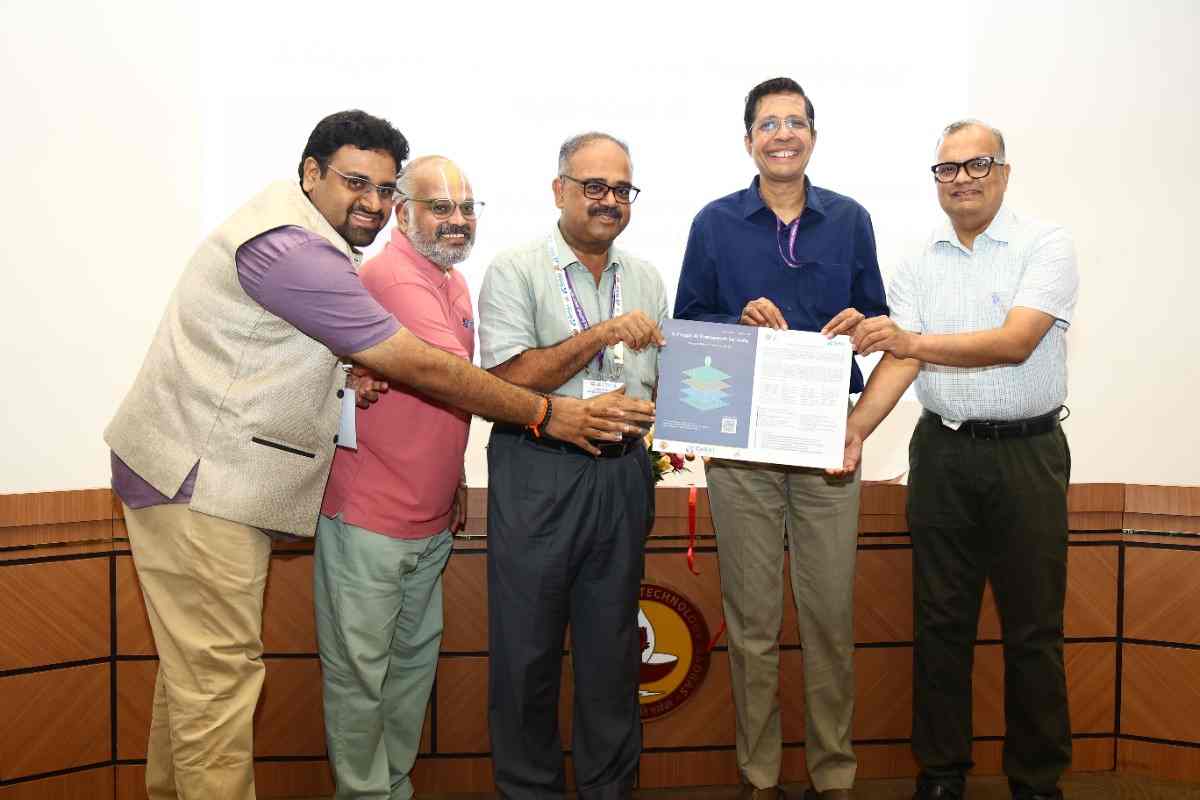
Photo : (L_R) Dr Gokul S Krishnan, Mr Venkatraghavan KS, Prof Balaraman Ravindran, Prof V Kamakoti & Prof Balkrishna C Rao releasing Frugal AI white paper.JPG
CHENNAI, 19th November 2026: Indian Institute of Technology Madras (IIT Madras) Wadhwani School of Data Science and Artificial Intelligence (WSAI) researchers are proposing that India adopts a Responsible Frugal AI Framework.
They are calling for a shift towards developing and deploying artificial intelligence systems that deliver maximum public value with minimum computational resources, energy and financial investment.
The white paper titled ‘A Frugal AI Framework for India from CeRAI’, presents a third path to India between replicating capital-intensive frontier-model programmes and remaining a downstream adopter of foreign AI. It recommends that India prioritise smaller, specialised, domain-specific and multilingual AI systems designed around the country’s requirements, infrastructure realities and diverse population.
The white paper can be downloaded from - https://cerai.iitm.ac.in/docs/Frugal_AI_Framework_India_Framework_Paper.pdf
The white paper was authored by Prof. Balaraman Ravindran, Head, Centre for Responsible AI (CeRAI) and WSAI, IIT Madras, Mr. Venkataraghavan KS, Senior Advisor, CeRAI, IIT Madras, Dr. Gokul S Krishnan, Research Director, CeRAI, IIT Madras, Prof. Balaji Srinivasan, WSAI, IIT Madras and Prof. Balkrishna C. Rao, Department of Engineering Design, IIT Madras.
It was released by Prof. V. Kamakoti, Director, IIT Madras, during the recently-held ‘Industry Conclave on AI Governance 2026’.
Speaking about the launched paper and the need for Frugal AI for the Indian ecosystem, Prof. V Kamakoti, Director, IIT Madras, said, “AI does not have to know everything to be useful. It has to know the right things, deeply, for the task at hand. Much of today’s AI uses enormous amounts of electricity and water to do tasks that a smaller, well-designed model can do as well. India needs AI that is useful, affordable and sustainable. India’s strength has always been frugal engineering, and this paper shows the scope to build AI that is right-sized, effective, responsible and sustainable”.
The framework in the paper introduces the concept of ‘Responsible Frugal AI’, which combines the principles of frugal engineering with Responsible AI. It advocates building AI systems that meet clearly defined functional requirements while using the least possible resources, without compromising reliability, robustness or accountability.
Elaborating on the key recommendations, Prof. Balaraman Ravindran, Head, CeRAI and WSAI, IIT Madras, said, “India does not need to replicate the capital-intensive AI development models pursued by countries such as the US and China, nor remain a downstream adopter of foreign AI technologies. Instead, it can develop an approach rooted in its own strengths in frugal innovation, engineering capabilities and digital public infrastructure.”
Dr. Gokul S Krishnan, Research Director, CeRAI, IIT Madras, added, “An important recommendation in our paper is for India to move away from the assumption that larger AI models are necessarily better. Our framework calls for first establishing whether AI is required for a particular task and then identifying the smallest sufficient AI model or technique capable of delivering the desired outcome. It also recommends considering simpler alternatives, including rules-based systems, retrieval-based approaches and conventional machine learning, wherever these can adequately address the problem.”
KEY RECOMMENDATIONS OF THE WHITE PAPER
The white paper outlines several recommendations to guide India's AI development and deployment strategy.
It calls for making frugality the default engineering principle for public-interest AI, with priority given to right-sized, specialised and multilingual systems rather than increasingly large models developed primarily for benchmark performance or prestige.
It also recommends that public investment focus on building shared AI infrastructure and common technology platforms, rather than creating isolated and duplicative systems. Such shared AI infrastructure, or public AI rails, can enable wider access, reduce development costs and support deployment across government departments and public institutions.
On AI sovereignty, the white paper advocates developing modular and interoperable systems that India can design, deploy, operate, inspect, maintain and adapt independently. It emphasises that sovereignty should be measured by the country's ability to exercise control over AI technologies and their underlying infrastructure, rather than simply by ownership of large AI models.
Recognising India's linguistic and infrastructural diversity, it calls for multilingual and vernacular-first AI development, with systems tested under real-world Indian conditions, including varying internet bandwidth, device capabilities, energy availability and institutional constraints.
The framework also recommends selective use of Generative AI, limiting it to applications where generating new content is essential to the task. Public AI systems, it says, should be evaluated on their actual utility per unit of resource, performance under real deployment conditions, resource consumption, accountability and social value rather than raw model capabilities or benchmark scores.
Another important recommendation is to distribute Frugal AI capabilities across ministries, State governments, universities and public institutions. The white paper also calls for aligning advanced frugal innovation principles with the India AI Governance Guidelines (2025), supported by practical implementation guidance. It further recommends publishing incidents and failures arising from Frugal AI deployments to facilitate learning and improve future implementations.
SEVEN-POINT CHECKLIST
To translate these principles into practice, the white paper proposes a seven-point adoption checklist for organisations and public institutions considering AI deployment.
1. The first requirement is to establish whether AI is genuinely necessary and whether it offers measurable improvements in public value or workflow performance compared with simpler alternatives.
2. Second, deployment constraints, including power availability, internet bandwidth, device capabilities, capital and operational expenditure, carbon budgets and regulatory requirements, must be defined before selecting a model.
3. Third, organisations must demonstrate why the smallest sufficient model has been selected, including whether smaller, specialised or composable models and alternatives were considered.
4. The AI solutions should be tested in real scenarios according to the environment of the Indian context.
5. Resource utilization metrics should be tracked throughout the lifecycle of the AI solution. This includes computing requirements, memory, latency, power usage, cost over the lifetime, and expenditure in proportion to the output. The framework highlights that cost of AI cannot be measured as a one-off metric but instead by measuring the cost over the lifetime of the solution (data collection, training, deployment, maintenance, retraining and decommissioning).
6. Total cost of ownership including GPU costs, bandwidth, vendor lock-in and re-training costs should be considered by Institutions.
7. And finally, AI systems must have proper documentation, auditing, human oversight and manual methods. This is especially important when making consequential decisions.
Click Here for More Latest News