
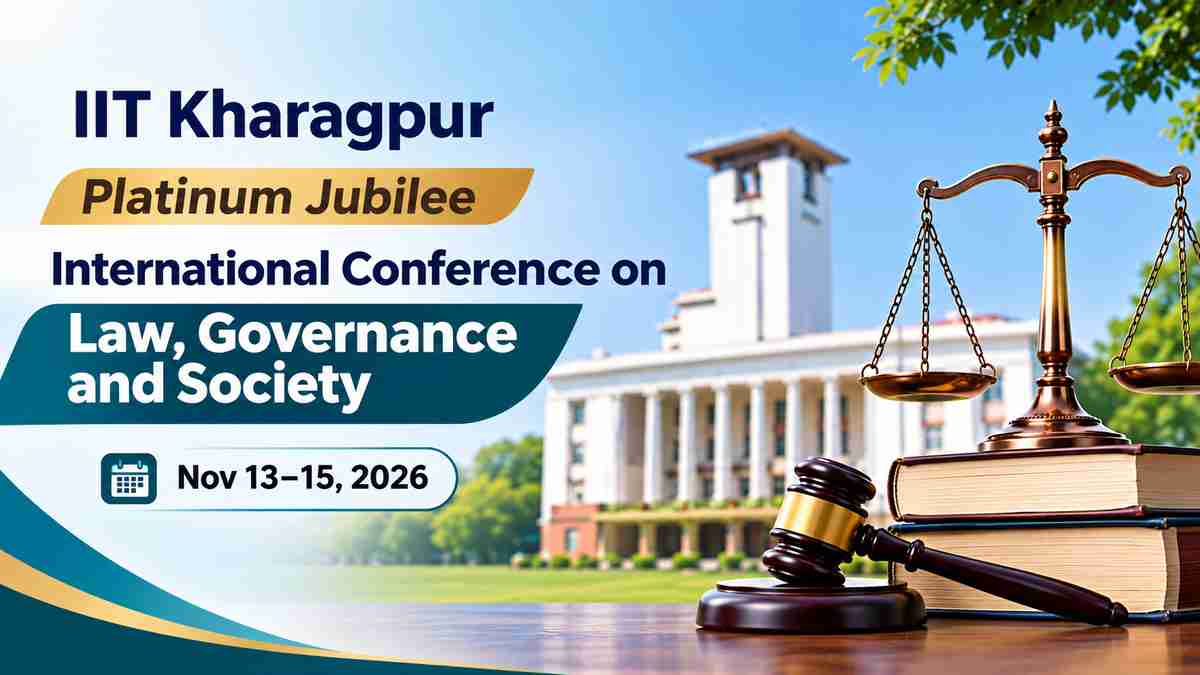
IIT Kharagpur Hosts Platinum Jubilee International Conference on Law, Governance and Society
West Bengal: With a world of increasing complexities surrounding artificial intelligence, environmental concerns, societal inequalities and accountability, the role of law and governance has also evolved. IIT Kharagpur is hosting an academic International Conference focusing on the role of society in law and governance. The Platinum Jubilee International Conference on Law, Governance and Society is being held from the 13th-15th November 2026 at the Indian Institute of Technology Kharagpur in West Bengal.
The conference, which is part of the institute's 75th anniversary celebrations, will bring together academics, legal professionals, policymakers, researchers, industry professionals and students to discuss how Legal Systems and governance can adapt to an ever-changing world. This conference is especially relevant as new technologies, environmental concerns and societal changes are challenging traditional Legal Systems. The conference encourages interdisciplinary research.
Why is IIT Kharagpur Hosting this Conference?
IIT Kharagpur was founded in 1951 and was the first Indian Institute of Technology in the country. The Platinum Jubilee is providing an opportunity to look into the future of law, policy and governance. The main question of the conference is how we can adapt our legal and governance systems to meet the needs of society.
The conference will investigate how the Legal Systems can adapt to meet the needs of people. Issues like what rights are being protected, who is having their voice heard and who is being left out will be discussed. The conference will try to bring together a range of different sectors. This includes academia, government, industry and civil society. The goal of the institute is to encourage interdisciplinary research.
Five Major Themes to Shape the Conference Discussions
The conference has 5 main themes:
1. Rights, Technology and Society: Law in the Age of Algorithms
This theme looks at how artificial intelligence, data and algorithms have impacted law. Topics may include privacy, transparency, discrimination, digital evidence, cybercrime and how technology has impacted our fundamental rights.
2. Pluralism, Language Rights and Cultural Justice
This theme looks at how we can protect our cultural identity, Language Rights, indigenous knowledge and ensure society is inclusive. It will also look at how decentralised governance and ecological restoration can help communities who may be at risk of losing their cultural and environmental knowledge.
3. Sustainable Rural Development
This theme looks at how we can improve rural infrastructure and transform livelihoods. It will also look at how we can make rural areas more resilient to climate change and manage natural resources. Panchayats, participatory governance and policies to meet the needs of women and marginalised groups will also be looked at.
4. Bhartiya Gyan: Past, Present and Future
This theme looks at Indian Knowledge Systems and how traditional laws, indigenous democracy, historical knowledge and modern policy can be used. It will also look at how relevant NEP 2020 is and how technology can be used to preserve and develop traditional knowledge.
5. Envisioning Law and Legal Systems in Viksit Bharat
This theme looks at how we can create Legal Systems that will help create an inclusive society. Topics include corporate governance, environmental, social and governance (ESG), constitutional rights, intellectual property, administrative justice and democratic accountability.
Who Can Attend the IIT Kharagpur Conference 2026?
Anyone interested in attending can attend. This includes:
- Academicians and researchers
- Legal professionals and practitioners
- Policymakers and government officials
- Industry experts and technologists
- Civil society organisations
- Students of law, policy, social sciences and technology
The conference will give an opportunity to share research between different disciplines.
Call for Papers: Submission and Formatting Requirements
The conference is calling for original research papers on the 5 themes and related topics. Submissions should be made using the form provided in the uploaded brochure.
|
Submission Requirement |
Details |
|
Abstract length |
500–800 words |
|
Full paper length |
8,000–10,000 words |
|
Font |
Times New Roman |
|
Main text size |
12 |
|
Footnote size |
10 |
|
Line spacing |
1.0 |
|
Citation style |
OSCOLA |
|
Maximum co-authors |
Two |
You must include the title of your paper, your name(s), your affiliation and contact information. You can only submit one abstract per author. If you have two authors on your paper you both must pay the registration fee. The deadline for submission of your abstract is 30th June 2026. You will be notified if your paper has been accepted by 15th July 2026. Full papers must be submitted by 31st July 2026. Registration will close on 15th August 2026.
Registration Fees and Publication Opportunity
The brochure lists the following registration charges:
|
Participant Category |
Registration Fee |
|
Academicians and professionals |
₹5,000 |
|
Research scholars and students |
₹2,000 |
|
International participants |
USD 150 |
High quality papers will be considered for publishing in an edited book. There is no guarantee your paper will be published.
Conference Organisers and Official Contact Details
The conference is organised by the Rajiv Gandhi School of Intellectual Property Law, Centre of Excellence in Public Policy Law and Governance, Department of Humanities and Social Sciences, Centre for Rural Development and Innovative Sustainable Technology, Centre of Studies and Research for Differently Abled and Centre of Excellence for Indian Knowledge Systems at IIT Kharagpur.
Convenors: Prof. Dipa Dube, Prof. Uday Shankar, Prof. Somnath Ghosal and Prof. Amrita Sen. Queries can be sent to:
- Email: convenor.pjcls@gmail.com
- Tel: 03222-281734 / 282237
- Conference Secretariat Rajiv Gandhi School of Intellectual Property Law IIT Kharagpur West Midnapur West Bengal - 721302
This conference is very significant as it looks at a range of issues such as regulation of artificial intelligence, improving rural governance and protecting cultural rights. As IIT Kharagpur celebrates its 75th anniversary it provides an opportunity to look at how law and policy can adapt to meet the needs of a society that is changing rapidly.
FAQs
1. When is the IIT Kharagpur International Conference on Law, Governance and Society 2026?
November 13-15, 2026 at IIT Kharagpur, West Bengal, India
2. What is the main objective of the IIT Kharagpur conference?
It is to consolidate researchers, legal professionals, policymakers and other end-users to interrogate contemporary challenges of law, governance, technology and society.
3. What are the five themes of the conference?
The themes are, Rights & Technology, Pluralism & Cultural Justice, Sustainable Rural Development, Bhartiya Gyan, and Legal Systems in Viksit Bharat.
4. Who can participate in the conference?
Researchers and Academicians, Legal Professionals, Policymakers, Government Officials, Industry Experts, Representatives of Civil Society Organizations, and Students of related fields.
5. What was the requirement for abstract submission?
The brochure asked for abstracts of 500-800 words, and full-length papers of 8000-10000 words, using Times New Roman and OSCOLA citation.
6. What was the registration fee for the IIT Kharagpur conference?
As per the brochure, the registration fees was ₹5000 for Academicians and Professionals, ₹2000 for Research Scholars and Students and USD 150 for International Participants.
7. Will conference papers be published?
Yes, if the papers are of high quality, they will be published in an edited volume.
Click Here for More Latest News