
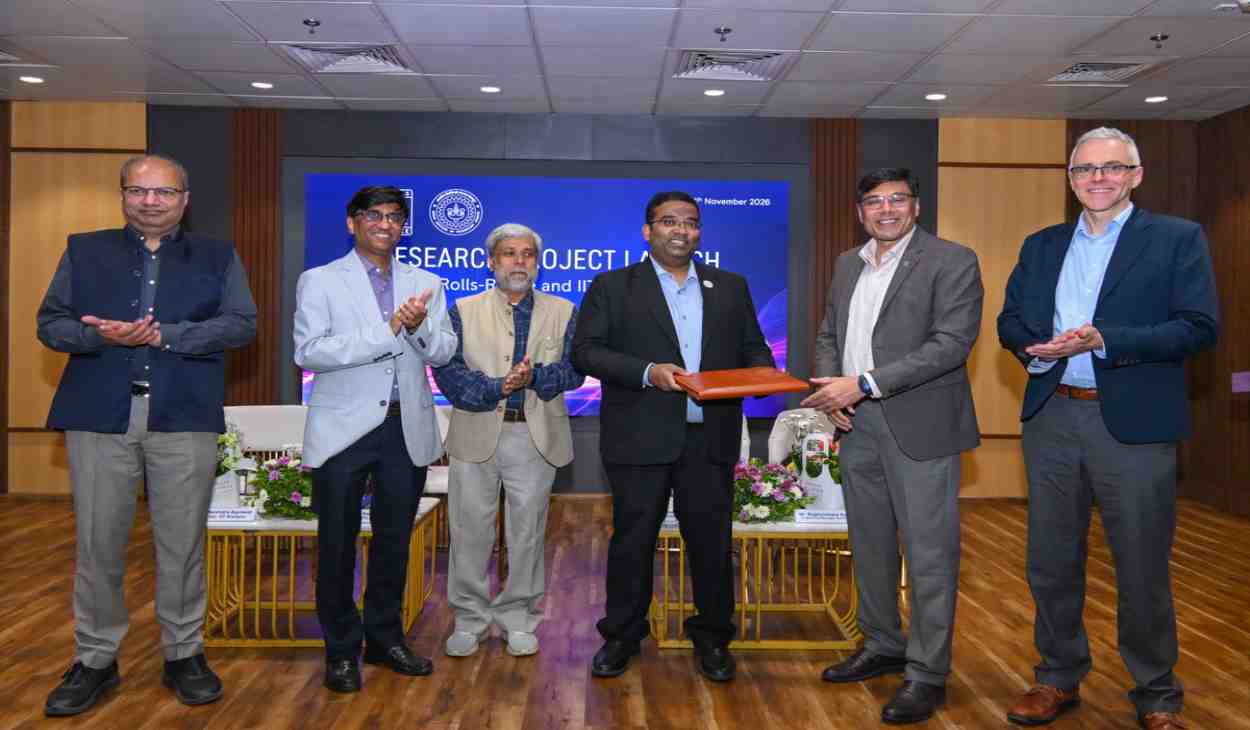
Kanpur: The Indian Institute of Technology (IIT) Kanpur and British aerospace and propulsion major Rolls-Royce have launched a six-month joint research initiative focused on Engine Vibration Related Noise (EVRN) to advance aircraft cabin noise reduction and enhance passenger comfort.
Launched on November 25, 2026, at the IIT Kanpur campus, the project marks Phase 1 of a broader industry–academia research program formalized under a Memorandum of Understanding (MoU) signed earlier in 2026 between Rolls-Royce India and IIT Kanpur.
The launch ceremony was attended by Prof. Abhay Karandikar, Member of NITI Aayog; Prof. Manindra Agrawal, Director of IIT Kanpur; Andy Rix, Associate Fellow, Rotor Dynamics, Rolls-Royce Plc; and Raghavendra Saroor, Program Manager, Future Defense Programs, Rolls-Royce, alongside senior institute faculty and company representatives.
IIT Kanpur – Rolls-Royce Cabin Noise Reduction Project: Key Overview
How the Research Project Works: Numerical Modeling Meets Experimental Fuselage Rig
While modern aero-engines such as Rolls-Royce’s Trent XWB already incorporate advanced acoustic technologies, engine-induced structural vibrations transmitted through the airframe remain a major contributor to noise inside aircraft cabins. Following a systems engineering approach, the joint team will examine this interplay through three core steps:
-
Experimental Aircraft Fuselage Model: Researchers at IIT Kanpur are establishing an integrated system-of-systems experimental fuselage test rig designed to replicate an aircraft under in-flight conditions.
-
Simulated Engine Vibration & Sensor Array: A controlled mechanical vibration source—representing an operating aircraft engine—is paired with an array of state-of-the-art vibration and acoustic sensors to track how structural vibrations propagate through the airframe and convert into cabin noise.
-
Numerical Methodology Validation: Experimental data gathered from the IIT Kanpur test-rig will be used to validate a numerical methodology developed by Rolls-Royce, generating reliable insights to guide future aircraft noise-suppression technologies.
1. Strengthening Deep-Tech Ecosystems and Student Talent
Commenting on the launch, Prof. Manindra Agrawal, Director of IIT Kanpur, stated that establishing and operating the experimental test-rig at IIT Kanpur will generate reliable insights into vibration transmission and noise-reduction strategies while strengthening the institute’s deep-tech ecosystem by connecting academic research directly with industry requirements.
Sashi Mukundan, Executive Vice President, Rolls-Royce India, emphasized that industry–academia collaborations play a vital role in advancing applied research, building local engineering capabilities, and preparing next-generation talent through joint projects, internships, and knowledge-sharing initiatives.
2. Potential for Multi-Phase Expansion
The current six-month project is structured as Phase 1 of the research program. Based on the experimental milestones and acoustic validation achieved over the next six months, IIT Kanpur and Rolls-Royce plan to explore subsequent research phases targeting practical aerospace noise-mitigation designs.
Important Links
-
IIT Kanpur Official Website & Press Release:
[https://www.iitk.ac.in/research-project-on-aircraft-cabin-noise-reduction](https://www.iitk.ac.in/research-project-on-aircraft-cabin-noise-reduction) -
Rolls-Royce Official Website:
[https://www.rolls-royce.com](https://www.rolls-royce.com)
Frequently Asked Questions (FAQs)
1. What is the objective of the joint research project between IIT Kanpur and Rolls-Royce? The project aims to study Engine Vibration Related Noise (EVRN)—specifically how engine-induced structural vibrations travel through an aircraft’s airframe and generate cabin noise—and to explore strategies to reduce cabin noise and improve passenger comfort.
2. How long is the IIT Kanpur–Rolls-Royce research project? The initiative is a six-month research project undertaken as Phase 1, with the possibility of subsequent phases depending on project outcomes.
3. How will researchers test aircraft cabin noise at IIT Kanpur? IIT Kanpur is setting up an experimental aircraft fuselage test-rig featuring a mechanical vibration source (simulating an engine) alongside advanced vibration and acoustic sensors to validate a numerical methodology developed by Rolls-Royce.
4. When was the IIT Kanpur and Rolls-Royce research project launched? The project was officially launched on November 25, 2026, at IIT Kanpur in the presence of NITI Aayog Member Prof. Abhay Karandikar, IIT Kanpur Director Prof. Manindra Agrawal, and senior Rolls-Royce executives.
5. What opportunities does this collaboration create for engineering students? Under the broader MoU between Rolls-Royce India and IIT Kanpur, the partnership supports joint research projects, student internships, knowledge exchange, and specialized skill development in aerospace and deep-tech engineering.
Click Here for More Latest News