
Guwahati, 26th October 2026: Indian Institute of Technology Guwahati (IIT Guwahati) researchers have studied the ways in which the plumbing system in plants behaves when they are subjected to drought-induced water stress. A plumbing system in plants allows water and nutrients to be transported within them, which helps in plant growth. The stem of a plant contains microtubes called xylem, which carry water from the roots to the leaves. These microtubes are interconnected through tiny openings called pits. The pits ensure that water and other nutrients move smoothly, with no blockages. Scientists worldwide are trying to understand how these xylem vessels behave during times of drought but have not made much progress. Computational modelling studies treated these xylem as rigid pipes and thus could not accurately show how plants adjust during times of water shortage.
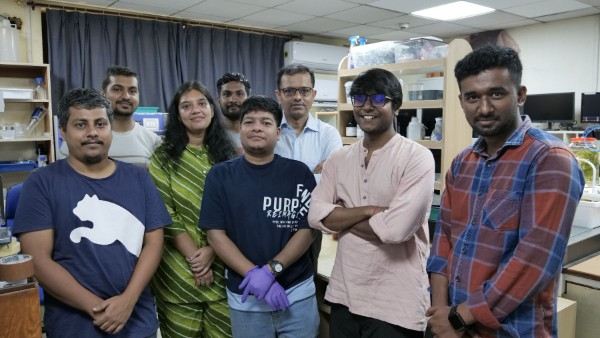
To bridge this knowledge gap, Prof. Pranab Kumar Mondal, Professor, Department of Mechanical Engineering, IIT Guwahati, along with his research team, combined experimental studies with realistic 3D computer simulations. The team experimentally measured the changes in dimensions, mechanical strength, and wall characteristics of the system, as well as the changes to the pit openings during times of water stress. Explaining the research, Prof. Pranab Kumar Mondal said, “We studied the stems of the Indian mustard plant using advanced imaging, microscopic force measurements, and chemical tracking. We then precisely mapped how drought alters the xylem in terms of wall elasticity and fluid movement. These measurements were used to build realistic 3D models. These models showed how plants reorient their xylem to optimise water transport during drought.”
The research showed that in times of acute water shortages, the microtubes within the plants become narrower and the pits become smaller, which increases resistance to fluid flow within the plant. Thus, water does not move easily up the stem. This prevents loss of water through transpiration at the top of the plant. Additionally, the researchers found that, in this process, water starts flowing sideways across the pits, maintaining water balance within the plant and preventing the breakdown of the tube network. Speaking about the real-world impact of this study, Prof. Mondal said, “This research will help us better understand how plants survive under water-scarce conditions. In the future, these insights may help scientists develop crop varieties that are more drought-tolerant and can use water more efficiently. Such knowledge could contribute to more sustainable agriculture and help maintain crop productivity in the face of climate change.”
The findings of this research can help scientists breed crop varieties that are more resistant to drought. These findings can also help farmers protect crops during water shortages, reduce losses, and support agricultural productivity in regions affected by changing climate conditions. The findings of this research have been published in the prestigious Applied Physics Reviews journal in a paper co-authored by Prof. Pranab Kumar Mondal, and Mr. Jinmay Kalita, research scholar of the Department of Mechanical Engineering at IIT Guwahati. Dr. Sumit Kumar Mehta, ANRF - National Post-Doctoral Fellow, worked in the Department of Mechanical Engineering at IIT Guwahati, along with Dr. Suraj Panja, Institute Post-Doctoral Fellow, IIT Guwahati.
The research conducted by the IIT Guwahati research team provides new insights into how plants respond to environmental stress and the development of predictive tools to study plant resilience. By combining experimental observations with realistic computer simulations, the study highlights the importance of integrating physics and plant science to address challenges related to sustainable agriculture and food security.
Click Here for More Institutional Activities