
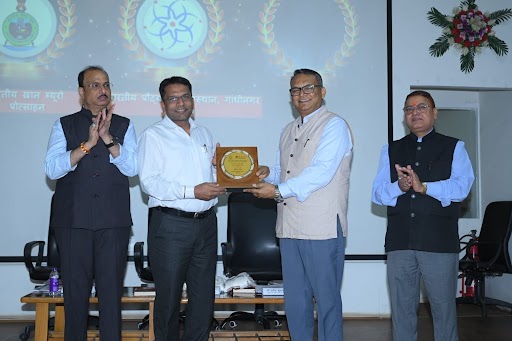
Gandhinagar : As higher education institutions in India strive to balance global academic standards with the promotion of national linguistic identity, an important question continues to emerge. The recent recognition of Indian Institute of Technology Gandhinagar with the TOLIC Gandhinagar Award offers a strong and inspiring answer, highlighting how institutions can successfully integrate excellence with the promotion of Hindi in official work.
In a notable development, IIT Gandhinagar has been awarded the third prize in the Office Category by the Town Official Language Implementation Committee Gandhinagar. This recognition came during the 26th Half Yearly Meeting and Annual Award Ceremony held on April 28, 2026, highlighting the institute’s consistent and structured efforts to promote Hindi in administrative and official communication.
The award was accepted by Mr Vipul Kumar Chaudhary, who serves as Deputy Registrar and In Charge Hindi Officer at the institute. His role has been central in ensuring that Hindi is not only encouraged but also effectively implemented across various levels of official work. This includes documentation, communication practices, and institutional processes that align with the guidelines of the Department of Official Language India.
The recognition is not just symbolic. It reflects a broader shift in how premier institutions like IITs are embracing multilingual communication without compromising efficiency or global relevance. While English continues to dominate academic discourse, the integration of Hindi into official work represents an important step toward inclusivity and accessibility, particularly for administrative staff and stakeholders who are more comfortable in the national language.
What makes this achievement even more meaningful is the collective effort behind it. According to Mr Chaudhary, the success is the result of consistent teamwork among officers and staff. This collaborative approach has helped create an environment where language adoption is not forced but naturally integrated into daily workflows.
The event also witnessed active participation from IIT Gandhinagar staff in various competitions organised by TOLIC Gandhinagar. Among them, Mr Parth Rajendrakumar Mehta received a consolation prize, further showcasing the institute’s engagement beyond formal compliance. Such participation indicates that the promotion of Hindi is being approached not just as a mandate but as a cultural and intellectual initiative.
The ceremony was attended by key figures including Mr Harish Singh Chauhan, Deputy Director Implementation at the Department of Official Language under the Ministry of Home Affairs, and Mr Sunil Sinha, Chairman of TOLIC Gandhinagar. Their presence underscored the importance of institutional participation in advancing the use of Hindi across government and semi government organisations.
But why does this matter in a larger context
India is a linguistically diverse country, and the promotion of Hindi in official domains has long been a policy objective. However, its success depends heavily on how institutions implement it. IIT Gandhinagar’s recognition suggests that structured planning, leadership support, and active participation can make a tangible difference.
It also raises an interesting point about the evolving role of language in education and administration. Institutions are no longer just centres of learning; they are also cultural spaces where identity and communication intersect. By promoting Hindi, IIT Gandhinagar is contributing to a more inclusive administrative culture that respects linguistic diversity while maintaining operational efficiency.
Looking ahead, the institute has expressed confidence in further strengthening the use of Hindi in official work. This includes setting higher benchmarks and continuing to innovate in how language is integrated into institutional practices.
For other institutions, this serves as both inspiration and a roadmap. The recognition by TOLIC Gandhinagar is not merely an award; it is a validation of sustained effort and a reminder that meaningful change often begins with consistent, collective action.
Click Here for More Latest News