
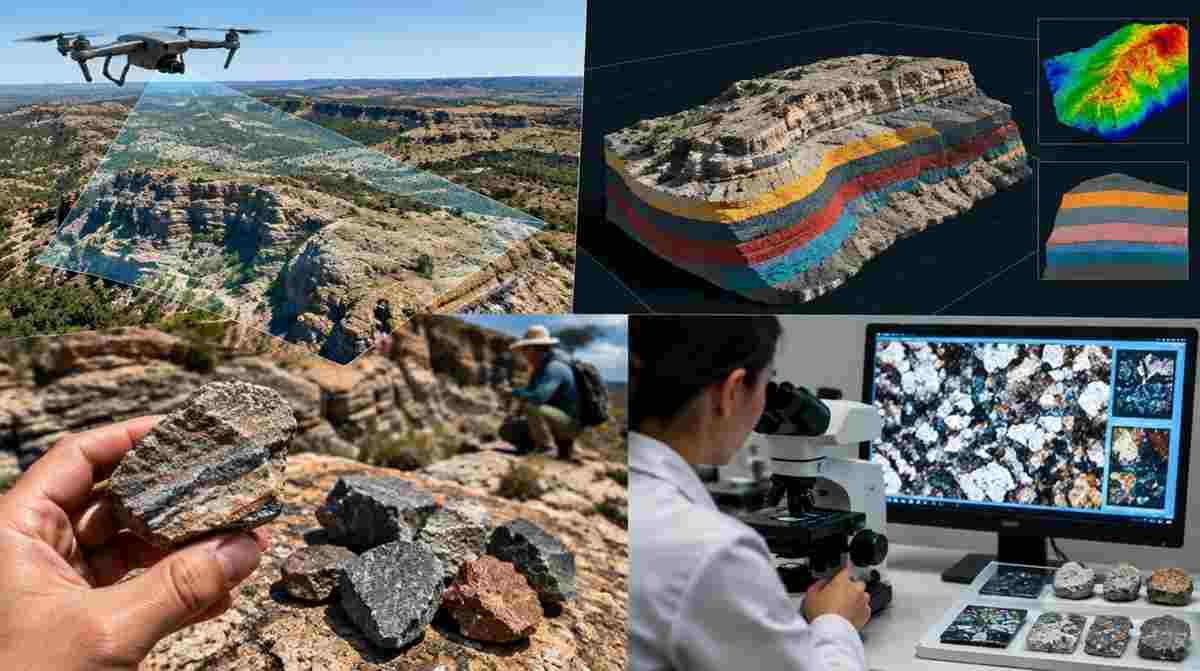
Drone-based 3D modelling and rock analysis of ancient lava flows in Maharashtra offer insights into underground geological formations for long-term CO2 storage.
Gandhinagar (Gujrat) : Researchers at the Indian Institute of Technology Gandhinagar (IITGN) are investigating ancient volcanic rocks in Maharashtra to assess their potential for long-term carbon dioxide (CO2) storage. The study examines how the structure and mineral composition of Deccan basalt formations could influence underground fluid movement and the storage of carbon dioxide through mineralisation.
As global efforts to address climate change intensify, carbon capture and storage (CCS) has emerged as a potential method for reducing the amount of CO2 released into the atmosphere. The technology involves capturing carbon dioxide and storing it in suitable geological formations deep underground. Basalt is attracting scientific interest because certain minerals within the rock can react with dissolved CO2 and convert it into stable carbonate minerals.
Why Deccan Basalt Is Important for Carbon Storage
The Deccan Traps of west-central India comprise extensive volcanic rock formations created by successive lava flows approximately 65 million years ago. These ancient formations provide an important geological setting for investigating whether basalt can support long-term carbon dioxide storage.
However, basalt formations are not uniform. Different lava flows can contain dense rock, fractures, pores, cavities and varying mineral compositions. These characteristics influence how fluids move through the rock and how effectively injected CO2 may interact with reactive minerals.
Understanding these variations is essential for determining whether particular geological formations could be suitable for commercial-scale carbon storage.
Researchers Use Drone-Based 3D Modelling
The IIT Gandhinagar research team investigated seven basalt lava flows at Kumbharli Ghat in Maharashtra's Western Ghats. The study used drone-based photogrammetry to create three-dimensional digital models of exposed rock formations.
Photogrammetry involves combining photographs taken from different positions to reconstruct the shape and structure of a landscape. By mapping individual lava flows, researchers can examine their boundaries, thickness, geometry and structural variations in greater detail.
The team combined this digital mapping approach with rock analysis to develop datasets that can help scientists understand the architecture of Deccan basalt formations.
According to the researchers, this is the first application of drone-based photogrammetry to map individual lava flows in the Deccan basalt region as part of this type of assessment.
How Surface Rock Studies Can Help Explain Underground Formations
Studying exposed rocks can provide insights into similar formations located deep underground. This approach, known as an outcrop-analogue method, enables researchers to examine geological features that may be difficult to observe directly below the surface.
The resulting information can help scientists develop models of underground basalt formations and investigate how differences in rock structure could influence the movement of fluids.
Prof. Pankaj Khanna, Associate Professor at IIT Gandhinagar's Department of Earth Sciences and Maritime Engineering, highlighted the importance of understanding the internal architecture of individual lava flows when assessing their suitability for carbon storage.
The findings could help researchers identify geological characteristics that warrant further investigation before potential storage sites are considered for large-scale CO2 injection.
Research Findings and Publication
The findings are presented in a research paper titled “Characterising the Architecture of Deccan Basalt Flows for Subsurface CO2 Storage: A 3D Digital Outcrop Analogue Approach.” The paper was published in Marine Geoscience and Energy Resources.
The research provides systematic datasets documenting variations in the structure and geometry of the investigated lava flows. These datasets may support future geological modelling and help researchers assess how exposed basalt formations can inform investigations of their buried equivalents.
The work is particularly relevant because successful CO2 mineralisation depends on multiple factors, including the availability of reactive minerals, the pathways through which fluids travel and the chemical interactions between injected carbon dioxide and surrounding rock.
Consequently, the storage potential of individual basalt formations must be evaluated using geological and chemical evidence rather than assuming that all basalt formations have the same properties.
What the Study Means for India's Carbon Storage Research
India's extensive Deccan basalt formations offer opportunities for further investigation into geological carbon storage. However, the study does not establish that the examined location is ready for commercial-scale CO2 storage. Additional research would be needed to evaluate subsurface conditions, storage capacity, injectivity, containment, long-term monitoring requirements and environmental risks.
The datasets developed through the IIT Gandhinagar study could serve as a foundation for further research in other areas of the Deccan basalt region and help scientists improve models of underground geological formations.
Lead author Debasmita Datta, a PhD student in IIT Gandhinagar's Department of Earth Sciences, noted that the datasets could help researchers better understand and model basalt formations underground.
The study contributes to broader scientific efforts to investigate geological carbon storage as one potential component of strategies to reduce net greenhouse gas emissions.
Frequently Asked Questions (FAQs)
1. What are IIT Gandhinagar researchers studying?
Researchers are investigating the structure, geometry and mineral characteristics of Deccan basalt lava flows in Maharashtra to understand their potential relevance to underground CO2 storage.
2. What is Deccan basalt?
Deccan basalt is volcanic rock formed by successive lava flows around 65 million years ago. It covers extensive areas of west-central India and forms part of the Deccan Traps.
3. How can basalt store carbon dioxide?
Certain minerals in basalt can react with carbon dioxide dissolved in water and convert it into stable carbonate minerals. This process, called mineralisation, can potentially provide long-term geological storage.
4. What technology did the researchers use?
The team used drone-based photogrammetry to create three-dimensional digital models of seven lava flows at Kumbharli Ghat, Maharashtra, and combined the models with rock analysis.
5. Why is 3D modelling important for carbon storage research?
Three-dimensional modelling helps researchers measure the boundaries, thickness, shape and structural variations of lava flows. This information can improve understanding of how fluids might move through comparable underground formations.
6. Does the study confirm that Deccan basalt is ready for commercial CO2 storage?
No. The study provides geological datasets and insights that can support further research. Commercial suitability would require additional assessment of underground storage capacity, fluid movement, containment and environmental safety.
7. Where was the research conducted?
The researchers examined seven basalt lava flows at Kumbharli Ghat in Maharashtra's Western Ghats.
8. Where was the research published?
The study was published in Marine Geoscience and Energy Resources under the title “Characterising the Architecture of Deccan Basalt Flows for Subsurface CO2 Storage: A 3D Digital Outcrop Analogue Approach.”
Click Here for More Science & Technology