
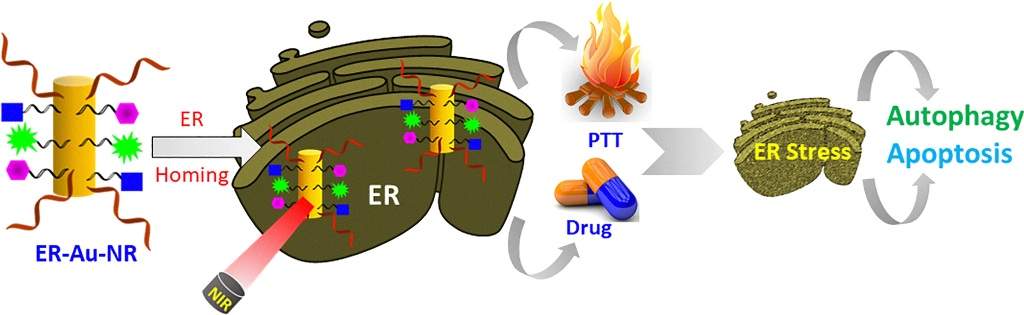
Gandhinagar: One of the major challenges in the quest to beat cancer is developing treatments that can selectively destroy cancer cells while leaving healthy cells unharmed. With this in mind, researchers at the Indian Institute of Technology Gandhinagar (IITGN) have devised a gold nanorod-based platform that delivers therapeutic agents specifically to the endoplasmic reticulum (ER), a structure responsible for protein production and processing within cells, while also generating heat when exposed to near-infrared light.
This research builds on the emerging field of organelle-targeted nanomedicine, which seeks to direct treatments to specific structures within cells. The ER is an important target because of its central role in maintaining cellular functions and responding to stress. When excessive stress disrupts its normal functioning, it can activate cellular pathways that ultimately lead to cell death. The findings of the study were published in the Journal of Materials Chemistry B in the paper titled, “Endoplasmic reticulum-targeted gold nanorod for chemo-photothermal therapy induces ER stress-mediated autophagy and apoptosis in cancer cells.” Speaking about the idea that shaped this approach, corresponding author Prof Sudipta Basu, Professor at IITGN’s Department of Chemistry, says, “One of the questions that motivated us was whether we could make a nanomaterial do more than simply carry a therapeutic molecule. We wanted to understand whether its design could also influence how and where that treatment interacts with a cancer cell.”
To put this concept into practice, the team used a gold nanorod, a nanoscale structure that can absorb near-infrared light and convert it into heat. They functionalised it with the chemotherapy drug cisplatin and indomethacin, along with a molecule called dansyl-sulfonamide that helps direct the nanorod towards the ER and enables subcellular imaging. According to the researchers, this platform represents the first reported integration of gold nanorods with these drugs for ER-targeted cancer treatment, combining targeted drug delivery with photothermal therapy, in which light-generated heat is used to damage cancer cells.
When they examined how these nanorods behaved inside cancer cells, cell culture experiments showed that they rapidly accumulated within the ER, overwhelming the cell’s protein-processing machinery and placing the cancer cells under significant stress. This was accompanied by increased levels of several ER-stress-related markers, while light irradiation further increased the generation of reactive oxygen species (ROS), molecules that can cause oxidative stress and cellular damage. The resulting stress was found to activate a cascade of responses, beginning with autophagy, through which cells break down and recycle damaged components, and progressing to apoptosis, a controlled form of cell death.
The team further evaluated the effects of the nanoplatform in colon cancer cells, cervical cancer cells and breast cancer cells. The ER-targeted nanorods effectively reduced their viability, while showing negligible toxicity towards non-cancerous cells under the experimental conditions.
Reflecting on her experience, lead author Asima Sahu explains, “For me, one of the most rewarding aspects of this work was seeing a carefully designed nanoscale system translate into measurable changes at the cellular level. It reinforced how small changes in material design can have meaningful biological consequences.” Second author Dipannita Chowdhury adds, “The study has also made us think more broadly about how we can design nanomedicines around the biology of a disease, rather than simply adapting existing treatments to a new delivery system.”
However, the findings are currently limited to laboratory-based cell studies. The research does not yet establish whether the nanorods can safely reach tumours, selectively accumulate within cancer cells, or be effectively distributed and cleared in a living organism. Further studies in animal models, along with detailed toxicity and pharmacokinetic evaluations, will therefore be needed to assess the safety, efficacy and translational potential of the approach before its suitability for clinical application can be assessed.
Ultimately, the study demonstrates how nanoscale material design can bring multiple therapeutic functions together within a single platform. While further research is needed to determine whether these findings can translate beyond cell cultures, the approach offers a promising direction for exploring more precise and sophisticated cancer treatments.
Click Here for More Science & Technology