
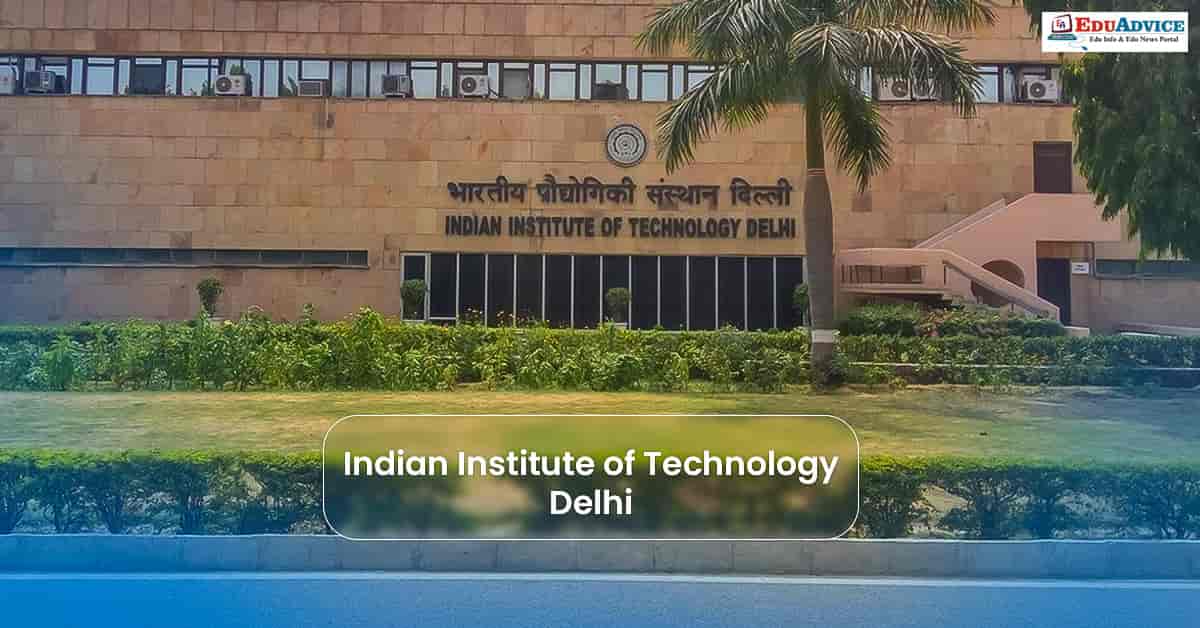
- IIT Delhi opens applications for the third batch of its six-month online Executive Programme for AI in Healthcare. Applications close on December 9, 2026.
New Delhi. ; The Continuing Education Programme (CEP) of the Indian Institute of Technology Delhi (IIT Delhi) has opened admissions for the third batch of its Executive Programme for AI in Healthcare. The six-month programme will be conducted online and is designed for graduate professionals working in industry and academia in areas relevant to artificial intelligence in healthcare.
According to the official IIT Delhi programme page, applications will remain open until December 9, 2026. The programme is scheduled to begin on December 12, 2026, and conclude on May 30, 2027.
The programme aims to provide practical exposure to artificial intelligence and machine learning in healthcare, including healthcare data analysis, clinical AI applications, generative AI, predictive modelling, healthcare automation and AI deployment.
IIT Delhi AI in Healthcare Programme 2026: Key Details
-
Programme: Executive Programme for AI in Healthcare
-
Institute: IIT Delhi
-
Organising department: Centre for Biomedical Engineering
-
Batch: 3
-
Duration: Six months
-
Mode: Online
-
Programme type: eVIDYA
-
Status: Admissions Open
-
Application deadline: December 9, 2026
-
Start date: December 12, 2026
-
End date: May 30, 2027
-
Programme fee: ₹1,50,000 + 18% GST
-
Class schedule: Saturday, 6:00 PM–7:30 PM; Sunday, 11:00 AM–12:30 PM
Who Can Apply for IIT Delhi AI in Healthcare Programme?
The programme is open to graduate professionals working in industry and academia in an area relevant to AI in healthcare. The official programme page describes the course as being designed for healthcare professionals, technology leaders and innovators who want to understand, evaluate and implement AI solutions in healthcare environments.
The programme FAQ further states that it is intended for professionals from healthcare, life sciences, information technology and related fields, including clinicians, researchers and technology leaders. It also states that a specific technical or medical background is not mandatory for joining the programme.
What Will Students Learn?
The six-month curriculum covers the application of AI across different healthcare and public-health contexts.
1. Foundations of AI for Healthcare
The first module introduces artificial intelligence, machine learning and deep learning from a healthcare perspective.
Topics include:
-
Fundamentals of AI, machine learning and deep learning
-
Prompt engineering and AI applications in healthcare
-
Supervised and unsupervised learning
-
Linear regression
-
Decision trees
-
Clustering
-
Logistic regression
-
Support Vector Machines
-
Neural networks and deep neural networks
-
Convolutional neural networks
-
Large language models
-
Generative AI
-
Python and MATLAB basics
-
Healthcare data handling using Pandas and NumPy
2. Healthcare Data and Clinical Big Data Analysis
This module focuses on different types of healthcare data and their analysis.
The curriculum covers:
-
Electronic Medical Record (EMR) data
-
Medical imaging data
-
Histopathology images
-
Physiological signals
-
Genomics data
-
Internet of Things (IoT) data
-
Healthcare datasets
-
Data anonymisation and preprocessing
-
Data cleaning and missing-value handling
-
Data normalisation
-
Feature engineering
-
Data augmentation
-
Training and testing data splits
-
Healthcare data ethics and compliance
-
HIPAA, GDPR and DISHA
-
Apache Spark and big-data analytics
3. AI Models and Predictive Analytics
Participants will work with machine learning and deep learning models used for healthcare applications.
The module includes:
-
Logistic Regression
-
Random Forest
-
Support Vector Machines
-
Neural Networks
-
Convolutional Neural Networks
-
Recurrent Neural Networks
-
Generative Adversarial Networks
-
Transformers
-
Image segmentation
-
Classification
-
Prediction
-
Synthetic image generation
Example project areas include medical-image analysis, physiological-signal diagnosis and disease classification.
4. AI Applications and Healthcare Automation
The programme also examines practical applications of AI in healthcare.
Topics include:
-
IoT sensors and real-time AI monitoring
-
AI-powered clinical decision support
-
Healthcare administration automation
-
Billing, triage and discharge automation
-
Robotic Process Automation tools
-
Generative AI in healthcare
-
Large language models
-
Prompt engineering
-
AI applications in radiology, genomics, surgery and pharmaceuticals
-
AI-powered chatbots
-
Virtual consultations
-
Regulatory considerations
5. AI Deployment and Integration
The fifth module focuses on deploying AI solutions and integrating them with healthcare systems.
Participants will learn about:
-
AI-powered healthcare dashboards
-
Streamlit and MATLAB GUI
-
Cloud deployment using introductory Google Cloud Platform and Amazon Web Services concepts
-
Integration of AI with Healthcare Information Systems (HIS)
-
Healthcare data visualisation
6. Public Health and Population Analytics
The final module includes applications of AI to public-health planning and population-level analysis.
Topics include:
-
Time-series modelling
-
Disease-spread mapping
-
AI-supported healthcare planning
-
Malaria and dengue surveillance
-
Public-health datasets
The programme also includes a group Capstone Project, in which participants develop an applied AI solution for healthcare using Python or MATLAB, followed by a final presentation and evaluation.
IIT Delhi AI Healthcare Programme: Learning Outcomes
According to IIT Delhi, participants will develop an understanding of AI, machine learning and deep learning fundamentals and their healthcare applications.
The expected learning areas include:
-
Understanding AI/ML/DL fundamentals
-
Managing and analysing healthcare data
-
Understanding healthcare-data ethics and compliance
-
Developing and evaluating predictive models
-
Exploring AI applications in radiology, pathology, physiology and ophthalmology
-
Understanding real-time patient monitoring using IoT
-
Working with clinical decision-support systems
-
Deploying AI models through dashboards and cloud platforms
-
Understanding integration with healthcare information systems
Tools Covered in the Programme
The official programme page lists several software tools and technologies associated with the curriculum, including:
-
Python
-
MATLAB
-
Pandas
-
NumPy
-
TensorFlow
-
Scikit-learn
-
Keras
-
Apache Spark
-
AWS
-
Google Cloud Platform
-
Streamlit
-
Hugging Face
-
3D Slicer
-
FIJI
-
spaCy
-
NLTK
IIT Delhi AI in Healthcare Programme Fee
The programme fee is ₹1,50,000 plus 18% GST.
The fee is divided into two instalments:
-
First instalment: ₹75,000 + GST, payable within three days of the offer letter
-
Second instalment: ₹75,000 + GST, payable on December 12, 2026
The institute states that fees must be submitted to the IIT Delhi CEP account and that GST at 18% will be charged in addition to the programme fee.
Certification
Participants who meet the prescribed evaluation requirements will receive an e-Certificate of Successful Completion from CEP, IIT Delhi.
The programme also provides a Certificate of Participation to candidates who meet the minimum attendance requirement but do not meet the evaluation criteria for successful completion. The institute states that only e-certificates will be issued.
Assessments and Capstone Project
Assessment components include:
-
Quizzes
-
Assignments
-
Clinical AI tasks
-
Mini viva sessions
-
Capstone project reviews
-
Mid-term reports
-
End-term reports
The official FAQ states that the final assessment includes multiple-choice questions, an oral viva and a practical coding test using Python or MATLAB, with online proctoring.
Programme Coordinators
The programme page lists Professor Anup Singh and Professor Amit Mehndiratta, both from the Centre for Biomedical Engineering at IIT Delhi, as programme coordinators.
Professor Anup Singh's listed areas include biomedical imaging, advanced MRI techniques, quantitative imaging and machine learning and deep learning for medical imaging. Professor Amit Mehndiratta is described as a physician-engineer working in neuro-assistive technologies and biomedical imaging.
Campus Immersion
The programme includes a campus immersion component. According to the official FAQ, the two-day campus immersion provides an opportunity for participants to interact with IIT Delhi faculty and peers.
However, travel, accommodation and related expenses are not included in the programme fee and are to be borne by participants.
Important Dates
The key dates for the IIT Delhi Executive Programme for AI in Healthcare, Batch 3, are:
-
Application deadline: December 9, 2026
-
Programme start date: December 12, 2026
-
Programme end date: May 30, 2027
-
Duration: Six months
How to Apply
Interested candidates can apply through the official IIT Delhi Continuing Education Programme portal.
Applicants should review the eligibility requirements, programme structure, fee details and admission conditions before submitting their applications.
The last date to apply is December 9, 2026.
Frequently Asked Questions (FAQs)
1. What is the IIT Delhi Executive Programme for AI in Healthcare?
It is a six-month online executive programme offered by the Continuing Education Programme (CEP), IIT Delhi, covering artificial intelligence applications in healthcare.
2. When does the third batch of the programme begin?
The programme begins on December 12, 2026.
3. What is the last date to apply?
The application deadline is December 9, 2026.
4. What is the duration of the programme?
The programme runs for six months, from December 12, 2026, to May 30, 2027.
5. What is the eligibility for the IIT Delhi AI in Healthcare programme?
The programme is open to graduate professionals working in industry and academia in an area relevant to AI in healthcare.
6. Is a technical or medical background mandatory?
The programme FAQ states that a specific technical or medical background is not mandatory and that graduate professionals from diverse academic and professional backgrounds can apply.
7. What is the fee for the programme?
The programme fee is ₹1,50,000 plus 18% GST.
8. What is the class schedule?
Online classes are scheduled for Saturday from 6:00 PM to 7:30 PM and Sunday from 11:00 AM to 12:30 PM.
9. Does the programme include a capstone project?
Yes. Participants undertake a group Capstone Project involving an applied AI solution for healthcare using Python or MATLAB.
10. What certificate will participants receive?
Participants meeting the evaluation requirements will receive an e-Certificate of Successful Completion from CEP, IIT Delhi. Candidates meeting the attendance requirement but not the evaluation criteria will receive a Certificate of Participation.
11. Does the programme include campus immersion?
Yes. The programme includes a two-day campus immersion. Travel, accommodation and related expenses are not included in the programme fee.
12. Which areas of healthcare AI are covered?
The programme covers AI/ML/DL foundations, healthcare data, predictive analytics, clinical AI, generative AI, healthcare automation, AI deployment, healthcare information systems and public-health analytics.
Official Link
IIT Delhi Executive Programme for AI in Healthcare – Batch 3
IIT Delhi Official Programme Announcement
Click Here for More Exams / Admission