
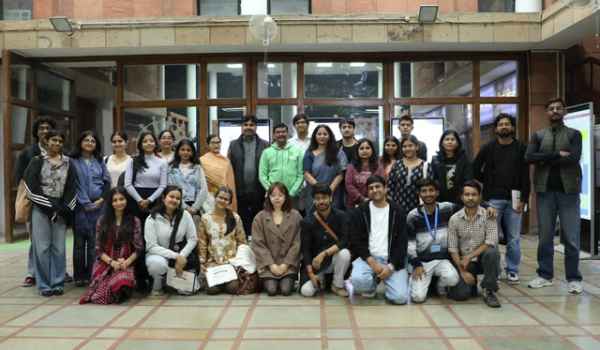
IIMC Students Discover Audio-Video Production at NCERT: What Happened on Day 2 of the Internship Programme?
New Delhi: Students at the Indian Institute of Mass Communication (IIMC) in New Delhi get classroom knowledge and skills. However, transforming an idea into an audio or video educational programme requires many other skills that cannot be learnt in the classroom. On the second day of their two-day internship programme at the Central Institute of Educational Technology (CIET), NCERT, a host of practical sessions on script-writing and media recording provided valuable insights to the participants.
The workshop enabled participants to learn both the creative as well as the technical aspects of educational media production. The practical sessions focused on developing scripts for educational audio/video programmes and recording them. Those conducting the sessions belonged to different aspects of media production and as such provided participants the opportunity to learn the process of developing educational communications aids.
What Did IIMC Students Learn on The Second Day at CIET-NCERT?
On the second day of the workshop, practical sessions were organized on different aspects of educational media production, such as: writing scripts for video programmes, recording video programmes, writing scripts for audio programmes and recording audio programmes.
Each of these sessions focused on a particular stage of the production process and helped participants visualize the overall nature of the process. The four sessions were planned as per the following schedule:
|
Session |
Resource Person |
|
Writing Scripts for Video Programmes |
Mr. Neeraj |
|
Recording of Video Programmes |
Ms. Binita Roy |
|
Writing Scripts for Audio Programmes |
Ms. Vimlesh Chaudhary and Mr. Ajit Horo |
|
Recording of Audio Programmes |
Ms. Vimlesh Chaudhary and Mr. Ajit Horo |
The combination of writing and recording sessions offered students exposure to both the conceptual and execution stages of educational media production.
From Scriptwriting to Video Recording: Getting to Know Educational Media
A key component of the program was scriptwriting for video production. Mr. Neeraj taught the students a critical aspect of video production. A video program begins long before a camera starts recording. It takes an idea and a plan to articulate that idea through a script.
For students of Mass Communication, especially those who want to specialize in Educational Media, understanding this concept is critical. In Educational Videos, the content has to be clear, message has to be logical and presented in a format that will facilitate learning. The video production session and the recording session by Ms. Binita Roy complemented the learning. Ms. Roy’s session also addressed the conversion of written scripts to visual and auditory formats.
Equitable Importance to Audio Production
Audio Communication was the other key area of interest on the second day. Ms. Vimlesh Chaudhary and Mr. Ajit Horo covered scriptwriting and recording for audio programs respectively. In audio based communication, unlike in video production, there’s a high reliance on spoken word, sound and information organized in a logical fashion without the use of visual aids. The script in such cases is the blueprint.
The sessions on audio scriptwriting and recording helped participants understand the process of developing an audio program from a written script to a recorded production. The Program sought to give an orientation to two key formats of production and use of audio-visual in Educational Communication.
Why Does CIET-NCERT's Internship Matter For Mass Communication Students?
The program focuses on the intersection of traditional media education with the use of educational technology and online resources. The Central Institute of Educational Technology (CIET) is part of NCERT. CIET works on educational media, digital learning resources and uses technology in teaching and learning. According to CIET's Planning and Research Division, they conduct exposure visits and internship programs for students of journalism and mass communication, education, engineering and teacher education. These programs assist the participants to develop their ICT skills and understanding of digital education initiatives.
The second day's program offered mass communication students of IIMC an opportunity to go beyond the conventional newsrooms, advertising agencies and entertainment for media production. Educational media requires a different kind of communication. The objective is to facilitate learning and understanding rather than to just capture the attention of the audience. The experience showed participants the various professionals who are part of the development of educational content, right from the script to the final audio-visual production.
A Practical Connection Between Mass Media and Educational Communication
On the second day of the internship, emphasis was laid on educational communication and media production. Students were introduced to the basics of audiovisual and video script writing and recording. This helped students understand various stages involved in developing audio and video educational resources. Knowledge of the production process of educational media helps an individual understand different career opportunities in educational broadcasting, digital learning resources, audiovisual production and institutional communication.
The program also integrated creative and technical aspects of the production of educational resources and demonstrated the importance of practical work and engagement. This aspect of the program created a bridge between mass media and educational communication. CIET-NCERT showed IIMC students the production aspect of educational communication. This highlighted the connection between mass communication education and the development of audio and video resources.
FAQs
1. What was the IIMC internship programme at CIET-NCERT?
This was a two-day internship programme aimed at providing IIMC students experience in the area of educational communication and media production including development and preparation of audio and video programmes.
2. What did students learn on Day 2 of the IIMC internship programme?
Students learned about video scriptwriting and video recording as well as audio scriptwriting and recording.
3. Who conducted the video scriptwriting session at CIET-NCERT?
Mr. Neeraj conducted this session.
4. Who conducted the video recording session?
Ms. Binita Roy conducted this session.
5. Who conducted the audio programme sessions?
Ms. Vimlesh and Mr. Ajit conducted the audio programme scriptwriting and audio programme recording sessions respectively.
6. What is CIET-NCERT?
The Central Institute of Educational Technology (CIET) is one of the units of NCERT that work on educational technology, media and educational technology and distance education.
7. Why is media production training important for mass communication students?
This training helps students understand the process of content production from beginning to end, including research, script writing, recording and presenting information through audio visuals.
8. Does CIET-NCERT conduct internships for students from other institutions?
Yes, CIET’s Planning and Research Division has exposure visits and internship programs for students of various disciplines and institutions including Journalism and Mass communication.
Click Here for More Latest News