
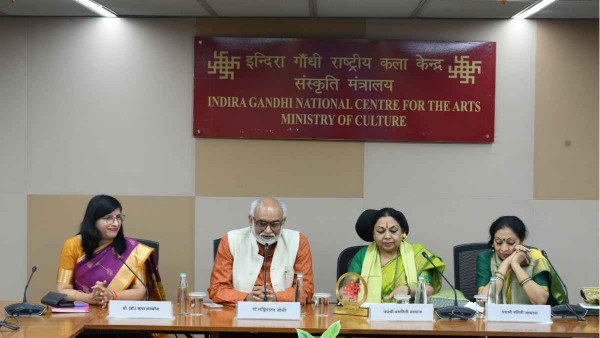
New Delhi, October 22, 2026: Can the principles that endow classical dance with emotional resonance seep into the quotidian? Such was the thought-provoking thesis put forth in a lecture by the Kaladarshan Division of the Indira Gandhi National Centre for the Arts (IGNCA); which saw revered Padma Shri Kathak exponent Nalini Asthana and her daughter Kamalini Asthana delve into the nexus between dance, aesthetic sensibility and the human condition.
Entitled “Aesthetic Sensibility in Dance: The Foundation of Life”, the lecture was part of the IGNCA’s series Indian Art, Aesthetics and Cultural Heritage and saw the distinguished artists expound on the emotive resonance of Indian classical dance and how its essence could be applied to human life in general.
Nalini and Kamalini Asthana On the Significance of Rasa
In their lecture, Nalini and Kamalini Asthana spoke about the concept of rasa, a fundamental principle in Indian classical dance that finds its origin in a Sanskrit verse, which was recited by the artists. The concept is one that encapsulates the very essence of dance, feeling and aesthetics. “The very basis of our dance is given by the following verse – ‘Yato hastastato drishtih, yato drishtistato manah, yato manastato bhavah, yato bhavastato rasah’,” the artists declared.
According to the artists, the above-mentioned verse signifies that the eyes follow the hands in dance, while the mind follows the eyes, the emotions find expression through the mind and ultimately, the emotions manifest as rasa. From thereon, the artists opined that without emotion and rasa, dance ceases to be a medium of aesthetic expression. In this regard, the artists remarked, “Our question to you all is – How do you find that aesthetic sensibility in your life?”
Indian Classical Dance As A Reflection of the Human Psyche
According to Nalini and Kamalini Asthana, the human faculty of consciousness and the ability to feel has an enormous bearing on art and aesthetics. As per the artists, if one is able to devote one’s consciousness wholeheartedly to any given activity, the emotional quotient and aesthetic pleasure that one derives from it increases manifold. To elucidate further, the artists recited an anecdote that spoke about how a certain person found aesthetic pleasure in everyday life – specifically cooking, painting and, of course, dancing.
“I think it’s all about how you perform the activity – with devotion or even a sense of worship,” remarked Nalini Asthana. Herein lies the philosophy of Indian classical dance – one that evokes emotions of the human psyche while calling for a deeper, introspective understanding of the self.
Kathak Dance and the Role of the Aesthetic in Everyday Life
Both Nalini and Kamalini Asthana are renowned exponents of the Indian classical dance form Kathak, for which they have been awarded the Padma Shri as well as the Sangeet Natak Akademi Award – the highest award in the field of Indian theatre and performance arts. In the lecture, which formed part of the Kaladarshan Division’s lecture series, the artists spoke about the cultural heritage of Indian classical dance, drawing heavily from their own repertoire of Kathak, as well as its application to everyday life.
As per the artists, Indian classical dance as an art form is replete with principles of aesthetics, which, like in the case of rasa, are used as tools of emotional expression. In this regard, Nalini Asthana remarked, “I think in the Indian classical dance, you get the entire gamut of emotions that humans experience.”
In sum, through their lecture, Nalini and Kamalini Asthana were able to impress upon the audience the sheer versatility and relevance of Indian classical dance – particularly Kathak that found resonance in the emotional spectrum of everyday human life.
IGNCA’s Kaladarshan Division Champions Indian Philosophy Through Indian Art
Dr Sachchidanand Joshi, Member Secretary, IGNCA presided over the function and emphasised on the need to study Indian artistic traditions and philosophies in order to have a better grasp of Indian cultural, aesthetic and philosophical thought.
Prof. (Dr) Richa Kamboj, Coordinator and Head, Kaladarshan Division, IGNCA, in her welcome address, spoke about the need to discuss the various facets of Indian art, aesthetics and culture in order to promote a wider understanding of Indian philosophy. Through its various initiatives and events, the IGNCA strives to document and promote India’s rich and diverse artistic and cultural heritage, both, within the country and beyond.
Final Thoughts
In conclusion, the Kaladarshan Division of the IGNCA once again proved its mettle by successfully hosting a lecture that not only delved into the emotional resonance of Indian classical dance but also reflected upon its relevance in the modern-day world.
By speaking about the concept of rasa, Nalini and Kamalini Asthana were able to connect the principles of aesthetics in Indian classical dance to the human psyche, thereby emphasising on the need for emotional resonance in everyday life.
Click Here for More Institutional Activities