
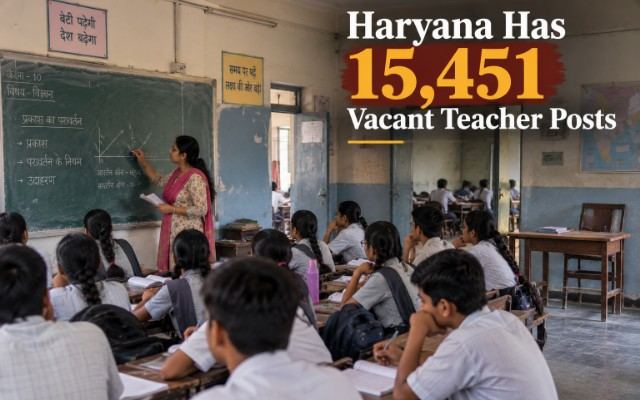
Chandigarh: Haryana's government schools have 15,451 vacant teacher posts, according to data placed before the state Assembly, highlighting significant differences in teacher availability across districts. The vacancies include posts for trained graduate teachers, postgraduate teachers, primary teachers and head teachers. The figures were disclosed by Haryana School Education Minister Mahipal Dhanda in a written reply during the Assembly's Budget session.
More Than 15,000 Posts Remain Vacant
According to the data, Haryana has:
-
7,707 TGT/ESHM posts vacant
-
3,998 PGT posts vacant
-
3,746 PRT/head-teacher posts vacant
The vacancies are not evenly distributed across the state.
Nuh-Mewat has the highest number of vacancies at 4,954, accounting for more than 32% of the total reported vacancies. Other districts with substantial numbers include Yamunanagar with 1,721 vacancies, Palwal with 1,595 and Gurugram with 1,130.
Districts With Major Teacher Vacancies
| District | Reported Vacancies |
|---|---|
| Nuh-Mewat | 4,954 |
| Yamunanagar | 1,721 |
| Palwal | 1,595 |
| Gurugram | 1,130 |
| Faridabad | 934 |
| Ambala | 925 |
| Sirsa | 914 |
Government Points to Student-Teacher Ratios
Despite the number of vacant sanctioned posts, the Haryana government has said that the overall student-teacher ratios remain within the prescribed norms. The state reported a 27:1 ratio at the primary level, against the prescribed 30:1 norm. At the upper-primary level, the ratio is 18:1, while the secondary and senior-secondary level has a ratio of 22:1. The government has therefore maintained that vacancies in sanctioned posts cannot alone be used to assess whether schools have an immediate shortage of teachers.
Why Vacancies Vary Across Districts
The figures show that the issue is particularly concentrated in certain parts of Haryana. Nuh-Mewat, for instance, accounts for nearly one-third of the vacancies reported across the state. Other districts such as Yamunanagar and Palwal also have significantly higher vacancies than several other parts of Haryana. This difference matters because a state-wide student-teacher ratio may appear adequate while individual schools or districts can still face shortages in particular subjects or teaching categories.
Recruitment and Promotions Delayed in Some Cases
The education minister said the government is committed to filling vacant teacher posts in a time-bound manner. However, recruitment and promotion processes for some posts have been affected by litigation, which has delayed their completion. The government has also pointed to infrastructure improvements in government schools. According to the Assembly response, no government school was without toilet or drinking-water facilities as of January 2026, while funds had also been sanctioned for additional toilets in 124 schools. At the same time, 135 schools were reported to be without boundary walls, showing that infrastructure gaps remain alongside staffing issues.
The Issue Beyond the State Average
The latest figures raise an important question about how teacher availability is measured. A statewide ratio may remain within the prescribed limit, but that does not necessarily mean that every school has enough teachers for every subject. A school with a shortage of a particular subject teacher can continue to face difficulties even when the overall state-level ratio looks adequate. This is particularly relevant for higher classes, where students require subject-specific teaching for board examinations and competitive examinations. The district-wise vacancy figures therefore provide a more detailed picture of the staffing situation in Haryana's government-school system.
What Happens Next?
The Haryana government has said that it is working towards filling the vacant posts, while some recruitment and promotion cases remain affected by legal proceedings. The latest Assembly data puts the scale of the vacancy issue at 15,451 posts, with the largest concentration in Nuh-Mewat and several other districts also reporting four-digit vacancies. For schools and students, the effectiveness of future recruitment will depend not only on reducing the overall number of vacancies but also on ensuring that teachers are available in the districts, schools and subjects where the requirement is highest.
Click Here for More Latest News