
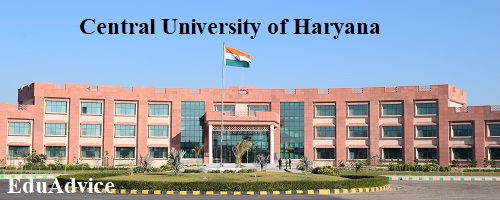
Haryana: School of Education, Central University of Haryana organized an extension lecture on “Professional Ethics” on April 5, 2022. Dr. Vijay Phogat, Associate Professor, Government College of Education, Chandigarh was the speaker of this programme.
Dr. Vijay Phogat delivered his lecture on ‘Professional Ethics’. He said teaching is a very noble profession which builds the nation. He discussed how mother being the first teacher to the child and how the primary school teacher having the second most important role in a child’s life. He cited an example- a mother wants her son to leave the habit of eating jaggery and she takes him to a teacher. The teacher, each day, advises the boy to the habit. The mother is surprised as the teacher is not doing anything but to advise the same thing again and again. One day, she questions and the teacher replies that he himself has the same habit and until he leaves the habit himself, how can he advise someone not to do same thing. Hence, a teacher should be ethical so that the child can be too.
Dr. Phogat explained the terminology “Professional Ethics” in detail. He elaborated how the teaching profession was not even considered as a profession. In 1960s, M. Limber lain said, “Teaching is a quasi- profession”. R.P. Singh, in his book ‘Indian Teacher Education’, has said that teaching is not a profession but a service. It was after National Council for Teacher Education (NCTE) got established and started functioning and setting standards and eligibility criteria to become a teacher in India, henceforth, this was considered as a profession.
The speaker discussed how teaching is a profession and what characteristics does it have as a profession:
a)Its members have an organized body of knowledge that separates the group from all others
b)It serves a great social purpose
c)There is cooperation achieved through a professional organization
d)There is a formal period of preparation and a requirement for continuous growth and development
e)There is a degree of autonomy accorded the professional
f)The profession has control or influence over education standards, admissions, professional development, ethical and performance standards, and professional discipline.
He added that every profession has a license and upon breaking rules or ethics, the license can be cancelled, but sadly there is no such system for teaching profession. Dr. Phogat explained the purpose of code of conduct- to increase professional and ethical consciousness among teachers and their sense of ethical responsibility; to guide teachers in making more informed ethical choices and to help the teaching profession itself function at the fullness of its potential. He also discussed the ‘guiding principles of code of conduct’ like responsibility to the profession must be realized, responsibility for professional competence, responsibility of the school community, and ethical use of ICT and also reply the students’ questions during question-answer session.