
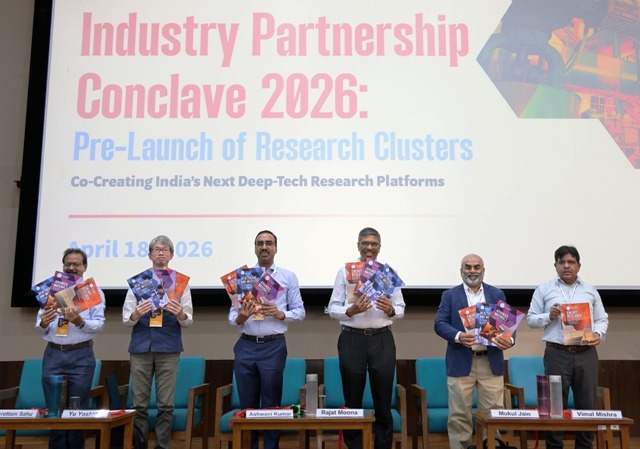
- The conclave focused on strengthening long-term academia–industry collaboration for deep-tech innovation.
- Industry leaders, startups, MSMEs, and policymakers engaged in discussions on scalable, real-world solutions.
Gandhinagar | April 18, 2026: The Indian Institute of Technology Gandhinagar (IITGN) successfully hosted the Industry Partnership Conclave 2026 (IPC 2026) on April 18, 2026, bringing together industry leaders, researchers, startups, and policymakers to strengthen long-term academia–industry collaboration.
The conclave marked the pre-launch of three interdisciplinary Research Clusters, the Advanced Materials Research Cluster (AMRC), the Energy Research Cluster (ERC), and the Healthcare and MedTech Research Cluster (HMRC), designed to translate cutting-edge research into deployable solutions for India’s strategic and industrial needs.
“The scale of transformation we are aiming for cannot be achieved in silos. It requires strong collaboration between government, industry, and premier institutions like IIT Gandhinagar,” said Shri Ashwani Kumar, Principal Secretary, Energy & Petrochemicals Department, Government of Gujarat who was the Chief Guest at the event.
He further highlighted the institution’s role in fostering innovation and collaboration. “Institutions like IIT Gandhinagar provide a unique ecosystem where academic excellence meets real-world problem solving. The openness, accessibility, and spirit of collaboration here are truly remarkable,” he said.
Emphasising the state’s growth trajectory, he pointed to rising infrastructure needs and emerging opportunities. “Gujarat is witnessing a rapid rise in energy demand, driven by growth in data centres, digital infrastructure, and industry,” he noted, underlining the importance of sustainable and scalable solutions.
“Looking ahead to 2047, many of the technologies and industries that will define our future do not yet exist,” he added, calling for stronger collaboration between academia, industry, and government to prepare for transformative change, and stressing the need for future-ready thinking and innovation-led development.
Prof Rajat Moona, Director, IITGN, in his address, highlighted the vision behind the initiative and the importance of collaborative research ecosystems. “India today has a unique strength in delivering high-quality solutions at scale and at low cost. To build on this, it is essential to bring together academia, industry, and research in a more integrated and collaborative manner,” he said.
“If we want to lead in deep-tech innovation, institutions must move beyond teaching and focus on driving research that leads to technology development and real-world applications. These clusters are designed to bring scale and structure to our research efforts, enabling deeper collaboration, stronger industry engagement, and a clearer pathway from research to innovation,” he opined.
MrYo Yoshida, Director General, Japan External Trade Organization (JETRO), emphasised the need for deeper collaboration. “One of the fastest and most effective ways to drive innovation is through cooperation between academia and industry, including partnerships across borders,” he said, expressing optimism that the conclave would serve as a starting point for new collaborations and joint initiatives. “Japan and India share strengths in key sectors. IITGN’s research clusters offer a strong platform for collaboration, with significant potential in advanced materials and energy transition,” he added.
Dr Mukul Jain, President, Zydus Research Centre, Zydus Lifesciences Ltd, emphasised the need for deeper industry–academia collaboration. “Initiatives like these research clusters mark an important shift towards long-term, co-creative partnerships that move beyond transactional engagements and focus on translating research into real-world impact,” he said.
Highlighting the growing complexity of challenges across sectors, he added, “As issues such as affordable healthcare, sustainable energy, and advanced materials become increasingly interconnected, no single sector can address them in isolation. The future lies in collaborative ecosystems that bring together diverse expertise.”
“There is a clear shift from working in silos to building collaborative, cluster-driven ecosystems that bring together academia, industry, and government. Such platforms are essential to accelerate progress in key areas like energy, advanced materials, and healthcare,” said Dr Narottam Sahoo, Advisor & Member Secretary, Gujarat Council on Science and Technology (GUJCOST).
The conclave witnessed strong participation, with over 450 delegates from more than 400 organisations, including leading industry leaders, startups, MSMEs, academic institutions, government agencies, and investor firms. Representatives from organisations such as Tata Consultancy Services (TCS), Larsen & Toubro (L&T), Reliance BP Mobility, GMR Group, and Zydus Lifesciences were among those present.
The conclave also featured an industry exposition, cluster-specific breakout sessions, and structured interactions with faculty leading each theme. The Advanced Materials Research Cluster (AMRC), Energy Research Cluster (ERC), and Healthcare & MedTech Research Cluster (HMRC) already engage with partners including Tata Semiconductor Manufacturing, ArcelorMittal Nippon Steel, Applied Materials, Texas Instruments, Zydus Lifesciences, GE Healthcare, Tata Consultancy Services, Reliance Industries, Adani Group, and key Gujarat utilities such as GUVNL, GETCO, and SLDC, among others.
The full launch of the clusters is expected later this year, with calls for joint proposals, consultancy engagements, and pilot deployments.
Participants also engaged in one-on-one meetings with faculty, exploring opportunities for co-development, joint research, and long-term partnerships. The conclave further included guided visits to advanced laboratories and research facilities, offering industry delegates a first-hand view of IITGN’s infrastructure and ongoing innovations.
Speaking at the conclave, Prof Vimal Mishra, Dean, Research & Development, IIT Gandhinagar, emphasised the importance of translational research. “Research cannot remain confined to laboratories, it must reach people and address real-world challenges,” he said.
“The concept of research clusters aims to bridge the gap between academia and industry by bringing together interdisciplinary expertise and aligning research with industry-driven needs,” he added.
Through initiatives such as IPC 2026, IIT Gandhinagar continues to position itself as a collaborative research partner, fostering innovation ecosystems that bring together academia, industry, and government.
The event was graced by Chief Guest Ashwani Kumar, Principal Secretary, Energy & Petrochemicals Department, Government of Gujarat, along with keynote speakers including Yu Yoshida, Director General, Japan External Trade Organization (JETRO); Dr Mukul Jain, President, Zydus Research Centre, Zydus Lifesciences Ltd; and Dr Narottam Sahoo, Advisor & Member Secretary, Gujarat Council on Science and Technology (GUJCOST).
Click Here for More Latest News