
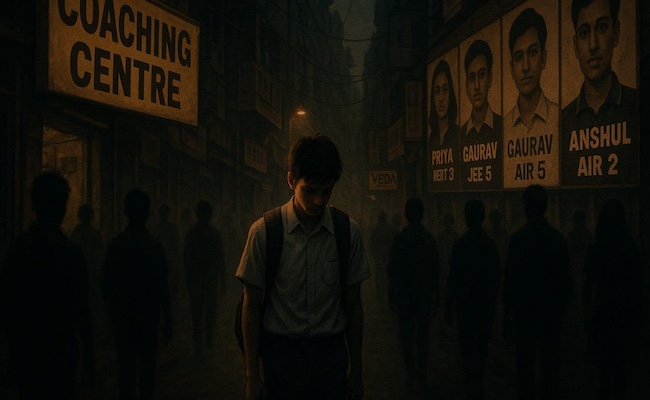
“The highest education is that which does not merely give us information but makes our life in harmony with all existence.” — Mahatma Gandhi
Introduction
India’s education system is witnessing a silent but powerful shift. Schools, once considered the primary spaces of learning, are increasingly being supplemented—or even replaced—by coaching institutes. This raises a critical question: why are schools no longer enough? The growing dependence on coaching reflects deeper structural issues within the education system, where conceptual clarity, skill development, and holistic growth are often missing.
Policy and Judicial Perspective
The Supreme Court in Unnikrishnan J.P. vs State of Andhra Pradesh (1993) recognized education as integral to the Right to Life under Article 21, emphasizing that education must enable meaningful development, not just certification.
Further, the National Education Policy (NEP) 2020 explicitly acknowledges the problem of rote learning and exam-centric systems, recommending a shift toward conceptual understanding, critical thinking, and experiential learning.
Despite these recommendations, the rise of coaching institutes indicates a gap between policy intent and ground reality.
Colonial Roots and the Foundation of the Problem
The current structure of education in India traces back to the colonial system introduced by the British, designed primarily to produce administrative and clerical workers rather than innovators or entrepreneurs. This system emphasized uniformity, memorization, and compliance, creating a culture where students are trained to follow instructions rather than think independently.
Even today, this legacy persists. The typical fixed classroom structure, textbook-driven teaching, and lack of practical exposure continue to dominate schools, limiting the development of real-world skills.
The Learning Gap: When Schooling Does Not Ensure Understanding
One of the most critical issues is the gap between schooling and actual learning. According to the ASER Report by Pratham, a significant proportion of students lack basic foundational skills. For instance, a large percentage of Grade 5 students are unable to read a Grade 2 level text, indicating that progression through grades does not guarantee understanding.
This lack of conceptual clarity forces students to seek external support through coaching, as schools fail to ensure strong academic foundations.
Rise of the Coaching Culture
The rapid expansion of coaching institutes highlights a systemic failure. According to industry estimates, India’s coaching market is valued at over billions of dollars and continues to grow rapidly, especially in urban areas.
What is more concerning is the overlap between schools and coaching. In many cases, teachers themselves encourage students to join private tuition, raising ethical concerns. When the same content is taught in school and then repeated in coaching classes, it reflects not the necessity of coaching, but the inefficiency of classroom teaching.
Redundancy in Learning: Repetition Without Understanding
Consider subjects like mathematics, where concepts such as integration and differentiation are taught. If these concepts are properly understood in school, there should be no need to relearn them in coaching institutes. However, due to poor conceptual teaching, students end up spending additional hours repeating the same content.
This leads to time inefficiency and cognitive overload, where students spend their entire day in academic activities without gaining deeper understanding.
Loss of Holistic Development
A major consequence of the coaching culture is the decline of holistic development. Students often spend their day attending school and coaching, leaving little to no time for extracurricular activities, physical exercise, creativity, or personal growth.
Research consistently shows that physical activity and experiential learning play a crucial role in cognitive development, yet these aspects are increasingly neglected. The belief that “more study equals better success” has overshadowed the importance of balanced development.
Economic and Social Inequality
The coaching system also creates inequality in access to education. Students from economically weaker backgrounds may not afford expensive coaching classes, leading to disparities in opportunities. This creates a system where success is influenced not just by ability, but by access to additional resources.
Gandhi’s Vision: Nai Talim
Long before these challenges emerged, Mahatma Gandhi proposed Nai Talim, a model of education focused on learning by doing, practical skills, and self-reliance. His vision emphasized that education should be integrated with real-life experiences, enabling students to develop both intellectual and practical capabilities.
In contrast to today’s system, Nai Talim promoted holistic development over rote learning, making it a relevant framework even in contemporary discussions on education reform.
The Need for Regulation and Awareness
The growing dominance of coaching institutes calls for strong regulatory intervention and systemic reform. At the same time, there is a need for greater awareness among parents, who often equate excessive academic engagement with success.
Students should not be confined to a cycle of school, coaching, and self-study, as this limits their exposure to diverse experiences. Encouraging practical learning, extracurricular participation, and physical activities is essential for overall development.
Conclusion
The rise of coaching culture is not just a trend but a reflection of deeper flaws in the education system. Schools are expected to be the primary centers of learning, yet their inability to deliver conceptual clarity has led to the emergence of parallel systems.
If education continues to prioritize marks over meaning, the reliance on coaching will only increase. The solution lies in reforming classroom teaching, focusing on understanding rather than memorization, and promoting holistic development.
A student attended school for six hours, then spent another three hours in coaching classes, and finally sat down for self-study late into the night. Despite this, he struggled to explain a simple concept he had “studied” multiple times.
He had seen the concept, heard it, and memorized it—but never truly understood it.
That is when it became clear:
the problem was not the student’s effort, but the system’s approach to learning.
Click Here for More Educational Column