
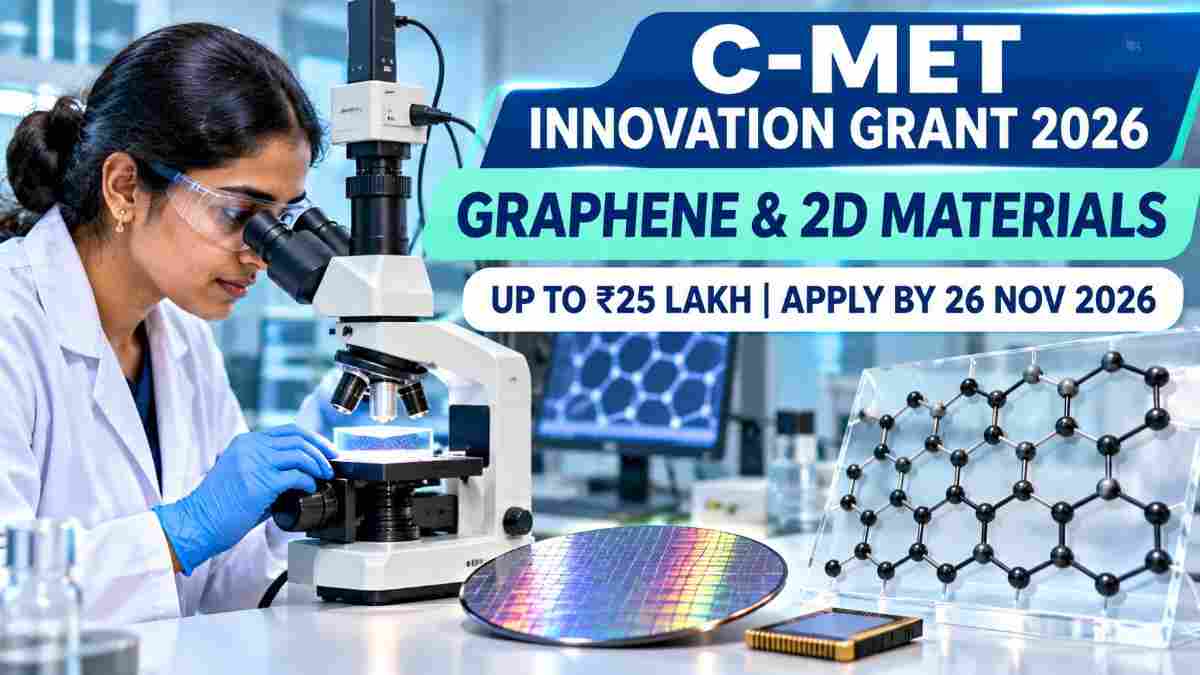
- Indian academic and research institutions, startups and entrepreneurs can seek funding support of up to ₹25 lakh for projects of up to one year. Applications close on November 26, 2026.
Thrissur : The Centre for Materials for Electronics Technology (C-MET) has announced an Innovation Grant for Graphene and 2D Materials for Advanced Electronics and Photonics, inviting applications from Indian academic institutions, research organisations, startups and entrepreneurs.
The grant aims to support research and innovation in graphene and two-dimensional materials, which have potential applications in advanced electronics and photonics. Selected projects can receive financial assistance of up to ₹25 lakh for a project duration of up to one year.
The last date to apply for the innovation grant is November 26, 2026.
Who Can Apply for the C-MET Innovation Grant?
According to the announcement, the opportunity is open to:
-
Indian academic institutions
-
Indian research institutions
-
Startups
-
Entrepreneurs
The announcement identifies these applicant categories as eligible to apply. Applicants should consult the official C-MET notification for the detailed eligibility conditions, application format and evaluation process.
Grant Amount and Project Duration
The key details announced for the funding opportunity are:
|
Particulars |
Details |
|---|---|
|
Grant |
Innovation Grant |
|
Research areas |
Graphene and 2D Materials |
|
Application focus |
Advanced Electronics and Photonics |
|
Maximum financial support |
₹25 lakh |
|
Project duration |
Up to one year |
|
Eligible applicants |
Indian academic and research institutions, startups and entrepreneurs |
|
Last date to apply |
November 26, 2026 |
Research Focus: Graphene and 2D Materials
Graphene and other two-dimensional materials are important areas of advanced materials research. Their potential applications in electronics and photonics make them relevant to the development of new technologies and devices.
Through this grant, C-MET is seeking to encourage innovation and research activity in these areas by providing financial support for eligible projects.
How to Apply for the C-MET Innovation Grant?
Interested applicants should visit the official C-MET website and access the Innovation Grant notification for complete application instructions, required documents and submission details.
Application deadline: November 26, 2026
Official notification: https://www.cmet.gov.in/node/4063
Applicants are advised to review the complete notification before submitting their proposals to ensure that they meet the prescribed requirements.
FAQs
1. What is the C-MET Innovation Grant?
It is a funding opportunity for innovation and research in graphene and 2D materials for advanced electronics and photonics.
2. How much funding is available under the C-MET grant?
The grant offers financial support of up to ₹25 lakh per project.
3. What is the maximum project duration?
The supported project can have a duration of up to one year.
4. Who is eligible to apply?
Indian academic institutions, research institutions, startups and entrepreneurs are identified as eligible applicant categories.
5. What are the research areas covered by the grant?
The grant focuses on graphene and 2D materials for advanced electronics and photonics.
6. What is the last date to apply?
The application deadline is November 26, 2026.
7. Where can applicants find the official notification?
Applicants can visit https://www.cmet.gov.in/node/4063 for the announcement and application details.
Click Here for More Science & Technology