
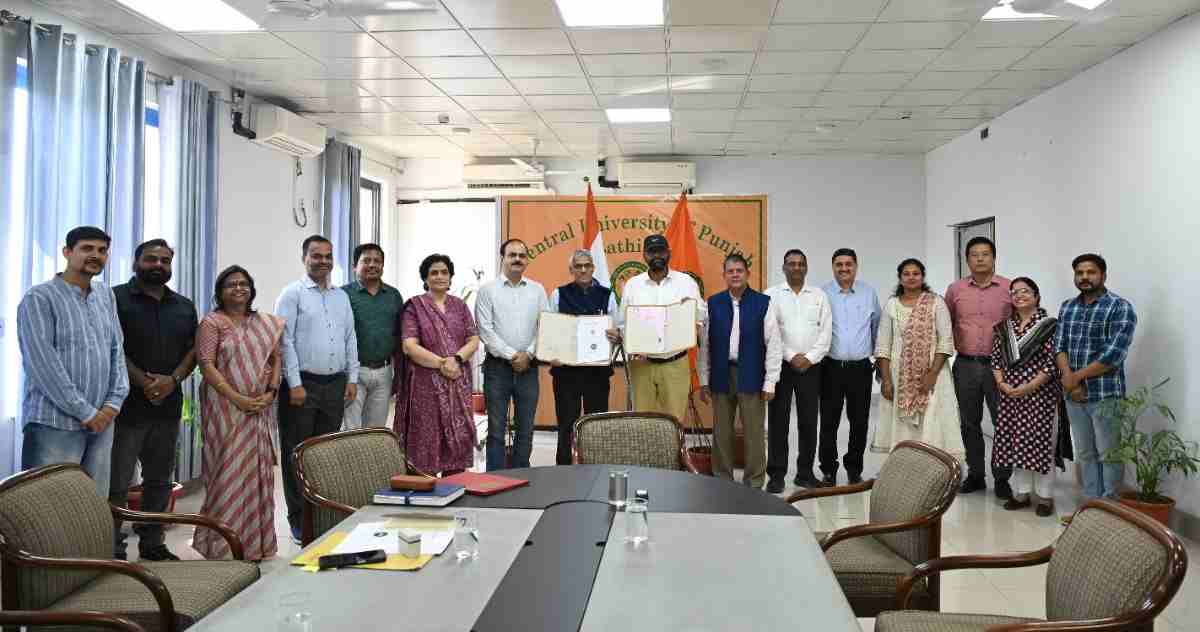
Central University of Punjab Signs MoU with CGWB to Study Uranium Contamination in Groundwater
Bathinda, October 27, 2026: The Central University of Punjab (CU Punjab), Bathinda, has signed a Memorandum of Understanding (MoU) with the Central Ground Water Board (CGWB), North Western Region (NWR), Chandigarh, to investigate groundwater quality, with a special focus on uranium contamination in the Bathinda and Goniana Mandi blocks of Punjab's Bathinda district.
The collaboration aims to strengthen groundwater quality assessment and uranium contamination studies under the National Aquifer Mapping and Management (NAQUIM) programme. By combining CGWB's technical expertise with the university's research capabilities, the partnership will examine groundwater conditions, identify contamination-prone areas and generate scientific inputs for sustainable groundwater management.
MoU Signing Ceremony
The MoU was signed in the presence of Prof. Ramakrishna Wusirika, Acting Vice-Chancellor of CU Punjab, and Mr. Nidhish Verma, Regional Director, CGWB, NWR, Chandigarh.
Dr. Vijay Sharma, Registrar, and Prof. J. K. Patnaik, the university's nodal officer, represented CU Punjab as signatories. Mr. Kuldeep Gopal Bhartariya, Scientist-C, represented CGWB.
The university delegation included Prof. Monisha Dhiman, Director of the Internal Quality Assurance Cell (IQAC); Prof. Anjana Munshi, Director of Research and Development; Prof. V. K. Garg, Head of the Department of Environmental Science and Technology; Prof. Bandana Samant, Head of the Department of Geology; Dr. L. T. Sasang Guite, Head of the Department of Geography; Prof. Sunil Mittal; Prof. Yogalakshmi K. N.; Prof. Sameer Durani; and faculty members from the Departments of Environmental Science and Technology and Geology.
Groundwater Sampling and Contamination Mapping
Under the agreement, CGWB will collect and analyse groundwater samples during the pre-monsoon and post-monsoon periods. The analysis will cover uranium, other heavy metals and major chemical components present in groundwater.
CGWB will also examine groundwater quality data, prepare maps showing contaminant distribution, monitor groundwater levels and prepare the final study report, incorporating technical inputs from CU Punjab.
The seasonal sampling approach is intended to help researchers examine groundwater quality across different periods and better understand the distribution of contaminants in the study area.
University to Conduct Geochemical and Health Risk Assessments
CU Punjab will undertake mineralogical and geochemical investigations to understand groundwater composition and the factors associated with uranium contamination. The university will also conduct health risk assessments and study possible measures to reduce risks associated with uranium-contaminated groundwater.
Both institutions will appoint nodal officers to coordinate the investigation and facilitate implementation of the agreed research activities.
Focus on Safe Drinking Water in Bathinda District
The study is expected to help identify areas where groundwater quality needs particular attention, assess variations in contamination levels and investigate factors influencing the presence and movement of uranium in groundwater.
Its findings could provide scientific inputs for groundwater quality management, planning appropriate mitigation measures and developing safe and sustainable drinking water strategies for the affected areas of Bathinda district.
The collaboration brings together groundwater monitoring, chemical analysis, geological investigation and health risk assessment to build a more detailed understanding of the region's groundwater challenges.
Strengthening Research and Groundwater Management
Through the partnership, Central University of Punjab and CGWB aim to combine their scientific knowledge and technical capabilities to improve understanding of groundwater quality issues in the region.
The research will contribute to the broader objective of protecting groundwater resources and supporting evidence-based decisions for their sustainable management.
The study's findings are expected to inform future planning and mitigation efforts. However, specific contamination levels, health outcomes and recommended interventions will depend on the results of the investigation.
Frequently Asked Questions (FAQs)
Q1. Which institutions have signed the groundwater research MoU?
The Central University of Punjab, Bathinda, and the Central Ground Water Board's North Western Region, Chandigarh, have signed the MoU.
Q2. What is the main objective of the collaboration?
The collaboration aims to investigate groundwater quality, with particular emphasis on uranium contamination, and generate scientific inputs for groundwater management and safe drinking water planning.
Q3. Which areas of Punjab will the study cover?
The investigation will focus on the Bathinda and Goniana Mandi blocks of Bathinda district.
Q4. What is the NAQUIM programme?
The study is being undertaken in connection with the National Aquifer Mapping and Management (NAQUIM) programme.
Q5. What will CGWB do under the MoU?
CGWB will collect and analyse groundwater samples, examine uranium and other chemical components, map contaminant distribution, monitor groundwater levels and prepare the final report with technical inputs from the university.
Q6. What will Central University of Punjab contribute?
The university will conduct mineralogical and geochemical studies, undertake health risk assessments and investigate possible measures to reduce risks associated with uranium contamination.
Q7. When will groundwater samples be collected?
CGWB will collect samples during both the pre-monsoon and post-monsoon periods.
Q8. Will the study identify safe drinking water solutions?
The findings are expected to support the planning of mitigation measures and safe drinking water strategies. Specific recommendations will depend on the study results.
Q9. Have the contamination levels been announced?
The supplied announcement does not provide measured uranium concentrations or final study findings. These are expected to be assessed through the investigation.
Click Here for More Institutional Activities