
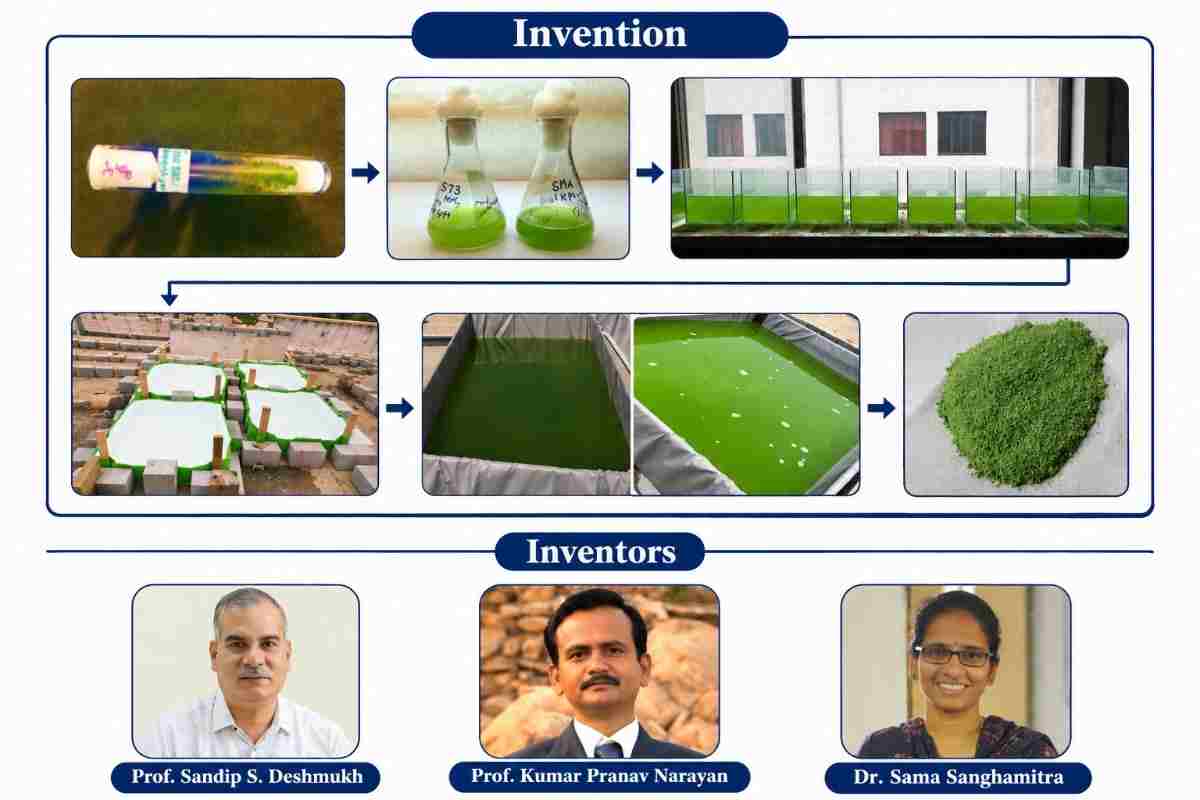
- Researchers at BITS Pilani Hyderabad Campus have secured an Indian patent for an affordable nutrient medium composition designed for large-scale microalgae cultivation. The formulation uses locally available agricultural-grade fertilisers and has potential applications in biofuel production, carbon capture, wastewater treatment and biotechnology.
HYDERABAD, November 26, 2026: Researchers at Birla Institute of Technology and Science (BITS) Pilani, Hyderabad Campus, have secured an Indian patent for an innovative nutrient medium composition that could make large-scale microalgae cultivation more affordable. The technology also has potential applications in renewable fuel production, carbon capture and other bio-based industries.
The patented innovation, titled "Nutrient Medium Composition for Mass Cultivation of Microalgae" (Indian Patent No. 603126, Application Number: 202211003678), offers a cost-effective alternative to conventional laboratory cultivation methods.
The formulation uses locally available agricultural-grade fertilisers to supply essential nutrients required for microalgal growth. By replacing expensive laboratory-grade chemicals with readily available fertilisers, the technology aims to reduce cultivation costs and improve the economic feasibility of large-scale microalgae production.
What Are Microalgae and Why Are They Important?
Microalgae are microscopic organisms that use sunlight and carbon dioxide to grow and produce biomass. They have attracted considerable research interest because of their potential applications across renewable energy, environmental management, agriculture and biotechnology.
Some important applications of microalgae include:
-
Biofuel Production: Microalgae can be used as a feedstock for biodiesel and other bio-based fuels.
-
Carbon Capture: Microalgae utilise carbon dioxide during photosynthesis, creating opportunities for carbon management applications.
-
Wastewater Treatment: Certain microalgae can help remove nutrients and pollutants from wastewater.
-
Biofertilisers: Microalgal biomass can be explored for agricultural applications and soil improvement.
-
Food and Nutraceuticals: Microalgae are potential sources of valuable nutrients and bioactive compounds.
-
Biotechnology: Microalgal biomass can be used in the development of various industrial and biological products.
However, conventional cultivation methods often require expensive laboratory-grade nutrients, making large-scale production economically challenging.
BITS Pilani Researchers Develop Affordable Nutrient Formulation
To address the cost challenges associated with microalgae cultivation, researchers at BITS Pilani Hyderabad have developed an alternative nutrient formulation using agricultural-grade fertilisers.
The research team comprises:
-
Prof. Sandip S. Deshmukh, Department of Mechanical Engineering.
-
Prof. K. Pranav Narayan, Department of Biological Sciences.
-
Dr. Sama Sanghamitra, Research Scholar.
The formulation uses agricultural-grade fertilisers as the primary sources of essential nutrients, including nitrogen, phosphorus, potassium and sulphur.
These nutrients support microalgal growth while reducing the cost and complexity associated with preparing conventional cultivation media.
The patented formulation is designed to provide an economical and practical alternative for researchers, biotechnology enterprises and potential industrial users interested in mass microalgae cultivation.
Microalgae Cultivation Cost Reduced to Approximately ₹2.40 per 100 Litres
One of the most notable aspects of the patented technology is its potential to reduce nutrient preparation costs.
According to the research team's technology-transfer assessment, the cost of macronutrients required to prepare 100 litres of the newly developed cultivation medium is approximately ₹2.40, compared with approximately ₹43 for conventional Bold's Basal Medium (BBM).
For non-agricultural and industrial-scale applications, the cost of the new formulation may increase to approximately ₹4.50 per 100 litres, depending on the non-subsidised price of fertilisers.
The research team explained:
"According to the technology-transfer assessment, the cost of macronutrients required to prepare 100 litres of the newly developed medium is approximately Rs. 2.40, compared with Rs. 43 for the conventional Bold's Basal Medium (BBM). However, for non-agricultural and industrial-scale usages, it may cost up to Rs. 4.50/100 litres of media depending on the non-subsidised rate of fertilizer."
This comparison relates specifically to nutrient inputs. The overall cost of microalgal biomass production and subsequent biofuel processing will need further assessment.
Successful Cultivation Demonstrated in a 10,000-Litre Open Pond
The researchers have evaluated the patented formulation through multiple experiments at different stages.
The testing process began under controlled laboratory conditions and subsequently progressed to non-sterile cultivation and outdoor open-pond systems.
The research team successfully cultivated microalgae in a 10,000-litre open pond using natural sunlight and atmospheric carbon dioxide to support microalgal growth.
This demonstration is significant because outdoor open-pond cultivation provides an opportunity to evaluate the formulation beyond conventional laboratory conditions.
The successful cultivation also indicates the potential of the nutrient medium for larger cultivation systems, although further industrial testing will be required to establish its long-term performance and commercial feasibility.
Simple Preparation and Practical Advantages
Apart from its cost advantages, the patented nutrient formulation is designed to simplify the cultivation process.
Its ingredients can be mixed under normal conditions and supplied in dry powder form. The powder can subsequently be dissolved in water before being used as a cultivation medium.
Some of the practical advantages include:
-
Use of locally available agricultural-grade fertilisers.
-
Reduced dependence on expensive laboratory-grade chemicals.
-
Simple preparation under normal conditions.
-
Convenient storage and transportation in dry powder form.
-
Potential suitability for larger microalgae cultivation systems.
These characteristics could make the formulation useful for research institutions, biotechnology companies and organisations exploring commercial microalgae production.
Potential Applications in Biofuel and Carbon Capture Industries
The patented innovation could have applications in several emerging sectors.
Biofuel Production
Microalgae are being explored as a renewable feedstock for biodiesel and other bio-based fuels. More affordable cultivation nutrients could help reduce one component of biomass production costs.
Carbon Capture
Microalgae consume carbon dioxide during photosynthesis. Economical cultivation systems could support research into integrating microalgae with industrial carbon management processes.
Wastewater Treatment
Microalgae cultivation systems can be explored for wastewater treatment and nutrient recovery, creating opportunities for integrated environmental applications.
Biotechnology and Agriculture
Microalgal biomass has potential applications in biofertilisers, soil improvement, nutraceuticals and other bio-based products.
However, the overall environmental and economic benefits of these applications, particularly biofuels, will depend on factors such as water and energy consumption, downstream processing and life-cycle performance.
Industry Collaboration Planned for Commercial Evaluation
As the next step towards potential commercial applications, the research team is in discussions with an industry partner to evaluate the patented formulation.
The potential industry partner has proposed a two-month evaluation to assess the formulation's suitability for microalgal carbon capture, biomass production and other possible applications.
The partner has also requested approximately 5 kg of the formulation for testing.
In parallel, the researchers are seeking collaborations with companies working in:
-
Biofuel production.
-
Algal biotechnology.
-
Carbon management.
-
Industrial biotechnology.
-
Renewable energy and sustainable technologies.
These collaborations are expected to support larger-scale testing, the development of suitable industrial protocols and assessments of technical, environmental and economic feasibility.
Further evaluation will help determine the technology's suitability for commercial adoption.
BITS Pilani's Contribution to Research and Innovation
The development highlights the role of academic research in addressing practical challenges associated with renewable energy and sustainable industrial technologies.
By focusing on the affordability of microalgae cultivation, the BITS Pilani Hyderabad research team has developed a patented formulation that could make biomass production more accessible to potential industrial users.
The successful 10,000-litre open-pond demonstration and ongoing industry discussions represent important steps towards evaluating the technology beyond laboratory research.
If further industrial validation is successful, the innovation could contribute to the development of more economical microalgae cultivation systems and support research in biofuels, carbon capture and other bio-based industries.
Frequently Asked Questions (FAQs)
1. What is the new microalgae cultivation technology developed by BITS Pilani?
BITS Pilani Hyderabad researchers have developed a patented nutrient medium composition that uses agricultural-grade fertilisers to support large-scale microalgae cultivation at a potentially lower cost.
2. What is the patent number of the BITS Pilani microalgae technology?
The innovation has been granted Indian Patent No. 603126, with Application Number 202211003678.
3. What is the name of the patented innovation?
The patent is titled "Nutrient Medium Composition for Mass Cultivation of Microalgae".
4. How much does the new microalgae cultivation medium cost?
According to the research team's technology-transfer assessment, the macronutrient cost is approximately ₹2.40 per 100 litres. For non-agricultural and industrial applications, it may increase to approximately ₹4.50 per 100 litres, depending on fertiliser prices.
5. How much does conventional Bold's Basal Medium cost?
The research team reports that the macronutrients required for 100 litres of conventional Bold's Basal Medium cost approximately ₹43.
6. Have the researchers tested the technology on a large scale?
Yes. The research team successfully cultivated microalgae in a 10,000-litre outdoor open pond using natural sunlight and atmospheric carbon dioxide.
7. Who developed the patented microalgae cultivation formulation?
The research team includes Prof. Sandip S. Deshmukh from the Department of Mechanical Engineering, Prof. K. Pranav Narayan from the Department of Biological Sciences, and Dr. Sama Sanghamitra, Research Scholar, at BITS Pilani Hyderabad Campus.
8. What are the potential applications of this technology?
Potential applications include biofuel production, carbon capture, wastewater treatment, biofertilisers, nutraceuticals and biotechnology products.
9. Can the patented formulation be used for industrial microalgae production?
The formulation has been tested in a 10,000-litre open pond. Further industrial evaluation is planned to establish its suitability for larger commercial applications.
10. Is BITS Pilani collaborating with any industry partner?
The research team is in discussions with a potential industry partner for a proposed two-month evaluation of the formulation. The partner has requested approximately 5 kg of the formulation for testing.
11. How can companies collaborate with the BITS Pilani research team?
Companies working in biofuels, algal biotechnology, carbon management and related sectors can explore research and industrial collaborations with the BITS Pilani Hyderabad team.
Click Here for More Science & Technology