
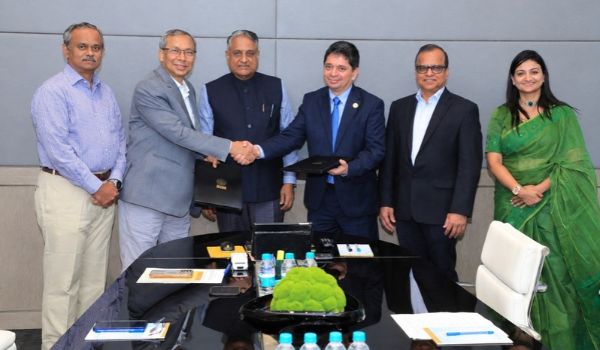
Chennai, November 13th, 2026: As the global landscape of higher education is being reshaped, Bharathidasan Institute of Management (BIM), Tiruchirappalli, and The University of Texas at Arlington (UTA), USA, have signed a Memorandum of Understanding (MoU) to offer the Master of Science in Artificial Intelligence for Business (MSAIB) to working professionals in India.
The initiative marks a significant step in BIM's internationalization strategy and responds to an emerging reality in global higher education: students increasingly seek international qualifications, global academic exposure, and industry-relevant capabilities without necessarily relocating overseas for extended periods.
The Changing Geography of Global Education
International student mobility is shifting as visa policies, rising education and living costs, geopolitical developments, and competitive education destinations shape students' choices.
According to the Institute of International Education's Open Doors 2025 report, the United States hosted approximately 1.18 million international students in 2024–25. However, new international student enrollments declined by 7%, with new graduate enrollments falling by 15%. A subsequent survey of US institutions for 2025–26 indicated a further 17% decline in new international enrollments.
Australia is facing similar pressures. Australian Government data for the year to August 2026 show a 12% decline in international student commencements compared with the corresponding period in 2025.
The United Kingdom is also seeing shifting patterns. UK Home Office statistics for the year ending June 2026 show a 16% year-over-year decline in sponsored study visa grants to Indian nationals.
Meanwhile, new centers of international education are strengthening their positions across Asia. Japan hosted 408,069 international students in 2025, a 21.2% increase from the previous year, while South Korea's international student population rose from 208,962 in 2024 to 253,434 in 2025.
These developments point toward a more diversified geography of higher education, with Asian institutions becoming increasingly important destinations and partners within global academic networks.
From Student Mobility to Knowledge Mobility
For business schools, this transformation offers an opportunity to rethink internationalization beyond the conventional model of sending students abroad.
International academic partnerships increasingly enable institutions to collaborate on curriculum development, faculty engagement, research, experiential learning, and cross-border degree delivery. These arrangements can provide students with access to international education while reducing the financial and professional disruption associated with full-time overseas study.
The BIM–UTA collaboration is conceived in this spirit, bringing together the academic strengths of a leading American public research university and BIM's industry-oriented management education ecosystem in India.
A US Master's Degree Designed for Working Professionals
The proposed two-year Master of Science in Artificial Intelligence for Business is a STEM-designated degree offered by The University of Texas at Arlington, a Carnegie R1 research university in the Dallas–Fort Worth Metroplex.
Designed primarily for working professionals, the program integrates artificial intelligence, machine learning, data engineering, generative AI, and business strategy, with a strong focus on real-world applications.
The hybrid learning model features eight-week courses with seven weeks of online instruction and one week of in-person learning. Students will be taught by UTA faculty and will also benefit from a one-week immersion in the United States, including company visits, interactions with business executives, and exposure to industry applications of artificial intelligence.
A capstone project that addresses real-world business challenges will enable participants to translate their learning into practical AI-driven solutions.
The program, with an indicative tuition fee of US$27,000, is designed to offer an alternative to the substantially higher overall cost of two years of full-time residential study in the United States.
BIM’s new campus, going beyond just an impressive physical architecture
Mr. Ravi Appaswamy, Chairman, Board of Governors, BIM Tiruchirappalli commented,
“World-class infrastructure is an enabler, not an end in itself. As BIM prepares to inaugurate its state-of-the-art campus on the Tiruchirappalli–Pudukkottai knowledge corridor, our ambition goes well beyond creating an impressive physical architecture. We are committed to building an institution distinguished by its intellectual capital, global academic best practices, research rigour and demonstrable impact on business and society. Management education must not merely respond to a changing world; it must help shape it. Our partnership with the University of Texas at Arlington and the recent induction of Prof. Bharat Bhasker, Director of IIM Ahmedabad, into our Board of Governors are deliberate steps in realizing this ambition. The Board is firmly committed to positioning BIM as a globally connected, academically distinguished and industry-relevant institution. As BIM enters a new phase of its transformational journey from its own campus, we are not simply building for the next decade; we are laying the foundations for the next generation of management education.”
Building a New Model of Internationalization
Speaking on the occasion, Dr Asit K. Barma, Director, BIM Tiruchirappalli, said:
"The geography of global management education is changing. For decades, internationalization was largely measured by the number of students crossing borders to study at universities abroad. Today, we must ask a more fundamental question: why should access to global knowledge require students to relocate?"
"At BIM, we believe the future lies in the mobility of knowledge, faculty, curriculum, and academic credentials, alongside student mobility. Our collaboration with The University of Texas at Arlington reflects this conviction. We are bringing the academic strengths of a leading American research university to Indian working professionals, enabling them to gain globally relevant AI capabilities without interrupting their careers.”
"This is also an important step in BIM's transformation into a globally connected institution. We view international partnerships not merely as a means of student exchange but as a way to democratize access to high-quality education and create enduring value for industry and society."
Responding to the AI Transformation of Business
Artificial intelligence is fundamentally changing how organizations compete, make decisions, serve customers and create value. As AI moves from experimentation to enterprise-wide adoption, businesses increasingly require professionals who can combine technological competence with managerial judgement, strategic thinking and responsible leadership. The MSAIB program is designed to address this emerging capability gap. Unlike programs focused exclusively on technical AI development, it integrates AI technologies with business applications, preparing professionals to identify opportunities, develop solutions and lead AI-enabled organizational transformation.
For BIM, the initiative builds on its ongoing efforts to integrate emerging technologies, analytics and experiential learning into management education.
A New Opportunity for Asia Pacific Business Schools
The BIM–UTA partnership also demonstrates how business schools can respond strategically to evolving patterns of student mobility.
As higher education markets become more regionalized and more internationally connected, institutions can redesign recruitment strategies, develop programs for working professionals, expand regional faculty and student exchanges, and create cross-border academic offerings.
For Asia-Pacific institutions, deeper collaboration could support joint research, shared industry projects, faculty mobility, executive education, and access to international qualifications through flexible delivery models.
Such partnerships can strengthen the region's academic ecosystem and make international education more accessible to professionals who might otherwise be constrained by cost, career responsibilities, or immigration-related uncertainties.
The BIM–UTA collaboration underscores an emerging proposition: the future of international education will be determined not solely by where students travel, but increasingly by how effectively institutions deliver global knowledge and learning opportunities to students wherever they are located.
Frequently Asked Questions
1. What is the BIM-UTA AI Master’s programme?
It is a proposed two-year Master of Science in Artificial Intelligence for Business (MSAIB) offered by the University of Texas at Arlington in partnership with BIM Institute, Tiruchirappalli.
2. What is the tuition fee for the BIM-UTA MSAIB programme?
The announcement mentions an indicative tuition fee of USD 27,000. Other expenses, if any, should be clarified by the universities.
3. Is the BIM-UTA AI Master’s programme STEM-designated?
Yes. The announcement mentions that the University of Texas at Arlington’s MSAIB programme is a STEM-designated programme.
4. What is the duration of the MSAIB programme?
The duration of the programme will be two years.
5. Will students have to travel to the US?
According to the proposed model, students will have to travel to the US for a week to meet company representatives and learn about business and industry.
6. Which subjects will be covered in the AI Master’s programme?
The programme will cover topics such as artificial intelligence, machine learning, data engineering, and business strategy.
7. Is the BIM-UTA programme suitable for working professionals?
Yes. The programme is designed keeping in mind the convenience of working professionals.
8. When will applications for the BIM-UTA MSAIB programme be available?
The announcement on November 13 does not mention the date when applications will be available. Interested students are suggested to follow the latest updates on the official pages of BIM and UTA.
Click Here for More Institutional Activities