
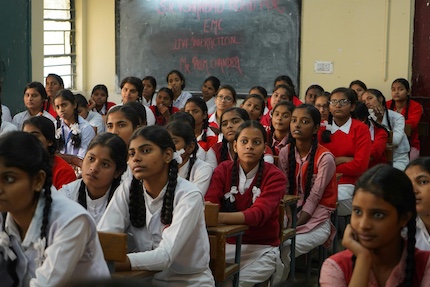
“Education is not the filling of a pail, but the lighting of a fire.”
Introduction: The Crisis Is No Longer Attendance, It Is Attention
For years, India’s education system focused on increasing school enrolment and classroom attendance. Governments introduced multiple initiatives, policies, mid day meal schemes, awareness campaigns, and Right to Education provisions to ensure that children entered schools and continued their education.
To a large extent, this mission succeeded.
Today, classrooms are fuller than ever before. Attendance rates in many schools have significantly improved. The problem, however, is no longer whether students are entering classrooms.
The real hidden crisis lies elsewhere.
Students are attending schools, but many are not truly learning.
The issue today is not attendance, but attention.
Classrooms Are Full, But Learning Outcomes Remain Weak
Reports such as the ASER Report by Pratham Foundation reveal a deeply concerning reality. Despite high classroom attendance, many students in Class 5 are still unable to read basic Class 2 English texts or solve elementary mathematical problems.
This raises a serious question:
If students are regularly attending schools, why are foundational learning outcomes still weak?
The answer lies inside the classroom itself.
Physical presence does not automatically guarantee mental engagement. A child may sit in a classroom for hours every day and still fail to develop conceptual understanding, analytical ability, or foundational literacy skills.
This clearly indicates that the education system is facing a deeper internal challenge.
The Hidden Problem Inside Modern Classrooms
The hidden problem is cognitive disengagement.
Modern students are increasingly struggling to concentrate for long periods. Their attention spans are shrinking rapidly due to excessive exposure to:
-
mobile phones
-
short video content
-
instant entertainment culture
-
artificial intelligence tools
-
constant digital stimulation
Students today are growing up in an environment where everything is available instantly. Information arrives within seconds. Answers are generated immediately. As a result, patience, deep reading habits, and sustained concentration are gradually declining.
Long classroom lectures are becoming less effective because students are psychologically conditioned for rapid content consumption.
The challenge is no longer bringing students into classrooms.
The challenge is keeping their minds inside the classroom.
Technology and Artificial Intelligence: A Double Edged Sword
Technology has undoubtedly improved access to education, but excessive dependence on it has also created unintended consequences.
Students increasingly rely on AI tools for:
-
assignments
-
projects
-
summaries
-
answers
-
presentations
The process of independent thinking, research, and exploration is slowly weakening.
Earlier, students visited libraries, referred to books, searched for multiple perspectives, and developed understanding gradually through effort and observation. Today, many students seek immediate solutions without understanding the logic behind them.
This weakens:
-
critical thinking
-
conceptual clarity
-
creativity
-
innovation
-
problem solving ability
Education is becoming more automated but less intellectual.
From Practical Learning to Passive Learning
If we compare historical learning systems with modern classrooms, an important difference becomes visible.
Traditional systems of education focused heavily on:
-
observation
-
discussion
-
practical application
-
experiential learning
-
discipline
-
interaction with teachers
Learning was deeply connected with understanding and real life application.
In contrast, many modern classrooms have become heavily dependent on:
-
rote learning
-
memorization
-
textbook repetition
-
examination pressure
Students are often taught what to write in examinations rather than how to think independently.
Even after attending schools, many students again attend tuition centres where the same concepts are repeated mechanically. If conceptual clarity is not developed in schools, tuition centres often continue the same pattern of memorization rather than solving the root problem.
This leads to:
-
academic fatigue
-
loss of curiosity
-
excessive pressure
-
wastage of student time
The Gap Is Not in Policy Formulation, But in Policy Execution
India does not lack educational policies.
The National Education Policy 2020 strongly emphasizes:
-
holistic development
-
experiential learning
-
conceptual understanding
-
multidisciplinary education
-
skill based learning
On paper, these reforms are progressive and visionary.
However, the real challenge lies in implementation.
The gap today is not policy formulation. The gap is policy execution.
A crucial question remains:
Are these reforms genuinely transforming classrooms at the ground level?
In many schools, education still revolves around:
-
marks
-
examinations
-
memorization
-
syllabus completion
The spirit of holistic education often remains confined to documents rather than classrooms.
Why Attention Matters for India’s Demographic Dividend
India became the world’s most populous country after surpassing China in 2022. This gives India a historic demographic advantage.
A large youth population can become:
-
a productive workforce
-
a source of innovation
-
an economic strength
-
a driver of national growth
But this demographic dividend can become a demographic disaster if foundational education remains weak.
If students fail to develop:
-
cognitive skills
-
analytical thinking
-
employable abilities
-
conceptual understanding
they may struggle to contribute effectively to India’s economy.
Weak educational foundations directly affect:
-
employability
-
productivity
-
skill development
-
innovation
-
national income
This ultimately impacts India’s per capita GDP and long term economic growth.
As India positions itself as the voice of the Global South, the quality of its human capital will determine its future global influence.
The Need for Interactive and Engaging Learning
Students become attentive when learning becomes meaningful.
Classrooms must move beyond passive lectures and focus more on:
-
visual learning
-
practical demonstrations
-
storytelling
-
experiments
-
discussions
-
videographics
-
collaborative activities
-
experiential learning
When students actively participate in the learning process, attention naturally improves.
Conceptual clarity develops only when students understand why they are learning something, not merely what they need to memorize.
Strong foundational learning eventually leads to:
-
lower dropout rates
-
better employability
-
stronger skills
-
economic productivity
-
social development
Conclusion: The Future of Education Depends on Attention
India has made significant progress in increasing educational access and classroom attendance.
But the next educational revolution must focus on attention, engagement, and meaningful learning.
The real measure of education is not how many students enter classrooms.
It is how many students truly understand, think, innovate, and grow through education.
Attendance without attention cannot build a skilled nation.
Only engaged classrooms can create empowered citizens, strong economies, and a truly developed India.
Click Here for More Educational Column