
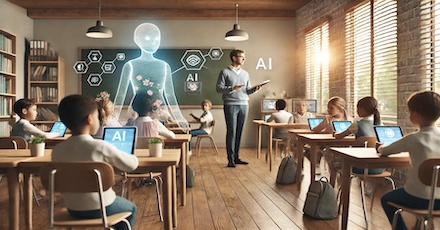
If education is meant to unlock human potential, can it remain standardized in an age defined by intelligent systems?
“Technology will not replace teachers, but teachers who use technology will replace those who do not.” This idea reflects the transformation underway in education. Reports by UNESCO, the World Economic Forum, and policy directions such as the National Education Policy 2020 emphasize that AI integration in education is no longer optional but essential for building adaptive, inclusive, and future ready learning systems.
Graduate Education Is Still Largely Standardized
Graduate education continues to rely on standardized curricula, fixed timelines, and uniform assessments, often overlooking individual learning differences. According to UNESCO’s Global Education Monitoring Report, traditional education systems struggle to address diverse learner needs, leading to gaps in outcomes. In India, surveys such as the All India Survey on Higher Education indicate increasing enrollment, but not necessarily improved learning quality or personalization. This highlights a structural limitation where education is designed for efficiency rather than individual growth.
AI Enables Personalization at Scale
AI introduces the ability to create personalized learning pathways, where content, pace, and evaluation adapt to each student. The World Economic Forum highlights that AI powered systems can analyze performance data and recommend tailored learning experiences. Platforms using adaptive learning technologies have shown improved engagement and comprehension. This marks a shift from a one size fits all model to a system where education becomes learner centric and responsive.
Data Driven Learning Improves Outcomes
AI leverages data analytics to transform how learning is delivered and assessed. Studies on adaptive learning systems indicate improvements in student retention rates and academic performance, as real time feedback helps address gaps immediately. The idea that data is the new oil becomes particularly relevant here, as educational institutions increasingly rely on data driven insights to enhance outcomes. This transition moves education from a reactive approach to a predictive and proactive system.
AI Bridges the Gap Between Education and Employability
A major concern in graduate education is the disconnect between academic learning and industry requirements. The World Economic Forum Future of Jobs Report highlights that a large share of jobs will require new and evolving skill sets. AI can help align curricula with industry needs, recommend relevant skills, and continuously update learning pathways. This ensures that graduates are not only academically equipped but also employable and industry ready.
Inclusivity and Accessibility Can Expand Significantly
AI has the potential to make education more inclusive and accessible. Tools such as speech recognition, language translation, and assistive technologies enable learners from diverse backgrounds to access quality education. UNESCO emphasizes that AI can support equitable education systems, particularly for students with disabilities and those from underserved communities. This expansion of access can democratize learning and reduce long standing educational inequalities.
The Risk of an Emerging AI Divide
While AI offers immense opportunities, it also raises the risk of a new form of inequality known as the AI divide. If AI is not integrated into education early, it may create disparities between those who have access to AI driven learning and those who do not. The concept of data as the new oil highlights the potential for data colonization, where control over data and AI technologies determines global influence. Just as historical inequalities were shaped by access to resources, future inequalities may be shaped by access to AI capabilities and digital infrastructure. This makes early adoption a strategic necessity.
Ethical Risks Cannot Be Ignored
The integration of AI in education raises concerns around data privacy, algorithmic bias, and transparency. Global policy discussions emphasize the need for ethical AI frameworks and regulatory oversight. Without safeguards, AI systems may reinforce existing inequalities rather than address them. Ensuring fairness, accountability, and inclusivity in AI systems is therefore critical for sustainable implementation.
Faculty Roles Will Transform Not Disappear
AI will not replace educators but will redefine their roles. While AI can automate tasks such as grading and content delivery, educators will focus on mentorship, critical thinking, and personalized guidance. This shift transforms teachers into facilitators of learning, enhancing the overall educational experience and ensuring that human interaction remains central to education.
India’s Opportunity in AI Driven Education
India is uniquely positioned to leverage AI in education due to its large youth population and expanding digital infrastructure. The National Education Policy 2020 provides a framework for integrating technology and innovation into education. By investing in AI driven learning systems, research, and digital infrastructure, India can strengthen its position as a global leader in education and effectively utilize its demographic dividend.
A Closing Reflection Learning That Understands You
A young student in a remote area, with limited access to quality teachers, can today learn from an AI powered platform that adapts to their pace, language, and understanding. This is not a distant vision but an emerging reality. The future of graduate education lies in systems that do not treat learners as part of a crowd, but as individuals with unique potential. The question is no longer whether AI will shape education, but whether we are ready to shape AI in a way that serves every learner equally and strengthens a truly inclusive and personalized learning ecosystem.Click Here for More Educational Column